Penn Image Computing and Science Laboratory, University of Pennsylvania, 3600 Market Street, Suite 370, Philadelphia, PA 19104, USA.
Neuroinformatics. 2011 Dec;9(4):381-400. doi: 10.1007/s12021-011-9109-y.
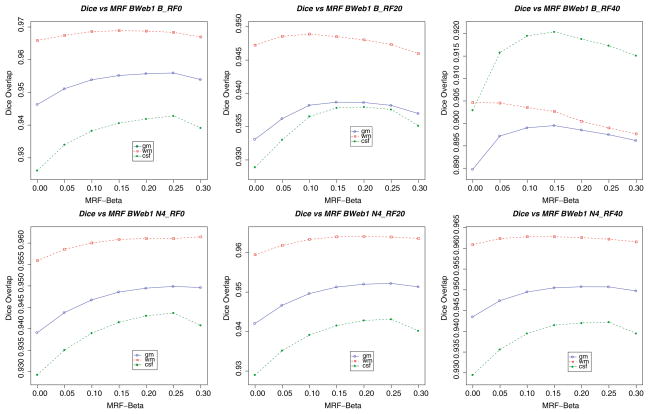
We introduce Atropos, an ITK-based multivariate n-class open source segmentation algorithm distributed with ANTs ( http://www.picsl.upenn.edu/ANTs). The Bayesian formulation of the segmentation problem is solved using the Expectation Maximization (EM) algorithm with the modeling of the class intensities based on either parametric or non-parametric finite mixtures. Atropos is capable of incorporating spatial prior probability maps (sparse), prior label maps and/or Markov Random Field (MRF) modeling. Atropos has also been efficiently implemented to handle large quantities of possible labelings (in the experimental section, we use up to 69 classes) with a minimal memory footprint. This work describes the technical and implementation aspects of Atropos and evaluates its performance on two different ground-truth datasets. First, we use the BrainWeb dataset from Montreal Neurological Institute to evaluate three-tissue segmentation performance via (1) K-means segmentation without use of template data; (2) MRF segmentation with initialization by prior probability maps derived from a group template; (3) Prior-based segmentation with use of spatial prior probability maps derived from a group template. We also evaluate Atropos performance by using spatial priors to drive a 69-class EM segmentation problem derived from the Hammers atlas from University College London. These evaluation studies, combined with illustrative examples that exercise Atropos options, demonstrate both performance and wide applicability of this new platform-independent open source segmentation tool.
我们介绍了 Atropos,这是一个基于 ITK 的多变量 n 类开源分割算法,与 ANTs(http://www.picsl.upenn.edu/ANTs)一起分发。使用基于贝叶斯的 EM 算法解决分割问题的公式,使用参数或非参数有限混合的类强度建模。Atropos 能够合并空间先验概率图(稀疏)、先验标签图和/或马尔可夫随机场(MRF)建模。Atropos 还被有效地实现为处理大量可能的标签(在实验部分,我们使用多达 69 个类),具有最小的内存占用。这项工作描述了 Atropos 的技术和实现方面,并在两个不同的真实数据集上评估了它的性能。首先,我们使用蒙特利尔神经学研究所的 BrainWeb 数据集通过以下方法评估三组织分割性能:(1)不使用模板数据的 K-均值分割;(2)使用从组模板导出的先验概率图进行 MRF 分割;(3)使用从组模板导出的空间先验概率图进行基于先验的分割。我们还通过使用空间先验来驱动来自伦敦大学学院的 Hammers 图谱的 69 类 EM 分割问题来评估 Atropos 的性能。这些评估研究,结合演示 Atropos 选项的说明性示例,展示了这个新的独立于平台的开源分割工具的性能和广泛适用性。