Department of Epidemiology, Center for Social Epidemiology and Population Health, School of Public Health, University of Michigan, Ann Arbor, Michigan, United States of America.
PLoS One. 2011 Feb 17;6(2):e16103. doi: 10.1371/journal.pone.0016103.
Studies have suggested that CMV infection may influence cardiovascular disease (CVD) risk and mortality. However, there have been no large-scale examinations of these relationships among demographically diverse populations. The inflammatory marker C-reactive protein (CRP) is also linked with CVD outcomes and mortality and may play an important role in the pathway between CMV and mortality. We utilized a U.S. nationally representative study to examine whether CMV infection is associated with all-cause and CVD-related mortality. We also assessed whether CRP level mediated or modified these relationships.
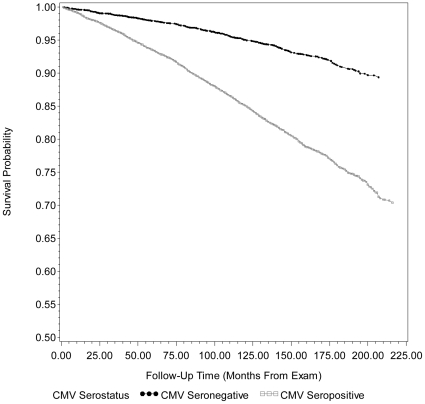
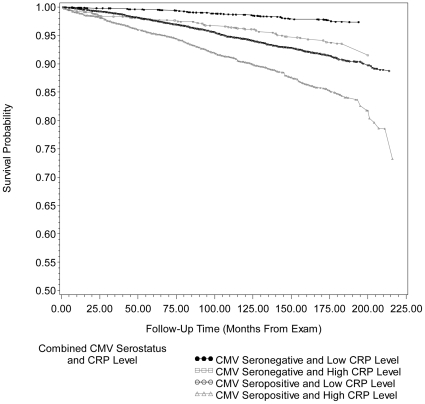
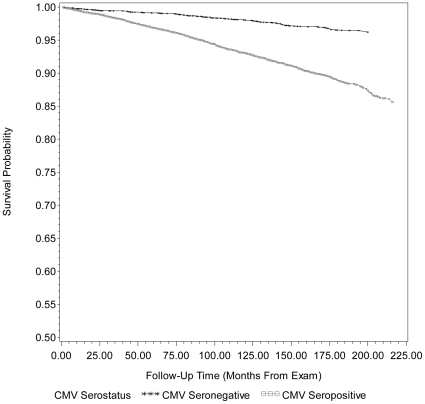
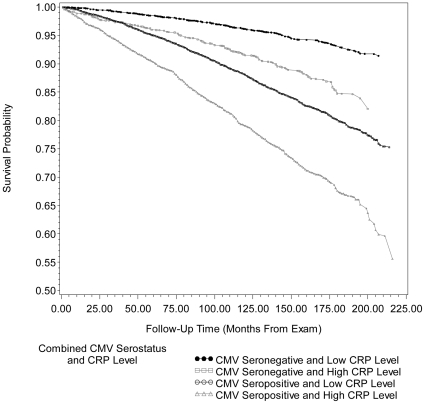
METHODOLOGY/PRINCIPAL FINDINGS: Data come from subjects ≥ 25 years of age who were tested for CMV and CRP level and were eligible for mortality follow-up on December 31(st), 2006 (N = 14153) in the National Health and Nutrition Examination Survey (NHANES) III (1988-1994). Cox proportional hazard models were used to estimate hazard ratios (HR) and 95% confidence intervals (CI) for all-cause and CVD-related mortality by CMV serostatus. After adjusting for multiple confounders, CMV seropositivity remained statistically significantly associated with all-cause mortality (HR 1.19, 95% CI: 1.01, 1.41). The association between CMV and CVD-related mortality did not achieve statistical significance after confounder adjustment. CRP did not mediate these associations. However, CMV seropositive individuals with high CRP levels showed a 30.1% higher risk for all-cause mortality and 29.5% higher risk for CVD-related mortality compared to CMV seropositive individuals with low CRP levels.
CONCLUSIONS/SIGNIFICANCE: CMV was associated with a significant increased risk for all-cause mortality and CMV seropositive subjects who also had high CRP levels were at substantially higher risk for both for all-cause and CVD-related mortality than subjects with low CRP levels. Future work should target the mechanisms by which CMV infection and low-level inflammation interact to yield significant impact on mortality.
研究表明,巨细胞病毒(CMV)感染可能会影响心血管疾病(CVD)的风险和死亡率。然而,在人口统计学上多样化的人群中,还没有对这些关系进行大规模的检查。炎症标志物 C 反应蛋白(CRP)也与 CVD 结局和死亡率有关,并且可能在 CMV 与死亡率之间的途径中发挥重要作用。我们利用一项美国全国代表性研究,研究 CMV 感染是否与全因和 CVD 相关的死亡率相关。我们还评估了 CRP 水平是否介导或改变了这些关系。
方法/主要发现:数据来自年龄在 25 岁及以上的人群,他们在 2006 年 12 月 31 日(NHANES III,1988-1994)的国家健康和营养调查(NHANES)III 中接受了 CMV 和 CRP 水平检测,并且有资格进行死亡率随访(N=14153)。使用 Cox 比例风险模型估计 CMV 血清学状态与全因和 CVD 相关死亡率的风险比(HR)和 95%置信区间(CI)。在调整了多个混杂因素后,CMV 血清阳性与全因死亡率仍存在统计学显著关联(HR 1.19,95%CI:1.01,1.41)。调整混杂因素后,CMV 与 CVD 相关死亡率之间的关联没有达到统计学意义。CRP 并未介导这些关联。然而,CRP 水平较高的 CMV 血清阳性个体的全因死亡率风险比 CRP 水平较低的 CMV 血清阳性个体高 30.1%,CVD 相关死亡率风险比 CRP 水平较低的 CMV 血清阳性个体高 29.5%。
结论/意义:CMV 与全因死亡率显著增加相关,而 CRP 水平较高的 CMV 血清阳性个体的全因和 CVD 相关死亡率风险均显著高于 CRP 水平较低的个体。未来的工作应针对 CMV 感染和低水平炎症相互作用产生重大影响的机制。