Department of Global Health, University of Washington, Seattle, WA, USA.
AIDS Behav. 2012 Apr;16(3):711-6. doi: 10.1007/s10461-011-9915-0.
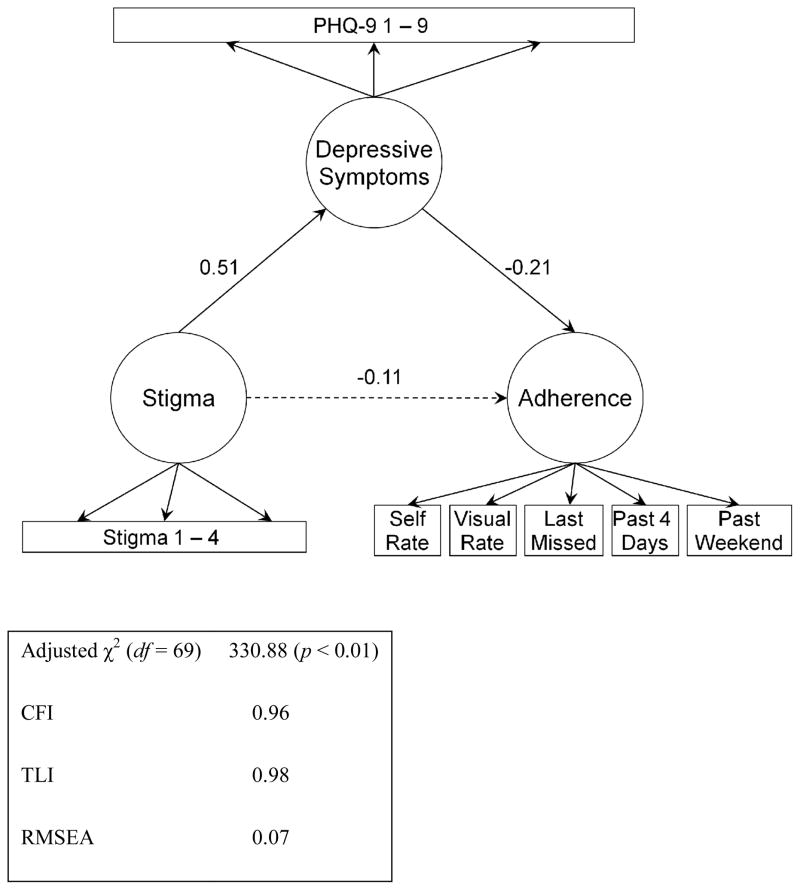
HIV-related stigma has a damaging effect on health outcomes among people living with HIV (PLWH), as studies have associated it with poor HIV medication adherence and depressive symptoms. We investigated whether depressive symptoms mediate the relationship between stigma and medication adherence. In a cross-sectional study, 720 PLWH completed instruments measuring HIV-related stigma, depressive symptoms, and HIV medication adherence. We used structural equation modeling (SEM) to investigate associations among these constructs. In independent models, we found that poorer adherence was associated with higher levels of stigma and depressive symptoms. In the simultaneous model that included both stigma and depressive symptoms, depression had a direct effect on adherence, but the effect of stigma on adherence was not statistically significant. This pattern suggested that depressive symptoms at least partially mediated the association between HIV-related stigma and HIV medication adherence. These findings suggest that interconnections between several factors have important consequences for adherence.
艾滋病毒相关耻辱感对艾滋病毒感染者(PLWH)的健康结果有破坏性影响,因为研究表明它与较差的艾滋病毒药物依从性和抑郁症状有关。我们调查了抑郁症状是否在耻辱感和药物依从性之间起中介作用。在一项横断面研究中,720 名 PLWH 完成了测量艾滋病毒相关耻辱感、抑郁症状和艾滋病毒药物依从性的工具。我们使用结构方程模型(SEM)来研究这些结构之间的关联。在独立模型中,我们发现较差的依从性与更高水平的耻辱感和抑郁症状有关。在同时包含耻辱感和抑郁症状的模型中,抑郁对依从性有直接影响,但耻辱感对依从性的影响在统计学上不显著。这种模式表明,抑郁症状至少部分中介了艾滋病毒相关耻辱感与艾滋病毒药物依从性之间的关联。这些发现表明,几个因素之间的相互关系对依从性有重要影响。