Department of Neuroscience, Swedish Medical Nanoscience Center, Karolinska Institutet, Stockholm, Sweden.
PLoS Pathog. 2011 Feb;7(2):e1001298. doi: 10.1371/journal.ppat.1001298. Epub 2011 Feb 24.
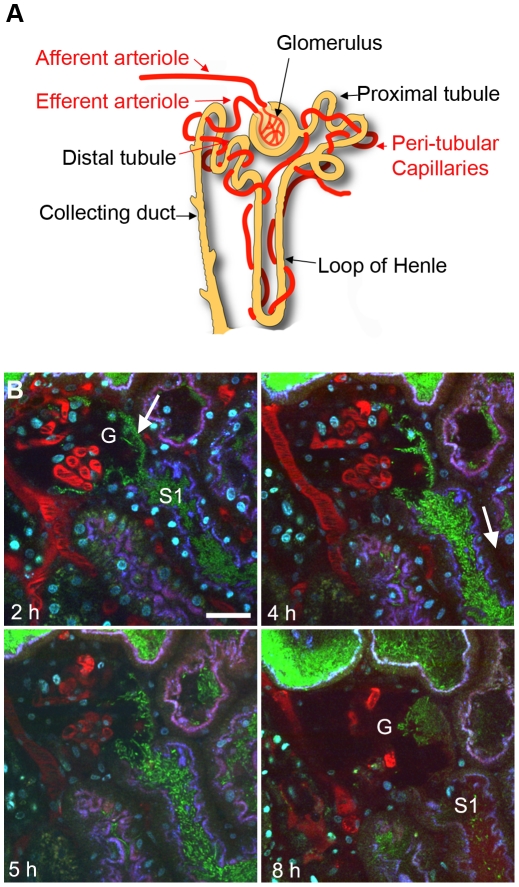
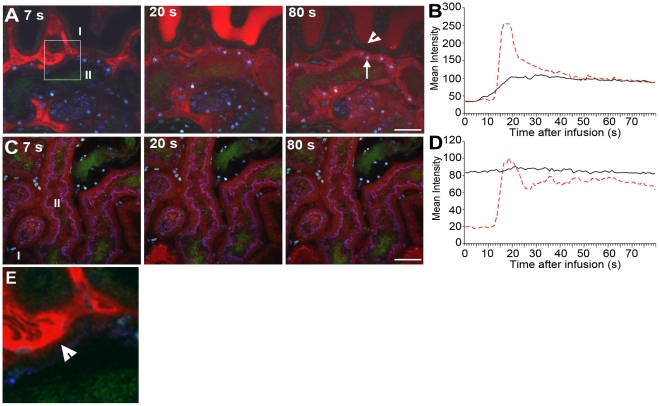
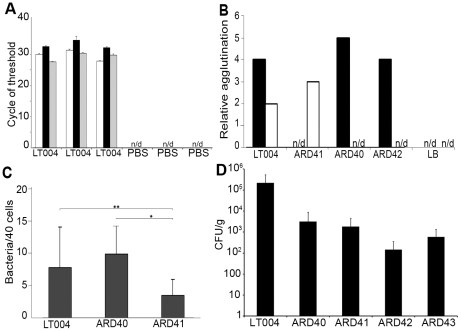
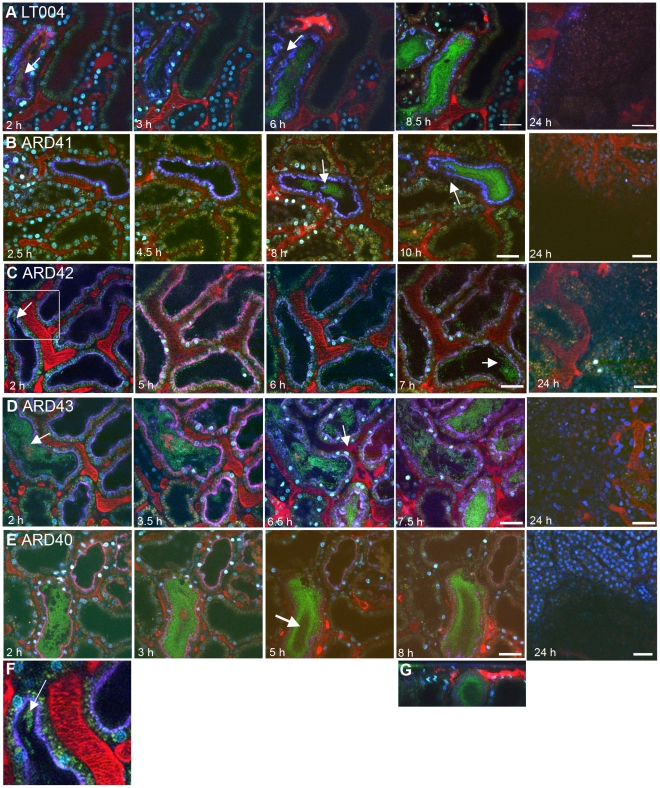
The progression of a natural bacterial infection is a dynamic process influenced by the physiological characteristics of the target organ. Recent developments in live animal imaging allow for the study of the dynamic microbe-host interplay in real-time as the infection progresses within an organ of a live host. Here we used multiphoton microscopy-based live animal imaging, combined with advanced surgical procedures, to investigate the role of uropathogenic Escherichia coli (UPEC) attachment organelles P and Type 1 fimbriae in renal bacterial infection. A GFP+ expressing variant of UPEC strain CFT073 and genetically well-defined isogenic mutants were microinfused into rat glomerulus or proximal tubules. Within 2 h bacteria colonized along the flat squamous epithelium of the Bowman's capsule despite being exposed to the primary filtrate. When facing the challenge of the filtrate flow in the proximal tubule, the P and Type 1 fimbriae appeared to act in synergy to promote colonization. P fimbriae enhanced early colonization of the tubular epithelium, while Type 1 fimbriae mediated colonization of the center of the tubule via a mechanism believed to involve inter-bacterial binding and biofilm formation. The heterogeneous bacterial community within the tubule subsequently affected renal filtration leading to total obstruction of the nephron within 8 h. Our results reveal the importance of physiological factors such as filtration in determining bacterial colonization patterns, and demonstrate that the spatial resolution of an infectious niche can be as small as the center, or periphery, of a tubule lumen. Furthermore, our data show how secondary physiological injuries such as obstruction contribute to the full pathophysiology of pyelonephritis.
自然细菌感染的进展是一个动态过程,受靶器官生理特征的影响。活体动物成像的最新发展允许在感染在活体宿主的器官内进展时实时研究动态微生物-宿主相互作用。在这里,我们使用基于多光子显微镜的活体动物成像,结合先进的手术程序,研究了尿路致病性大肠杆菌(UPEC)附着器 P 和 1 型菌毛在肾脏细菌感染中的作用。我们将 GFP+表达变体的 UPEC 菌株 CFT073 和遗传上定义明确的同基因突变体微注入大鼠肾小球或近端小管。尽管暴露于初级滤液中,细菌仍在 2 小时内沿着 Bowman 囊的扁平鳞状上皮定植。当面临近端小管中滤液流动的挑战时,P 菌毛和 1 型菌毛似乎协同作用以促进定植。P 菌毛增强了对管状上皮的早期定植,而 1 型菌毛通过一种据信涉及细菌间结合和生物膜形成的机制介导对管状中心的定植。随后,管腔内异质细菌群落影响肾脏过滤,导致 8 小时内肾单位完全阻塞。我们的结果揭示了生理因素(如过滤)在决定细菌定植模式中的重要性,并表明感染生态位的空间分辨率可以小到管状内腔的中心或外围。此外,我们的数据显示了继发性生理损伤(如阻塞)如何导致肾盂肾炎的全部病理生理学。