Mucosal Immunology Section, International Vaccine Institute, Seoul, South Korea.
PLoS Pathog. 2011 Feb;7(2):e1001304. doi: 10.1371/journal.ppat.1001304. Epub 2011 Feb 24.
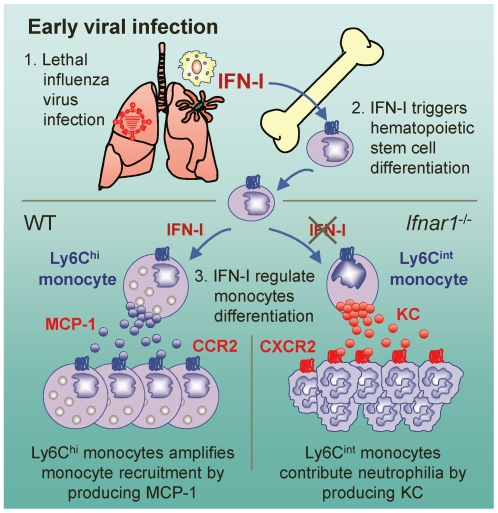
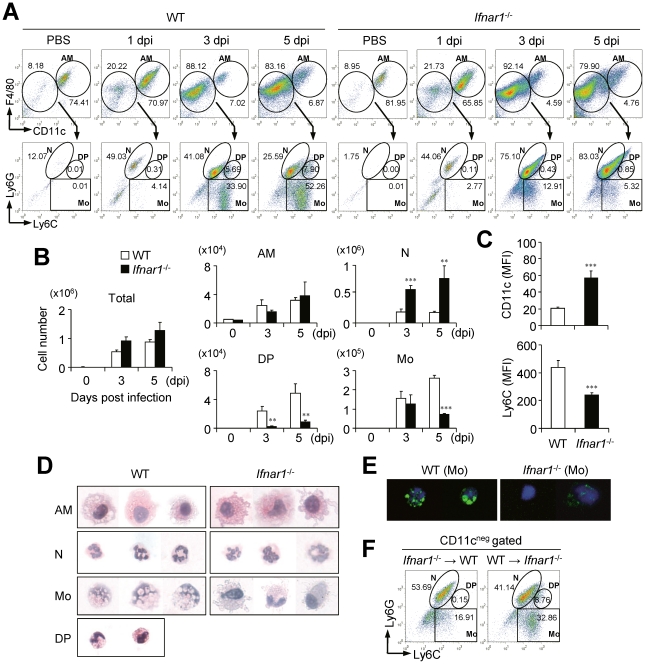
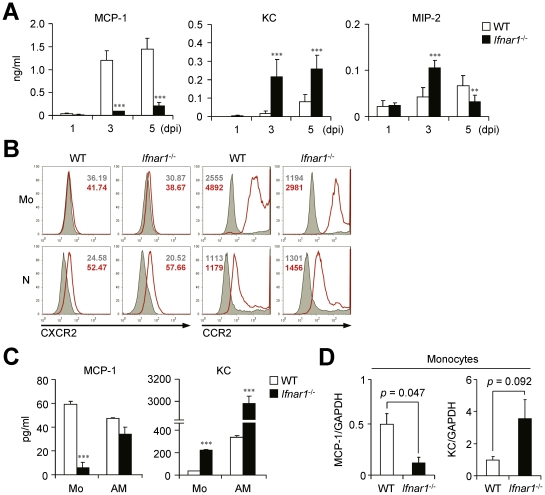
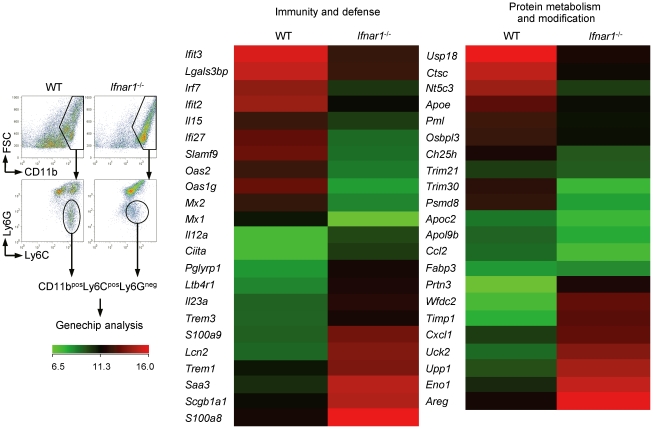
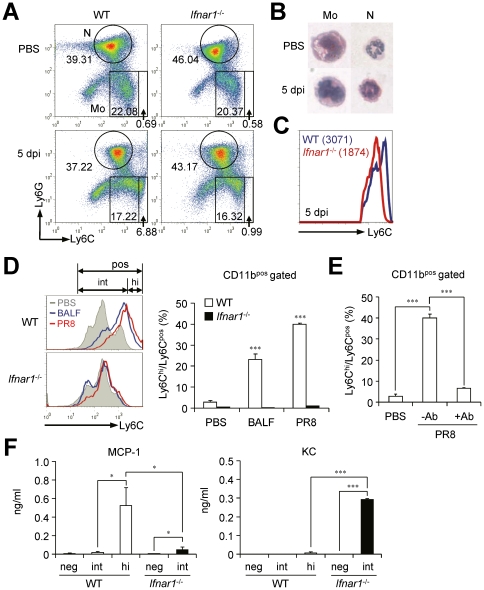
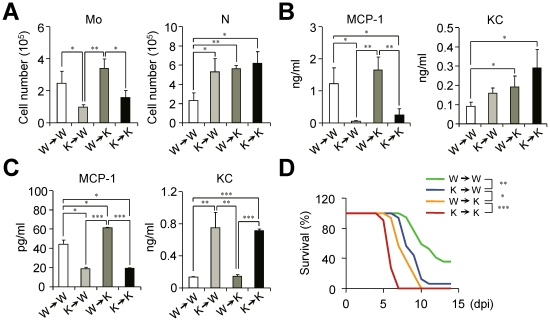
Type I interferon (IFN-I) plays a critical role in the homeostasis of hematopoietic stem cells and influences neutrophil influx to the site of inflammation. IFN-I receptor knockout (Ifnar1⁻/⁻) mice develop significant defects in the infiltration of Ly6C(hi) monocytes in the lung after influenza infection (A/PR/8/34, H1N1). Ly6C(hi) monocytes of wild-type (WT) mice are the main producers of MCP-1 while the alternatively generated Ly6C(int) monocytes of Ifnar1⁻/⁻ mice mainly produce KC for neutrophil influx. As a consequence, Ifnar1⁻/⁻ mice recruit more neutrophils after influenza infection than do WT mice. Treatment of IFNAR1 blocking antibody on the WT bone marrow (BM) cells in vitro failed to differentiate into Ly6C(hi) monocytes. By using BM chimeric mice (WT BM into Ifnar1⁻/⁻ and vice versa), we confirmed that IFN-I signaling in hematopoietic cells is required for the generation of Ly6C(hi) monocytes. Of note, WT BM reconstituted Ifnar1⁻/⁻ chimeric mice with increased numbers of Ly6C(hi) monocytes survived longer than influenza-infected Ifnar1⁻/⁻ mice. In contrast, WT mice that received Ifnar1⁻/⁻ BM cells with alternative Ly6C(int) monocytes and increased numbers of neutrophils exhibited higher mortality rates than WT mice given WT BM cells. Collectively, these data suggest that IFN-I contributes to resistance of influenza infection by control of monocytes and neutrophils in the lung.
I 型干扰素 (IFN-I) 在造血干细胞的动态平衡中发挥关键作用,并影响中性粒细胞向炎症部位的浸润。流感感染后(A/PR/8/34,H1N1),IFN-I 受体敲除 (Ifnar1⁻/⁻) 小鼠的 Ly6C(hi) 单核细胞在肺部的浸润出现显著缺陷。野生型 (WT) 小鼠的 Ly6C(hi) 单核细胞是 MCP-1 的主要产生者,而 Ifnar1⁻/⁻ 小鼠中产生的替代性 Ly6C(int) 单核细胞主要产生 KC 以吸引中性粒细胞。因此,与 WT 小鼠相比,Ifnar1⁻/⁻ 小鼠在流感感染后招募更多的中性粒细胞。体外使用 IFNAR1 阻断抗体处理 WT 骨髓 (BM) 细胞未能分化为 Ly6C(hi) 单核细胞。通过使用 BM 嵌合小鼠(WT BM 转入 Ifnar1⁻/⁻ 和反之亦然),我们证实造血细胞中的 IFN-I 信号传导对于 Ly6C(hi) 单核细胞的生成是必需的。值得注意的是,WT BM 重建的 Ifnar1⁻/⁻ 嵌合小鼠的 Ly6C(hi) 单核细胞数量增加,存活时间更长,而流感感染的 Ifnar1⁻/⁻ 小鼠则存活时间更短。相比之下,接受 Ifnar1⁻/⁻ BM 细胞的 WT 小鼠具有替代性 Ly6C(int) 单核细胞和更多数量的中性粒细胞,其死亡率高于接受 WT BM 细胞的 WT 小鼠。总之,这些数据表明 IFN-I 通过控制肺部的单核细胞和中性粒细胞来促进对流感感染的抵抗。