Division of Allergy, Pulmonary, and Critical Care Medicine, Vanderbilt University School of Medicine, T-1218 MCN Nashville, TN 37221, USA.
Crit Care. 2011;15(2):R86. doi: 10.1186/cc10084. Epub 2011 Mar 7.
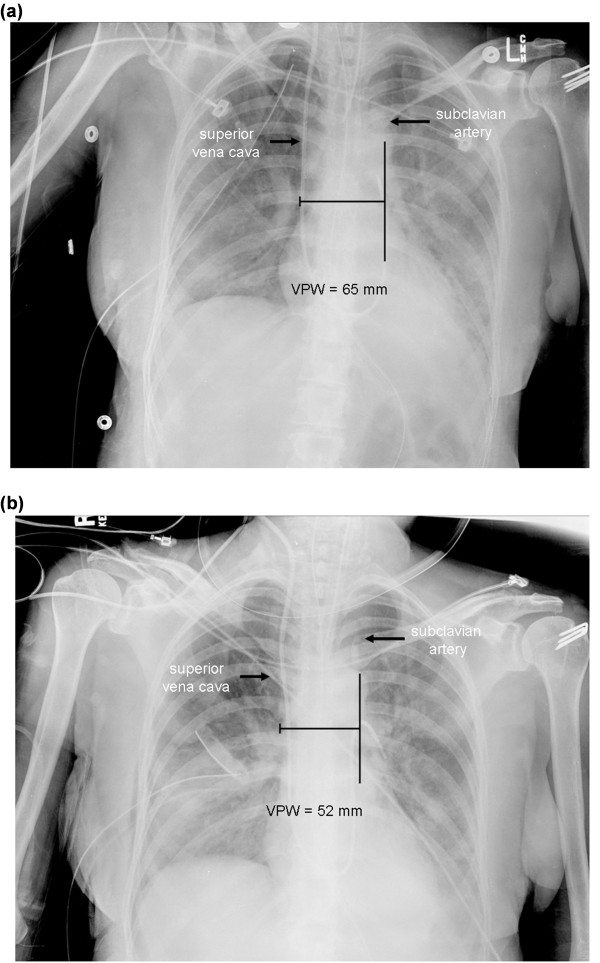
Conservative fluid management in patients with acute lung injury (ALI) increases time alive and free from mechanical ventilation. Vascular pedicle width (VPW) is a non-invasive measurement of intravascular volume status. The VPW was studied in ALI patients to determine the correlation between VPW and intravascular pressure measurements and whether VPW could predict fluid status.
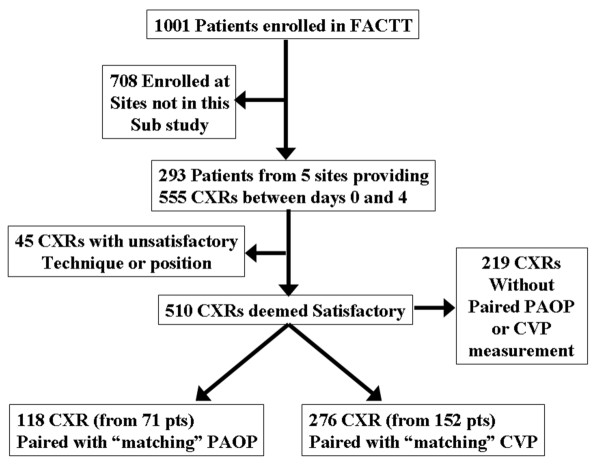
This retrospective cohort study involved 152 patients with ALI enrolled in the Fluid and Catheter Treatment Trial (FACTT) from five NHLBI ARDS (Acute Respiratory Distress Syndrome) Network sites. VPW and central venous pressure (CVP) or pulmonary artery occlusion pressure (PAOP) from the first four study days were correlated. The relationships between VPW, positive end-expiratory pressure (PEEP), cumulative fluid balance, and PAOP were also evaluated. Receiver operator characteristic (ROC) curves were used to determine the ability of VPW to detect PAOP < 8 mmHg and PAOP ≥ 18 mm Hg.
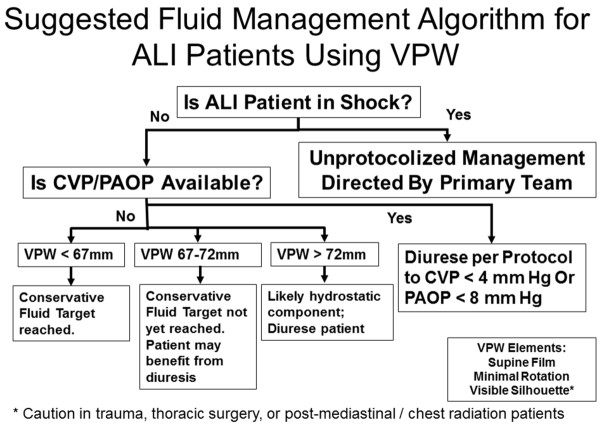
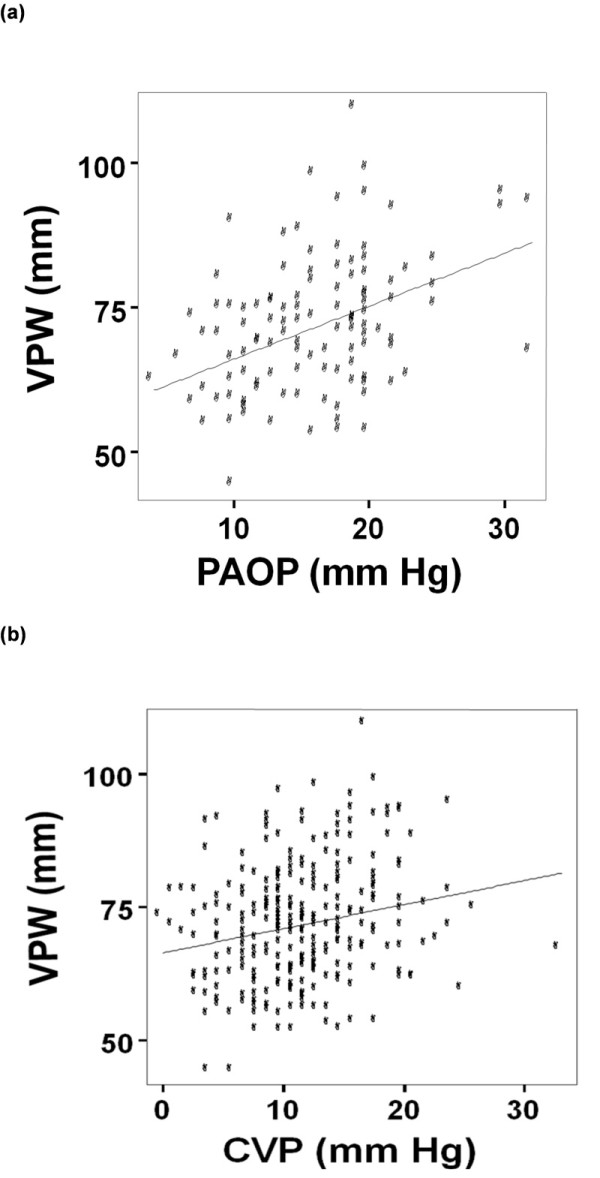
A total of 71 and 152 patients provided 118 and 276 paired VPW/PAOP and VPW/CVP measurements, respectively. VPW correlated with PAOP (r = 0.41; P < 0.001) and less well with CVP (r = 0.21; P = 0.001). In linear regression, VPW correlated with PAOP 1.5-fold better than cumulative fluid balance and 2.5-fold better than PEEP. VPW discriminated achievement of PAOP < 8 mm Hg (AUC = 0.73; P = 0.04) with VPW ≤67 mm demonstrating 71% sensitivity (95% CI 30 to 95%) and 68% specificity (95% CI 59 to 75%). For discriminating a hydrostatic component of the edema (that is, PAOP ≥ 18 mm Hg), VPW ≥ 72 mm demonstrated 61.4% sensitivity (95% CI 47 to 74%) and 61% specificity (49 to 71%) (area under the curve (AUC) 0.69; P = 0.001).
VPW correlates with PAOP better than CVP in patients with ALI. Due to its only moderate sensitivity and specificity, the ability of VPW to discriminate fluid status in patients with acute lung injury is limited and should only be considered when intravascular pressures are unavailable.
在急性肺损伤(ALI)患者中进行保守的液体管理会增加患者存活并脱离机械通气的时间。血管蒂宽度(VPW)是一种非侵入性的血管内容量状态测量方法。本研究旨在探讨 ALI 患者的 VPW 与血管内压力测量值之间的相关性,以及 VPW 是否可以预测液体状态。
这是一项回顾性队列研究,共纳入了来自五个 NHLBI ARDS(急性呼吸窘迫综合征)网络站点的 FACTT 试验中的 152 名 ALI 患者。对患者第 1 至 4 天的 VPW 和中心静脉压(CVP)或肺动脉闭塞压(PAOP)进行了相关性分析。同时还评估了 VPW 与呼气末正压(PEEP)、累积液体平衡和 PAOP 之间的关系。使用受试者工作特征(ROC)曲线来确定 VPW 检测 PAOP<8mmHg 和 PAOP≥18mmHg 的能力。
共 71 名和 152 名患者分别提供了 118 次和 276 次 VPW/PAOP 和 VPW/CVP 配对测量值。VPW 与 PAOP 呈正相关(r=0.41;P<0.001),与 CVP 的相关性稍差(r=0.21;P=0.001)。在线性回归中,VPW 与 PAOP 的相关性比累积液体平衡高 1.5 倍,比 PEEP 高 2.5 倍。VPW 可以区分 PAOP<8mmHg(AUC=0.73;P=0.04),当 VPW≤67mm 时,灵敏度为 71%(95%CI 30%至 95%),特异性为 68%(95%CI 59%至 75%)。对于鉴别水肿的静水压力成分(即 PAOP≥18mmHg),VPW≥72mm 时,灵敏度为 61.4%(95%CI 47%至 74%),特异性为 61%(95%CI 49%至 71%)(曲线下面积(AUC)为 0.69;P=0.001)。
在 ALI 患者中,VPW 与 PAOP 的相关性优于 CVP。由于其灵敏度和特异性仅为中等水平,因此 VPW 区分急性肺损伤患者液体状态的能力有限,只有在无法获得血管内压力时才应考虑使用。