CELL Unit, de Duve Institute and Université catholique de Louvain, Brussels, Belgium.
PLoS One. 2011 Feb 28;6(2):e17021. doi: 10.1371/journal.pone.0017021.
We recently reported that sphingomyelin (SM) analogs substituted on the alkyl chain by various fluorophores (e.g. BODIPY) readily inserted at trace levels into the plasma membrane of living erythrocytes or CHO cells and spontaneously concentrated into micrometric domains. Despite sharing the same fluorescent ceramide backbone, BODIPY-SM domains segregated from similar domains labelled by BODIPY-D-e-lactosylceramide (D-e-LacCer) and depended on endogenous SM.
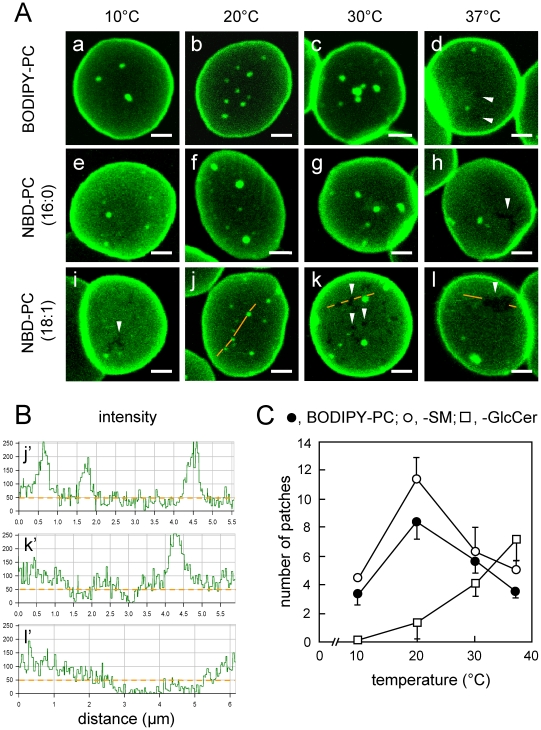
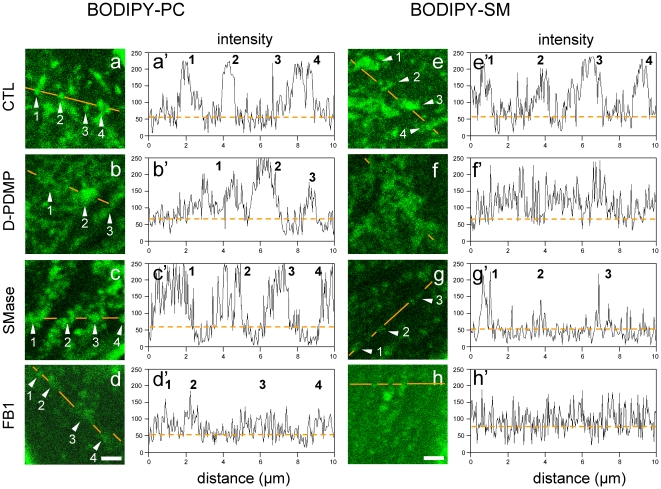
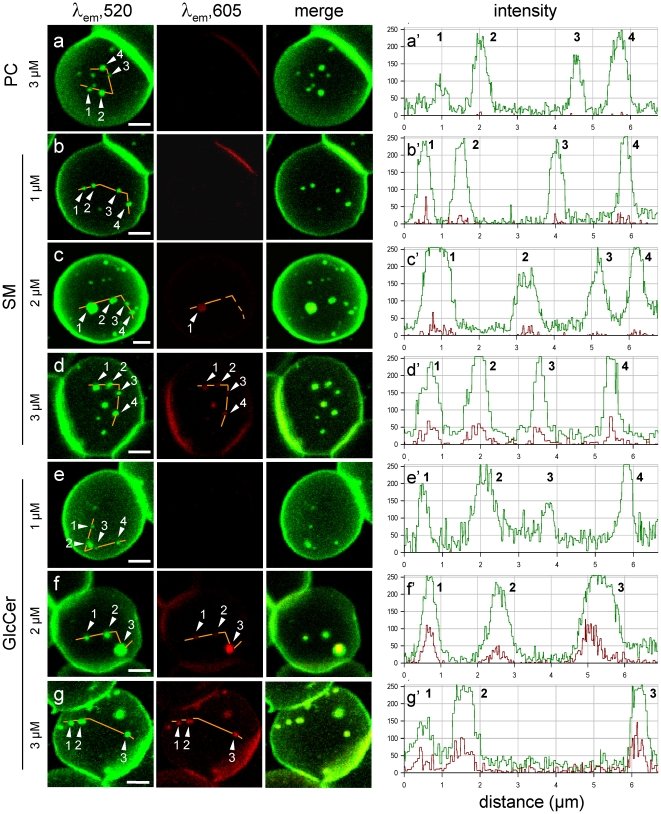
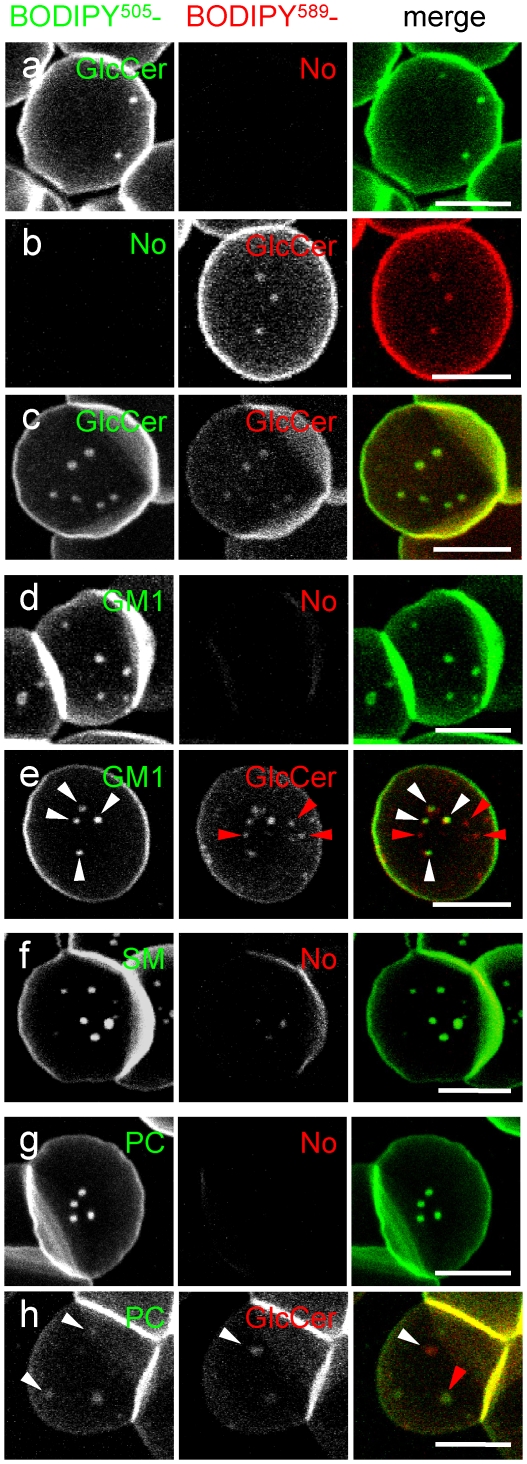
METHODOLOGY/PRINCIPAL FINDINGS: We show here that BODIPY-SM further differed from BODIPY-D-e-LacCer or -glucosylceramide (GlcCer) domains in temperature dependence, propensity to excimer formation, association with a glycosylphosphatidylinositol (GPI)-anchored fluorescent protein reporter, and lateral diffusion by FRAP, thus demonstrating different lipid phases and boundaries. Whereas BODIPY-D-e-LacCer behaved like BODIPY-GlcCer, its artificial stereoisomer, BODIPY-L-t-LacCer, behaved like BODIPY- and NBD-phosphatidylcholine (PC). Surprisingly, these two PC analogs also formed micrometric patches yet preferably at low temperature, did not show excimer, never associated with the GPI reporter and showed major restriction to lateral diffusion when photobleached in large fields. This functional comparison supported a three-phase micrometric compartmentation, of decreasing order: BODIPY-GSLs > -SM > -PC (or artificial L-t-LacCer). Co-existence of three segregated compartments was further supported by double labelling experiments and was confirmed by additive occupancy, up to ∼70% cell surface coverage. Specific alterations of BODIPY-analogs domains by manipulation of corresponding endogenous sphingolipids suggested that distinct fluorescent lipid partition might reflect differential intrinsic propensity of endogenous membrane lipids to form large assemblies.
CONCLUSIONS/SIGNIFICANCE: We conclude that fluorescent membrane lipids spontaneously concentrate into distinct micrometric assemblies. We hypothesize that these might reflect preexisting compartmentation of endogenous PM lipids into non-overlapping domains of differential order: GSLs > SM > PC, resulting into differential self-adhesion of the two former, with exclusion of the latter.
我们最近报道称,各种荧光团(例如 BODIPY)取代神经酰胺(SM)烷基链上的 SM 类似物可以痕量水平插入活红细胞或 CHO 细胞的质膜中,并自发浓缩成微米级域。尽管具有相同的荧光神经酰胺骨干,但 BODIPY-SM 域与由 BODIPY-D-e-乳糖基神经酰胺(D-e-LacCer)标记的类似域分离,并依赖于内源性 SM。
方法/主要发现:我们在这里表明,BODIPY-SM 与 BODIPY-D-e-LacCer 或 -葡萄糖神经酰胺(GlcCer)域在温度依赖性、二聚体形成倾向、与糖基磷脂酰肌醇(GPI)锚定荧光蛋白报告子的关联以及 FRAP 侧向扩散方面进一步不同,从而证明了不同的脂质相和边界。虽然 BODIPY-D-e-LacCer 的行为与 BODIPY-GlcCer 相似,但它的人工立体异构体 BODIPY-L-t-LacCer 的行为则与 BODIPY 和 NBD-磷脂酰胆碱(PC)相似。令人惊讶的是,这两种 PC 类似物也形成了微米级的斑块,但更喜欢在低温下,不显示二聚体,从不与 GPI 报告子结合,并且在大区域光漂白时对侧向扩散有主要限制。这种功能比较支持一个具有递减顺序的三相微米级隔室化:BODIPY-GSLs > -SM > -PC(或人工 L-t-LacCer)。通过双重标记实验进一步支持了三个隔室的共存,并通过加和占有率(高达约 70%的细胞表面覆盖率)得到了证实。通过操纵相应的内源性鞘脂来改变 BODIPY 类似物的域,这表明不同的荧光脂质分区可能反映了内源性膜脂质形成大组装的不同固有倾向。
结论/意义:我们得出结论,荧光膜脂质自发浓缩成不同的微米级组装体。我们假设,这可能反映了内源性 PM 脂质预先存在的隔室化,形成了非重叠的不同阶域:GSLs > SM > PC,导致前两者的自粘性不同,而后者被排除在外。