The Jackson Laboratory, 600 Main St., Bar Harbor, ME 04609, USA.
J Biomed Inform. 2011 Dec;44 Suppl 1(Suppl 1):S5-S11. doi: 10.1016/j.jbi.2011.03.003. Epub 2011 Mar 21.
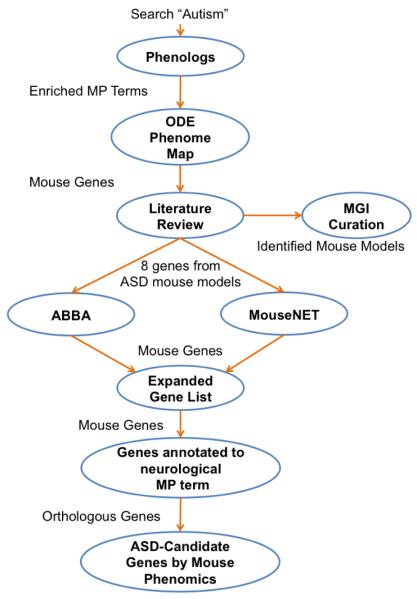
Autism spectrum disorders (ASD) represent a group of developmental disabilities with a strong genetic basis. The laboratory mouse is increasingly used as a model organism for ASD, and MGI, the Mouse Genome Informatics resource, is the primary model organism database for the laboratory mouse. MGI uses the Mammalian Phenotype (MP) ontology to describe mouse models of human diseases. Using bioinformatics tools including Phenologs, MouseNET, and the Ontological Discovery Environment, we tested data associated with MP terms to characterize new gene-phenotype associations related to ASD. Our integrative analysis using these tools identified numerous mouse genotypes that are likely to have previously uncharacterized autistic-like phenotypes. The genes implicated in these mouse models had considerable overlap with a set of over 300 genes recently associated with ASD due to small, rare copy number variation (Pinto et al., 2010). Prediction and characterization of autistic mutant mouse alleles assists researchers in studying the complex nature of ASD and provides a generalizable approach to candidate gene prioritization.
自闭症谱系障碍 (ASD) 是一组具有强烈遗传基础的发育障碍。实验室小鼠越来越多地被用作 ASD 的模型生物,而 MGI(小鼠基因组信息学资源)是实验室小鼠的主要模型生物数据库。MGI 使用哺乳动物表型 (MP) 本体论来描述人类疾病的小鼠模型。我们使用 Phenologs、MouseNET 和 Ontological Discovery Environment 等生物信息学工具,测试与 MP 术语相关的数据,以描述与 ASD 相关的新的基因-表型关联。我们使用这些工具进行的综合分析确定了许多可能具有以前未被描述的自闭症样表型的小鼠基因型。这些小鼠模型中涉及的基因与一组最近由于小的、罕见的拷贝数变异与 ASD 相关的超过 300 个基因有很大的重叠(Pinto 等人,2010 年)。对自闭症突变体小鼠等位基因的预测和特征分析有助于研究人员研究 ASD 的复杂性质,并为候选基因优先级排序提供一种可推广的方法。