Department of Biosystems Science and Engineering and Swiss Institute of Bioinformatics, ETH Zurich, Basel, Switzerland.
PLoS Comput Biol. 2011 Feb;7(2):e1001083. doi: 10.1371/journal.pcbi.1001083. Epub 2011 Feb 17.
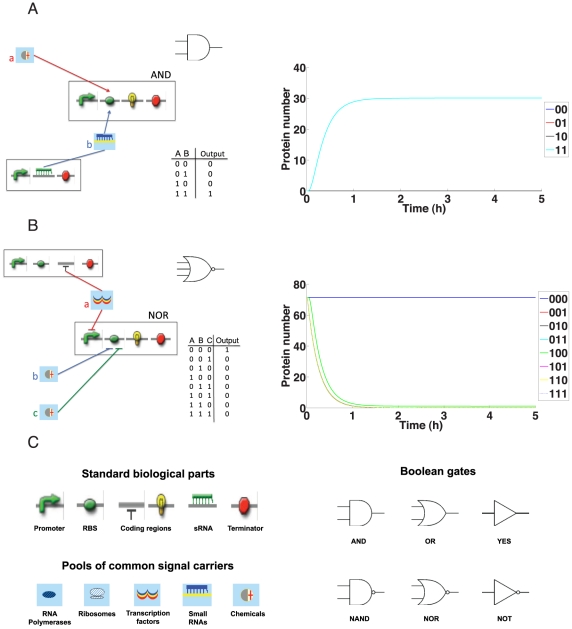
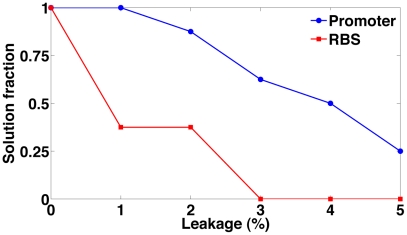
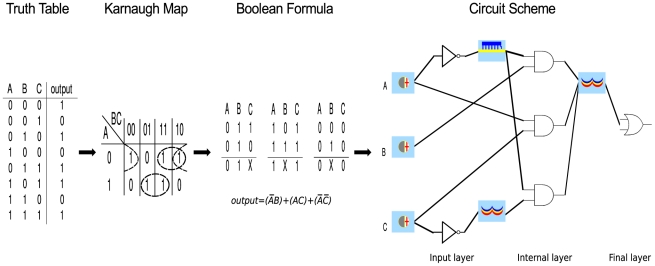
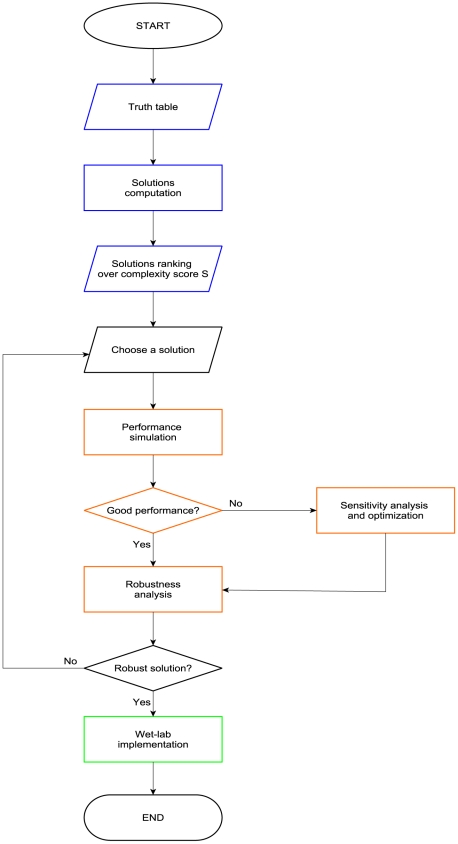
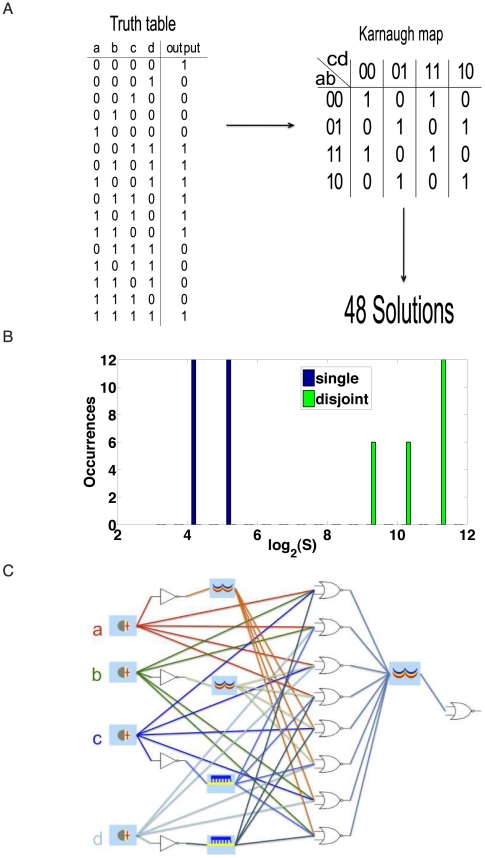
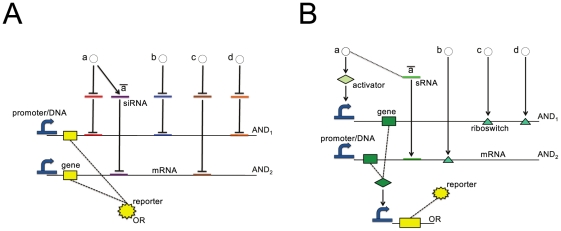
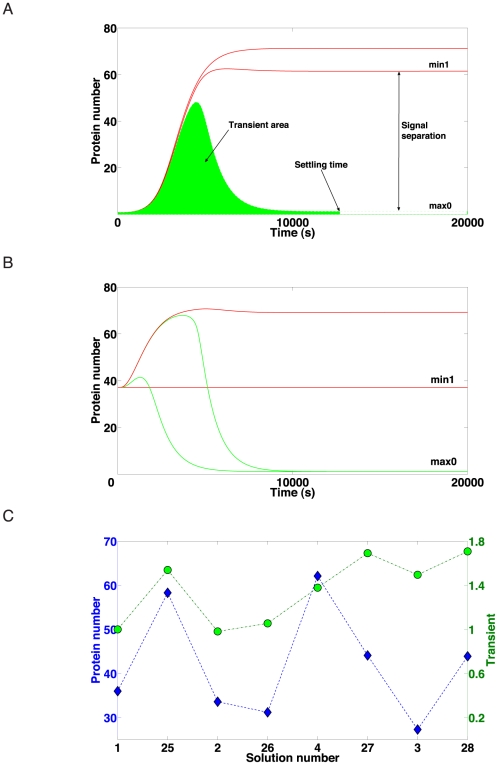
De novo computational design of synthetic gene circuits that achieve well-defined target functions is a hard task. Existing, brute-force approaches run optimization algorithms on the structure and on the kinetic parameter values of the network. However, more direct rational methods for automatic circuit design are lacking. Focusing on digital synthetic gene circuits, we developed a methodology and a corresponding tool for in silico automatic design. For a given truth table that specifies a circuit's input-output relations, our algorithm generates and ranks several possible circuit schemes without the need for any optimization. Logic behavior is reproduced by the action of regulatory factors and chemicals on the promoters and on the ribosome binding sites of biological Boolean gates. Simulations of circuits with up to four inputs show a faithful and unequivocal truth table representation, even under parametric perturbations and stochastic noise. A comparison with already implemented circuits, in addition, reveals the potential for simpler designs with the same function. Therefore, we expect the method to help both in devising new circuits and in simplifying existing solutions.
从头开始设计能够实现明确目标功能的合成基因电路是一项艰巨的任务。现有的、盲目尝试的方法在网络的结构和动力学参数值上运行优化算法。然而,缺乏更直接的用于自动电路设计的合理方法。我们专注于数字合成基因电路,开发了一种用于计算机自动设计的方法和相应的工具。对于指定电路输入-输出关系的给定真值表,我们的算法生成并对几种可能的电路方案进行排序,而无需任何优化。调节因子和化学物质对启动子和生物布尔门的核糖体结合位点的作用再现逻辑行为。对于具有多达四个输入的电路的模拟表明,即使在参数波动和随机噪声下,也能忠实地、明确地表示真值表。与已经实现的电路进行比较,此外,还揭示了具有相同功能的更简单设计的潜力。因此,我们希望该方法不仅有助于设计新的电路,而且有助于简化现有的解决方案。