Department of Pathology, University of Washington School of Medicine, Seattle, 98104, USA.
Ann Neurol. 2011 Mar;69(3):570-80. doi: 10.1002/ana.22311. Epub 2011 Mar 11.
There is a clear need to develop biomarkers for Parkinson disease (PD) diagnosis, differential diagnosis of Parkinsonian disorders, and monitoring disease progression. We and others have demonstrated that a decrease in DJ-1 and/or α-synuclein in the cerebrospinal fluid (CSF) is a potential index for Parkinson disease diagnosis, but not for PD severity.
Using highly sensitive and quantitative Luminex assays, we measured total tau, phosphorylated tau, amyloid beta peptide 1-42 (Aβ(1-42)), Flt3 ligand, and fractalkine levels in CSF in a large cohort of PD patients at different stages as well as healthy and diseased controls. The utility of these 5 markers was evaluated for disease diagnosis and severity/progression correlation alone, as well as in combination with DJ-1 and α-synuclein. The major results were further validated in an independent cohort of cross-sectional PD patients as well as in PD cases with CSF samples collected longitudinally.
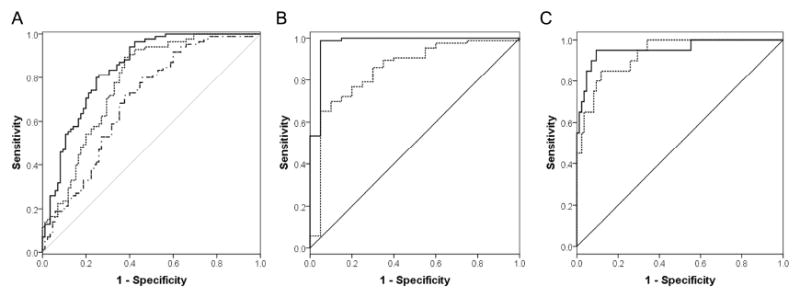
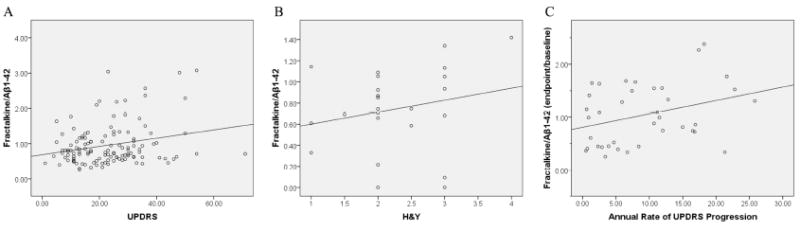
The results demonstrated that combinations of these biomarkers could differentiate PD patients not only from normal controls but also from patients with Alzheimer disease (AD) and multiple system atrophy. Particularly, with CSF Flt3 ligand, PD could be clearly differentiated from multiple system atrophy, a disease that overlaps with PD clinically, with excellent sensitivity (99%) and specificity (95%). In addition, we identified CSF fractalkine/Aβ(1-42) that positively correlated with PD severity in cross-sectional samples as well as with PD progression in longitudinal samples.
We have demonstrated that this panel of 7 CSF proteins could aid in Parkinson disease diagnosis, differential diagnosis, and correlation with disease severity and progression.
开发用于帕金森病(PD)诊断、帕金森障碍的鉴别诊断以及监测疾病进展的生物标志物存在明确的需求。我们和其他人已经证明,脑脊液(CSF)中 DJ-1 和/或α-突触核蛋白的减少是帕金森病诊断的潜在指标,但不能用于 PD 严重程度的评估。
我们使用高度敏感和定量的 Luminex 检测法,在不同阶段的大量 PD 患者以及健康和患病对照者的 CSF 中测量总 tau、磷酸化 tau、淀粉样β肽 1-42(Aβ(1-42))、Flt3 配体和 fractalkine 水平。单独评估了这 5 种标志物在疾病诊断和严重程度/进展相关性方面的应用,以及与 DJ-1 和α-突触核蛋白联合应用的情况。主要结果在一个独立的 PD 患者的横断面队列中以及在具有 CSF 样本的 PD 病例的纵向队列中进一步得到验证。
结果表明,这些生物标志物的组合不仅可以将 PD 患者与正常对照者区分开来,而且可以将其与阿尔茨海默病(AD)和多系统萎缩患者区分开来。特别是,通过 CSF Flt3 配体,PD 可以与临床上与 PD 重叠的多系统萎缩清楚地区分开来,具有出色的敏感性(99%)和特异性(95%)。此外,我们还发现,CSF fractalkine/Aβ(1-42)在横断面样本中与 PD 严重程度以及纵向样本中的 PD 进展呈正相关。
我们已经证明,这一组 7 种 CSF 蛋白可以帮助进行帕金森病诊断、鉴别诊断以及与疾病严重程度和进展的相关性评估。