Schering-Plough Corporation, Kenilworth, New Jersey, USA.
Ann Rheum Dis. 2011 Jun;70(6):973-81. doi: 10.1136/ard.2010.147744. Epub 2011 Mar 14.
To create a model that provides a potential basis for candidate selection for anti-tumour necrosis factor (TNF) treatment by predicting future outcomes relative to the current disease profile of individual patients with ankylosing spondylitis (AS).
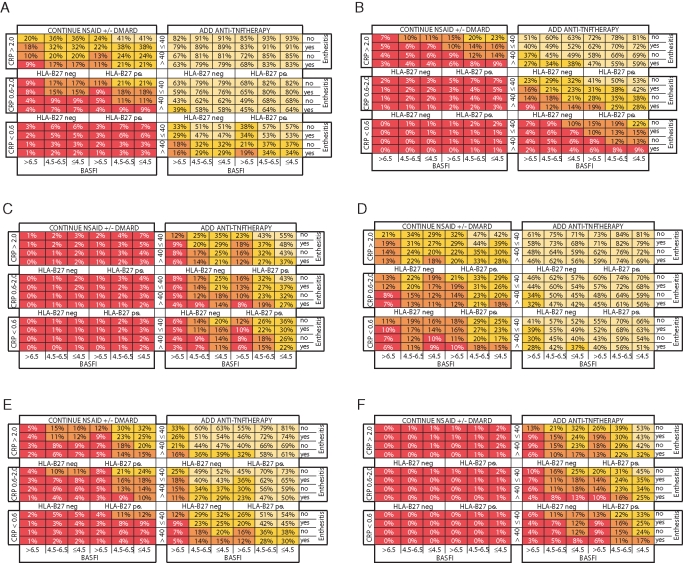
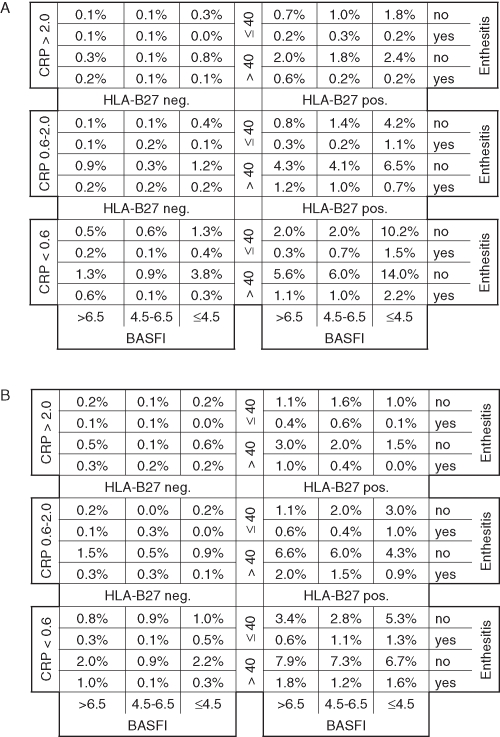
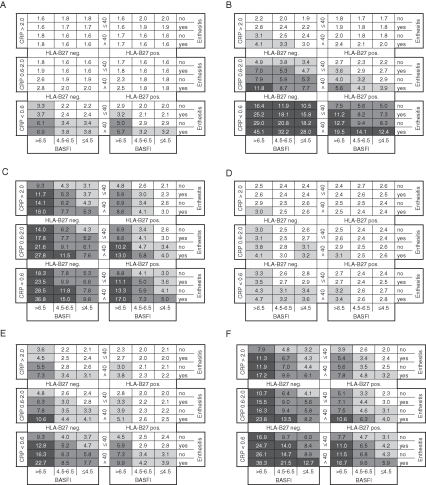
ASSERT and GO-RAISE trial data (n=635) were analysed to identify baseline predictors for various disease-state and disease-activity outcome instruments in AS. Univariate, multivariate, receiver operator characteristic and correlation analyses were performed to select final predictors. Their associations with outcomes were explored. Matrix and algorithm-based prediction models were created using logistic and linear regression, and their accuracies were compared. Numbers needed to treat were calculated to compare the effect size of anti-TNF therapy between the AS matrix subpopulations. Data from registry populations were applied to study how a daily practice AS population is distributed over the prediction model.
Age, Bath ankylosing spondylitis functional index (BASFI) score, enthesitis, therapy, C-reactive protein (CRP) and HLA-B27 genotype were identified as predictors. Their associations with each outcome instrument varied. However, the combination of these factors enabled adequate prediction of each outcome studied. The matrix model predicted outcomes as well as algorithm-based models and enabled direct comparison of the effect size of anti-TNF treatment outcome in various subpopulations. The trial populations reflected the daily practice AS population.
Age, BASFI, enthesitis, therapy, CRP and HLA-B27 were associated with outcomes in AS. Their combined use enables adequate prediction of outcome resulting from anti-TNF and conventional therapy in various AS subpopulations. This may help guide clinicians in making treatment decisions in daily practice.
通过预测个体强直性脊柱炎(AS)患者当前疾病特征与未来结局的关系,建立一个模型,为抗肿瘤坏死因子(TNF)治疗的候选者选择提供潜在依据。
对 ASSERT 和 GO-RAISE 试验数据(n=635)进行分析,以确定 AS 患者各种疾病状态和疾病活动度结局指标的基线预测因素。采用单变量、多变量、受试者工作特征和相关性分析来选择最终的预测因素。并探讨其与结局的关联。使用逻辑回归和线性回归创建基于矩阵和算法的预测模型,并比较其准确性。计算治疗效果大小,比较不同 AS 矩阵亚群中抗 TNF 治疗的效果。将来自登记人群的数据应用于研究日常实践中 AS 人群在预测模型中的分布情况。
年龄、巴斯强直性脊柱炎功能指数(BASFI)评分、附着点炎、治疗、C 反应蛋白(CRP)和 HLA-B27 基因型被确定为预测因素。它们与每种结局指标的关联各不相同。然而,这些因素的组合能够充分预测研究中的每种结局。矩阵模型可以预测结局,与基于算法的模型一样,并能够直接比较各种亚群中抗 TNF 治疗结局的治疗效果大小。试验人群反映了日常实践中的 AS 人群。
年龄、BASFI、附着点炎、治疗、CRP 和 HLA-B27 与 AS 的结局相关。它们的联合使用能够充分预测各种 AS 亚群中抗 TNF 和常规治疗的结局。这可能有助于指导临床医生在日常实践中做出治疗决策。