Department of Entomology/Center for Molecular Neurobiology, The Ohio State University, Columbus, OH 43210, USA.
Parkinsons Dis. 2011 Feb 15;2011:247467. doi: 10.4061/2011/247467.
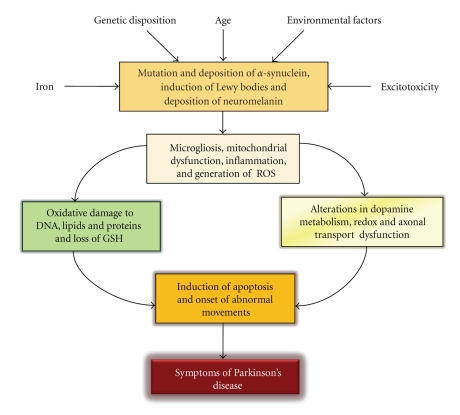
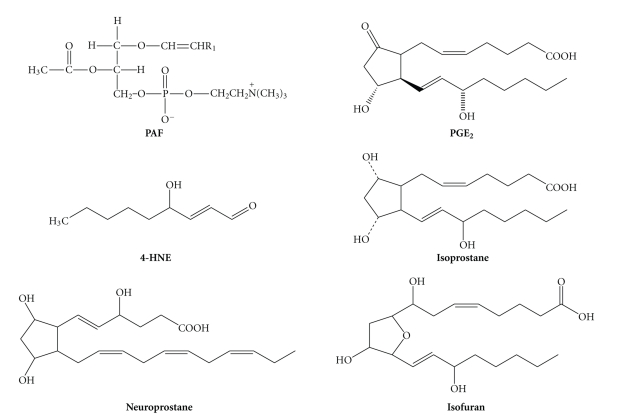
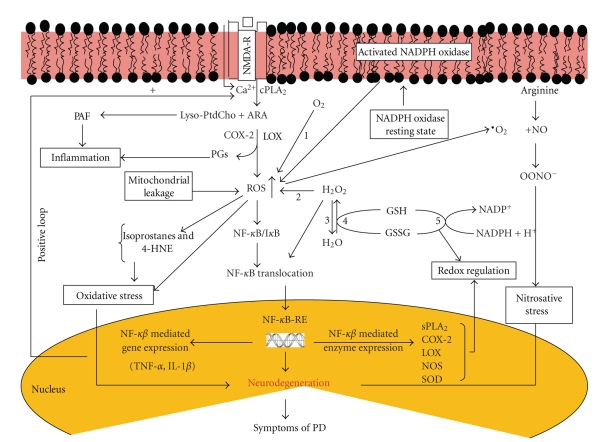
Parkinson's disease (PD) is a neurodegenerative movement disorder of unknown etiology. PD is characterized by the progressive loss of dopaminergic neurons in the substantia nigra, depletion of dopamine in the striatum, abnormal mitochondrial and proteasomal functions, and accumulation of α-synuclein that may be closely associated with pathological and clinical abnormalities. Increasing evidence indicates that both oxidative stress and inflammation may play a fundamental role in the pathogenesis of PD. Oxidative stress is characterized by increase in reactive oxygen species (ROS) and depletion of glutathione. Lipid mediators for oxidative stress include 4-hydroxynonenal, isoprostanes, isofurans, isoketals, neuroprostanes, and neurofurans. Neuroinflammation is characterized by activated microglial cells that generate proinflammatory cytokines, such as TNF-α and IL-1β. Proinflammatory lipid mediators include prostaglandins and platelet activating factor, together with cytokines may play a prominent role in mediating the progressive neurodegeneration in PD.
帕金森病(PD)是一种病因不明的神经退行性运动障碍。PD 的特征是黑质中多巴胺能神经元进行性丧失,纹状体中多巴胺耗竭,线粒体和蛋白酶体功能异常,以及α-突触核蛋白的积累,这可能与病理和临床异常密切相关。越来越多的证据表明,氧化应激和炎症可能在 PD 的发病机制中发挥基本作用。氧化应激的特征是活性氧(ROS)增加和谷胱甘肽耗竭。氧化应激的脂质介质包括 4-羟基壬烯醛、异前列腺素、异呋喃、异酮、神经前列腺素和神经呋喃。神经炎症的特征是小胶质细胞被激活,产生促炎细胞因子,如 TNF-α 和 IL-1β。促炎脂质介质包括前列腺素和血小板激活因子,以及细胞因子,可能在介导 PD 中的进行性神经退行性变中发挥突出作用。