Division of Nutritional Sciences and Department of Biomedical Sciences, Cornell University, Ithaca, New York 14850, USA.
Cancer Res. 2011 Mar 15;71(6):2098-107. doi: 10.1158/0008-5472.CAN-10-1886.
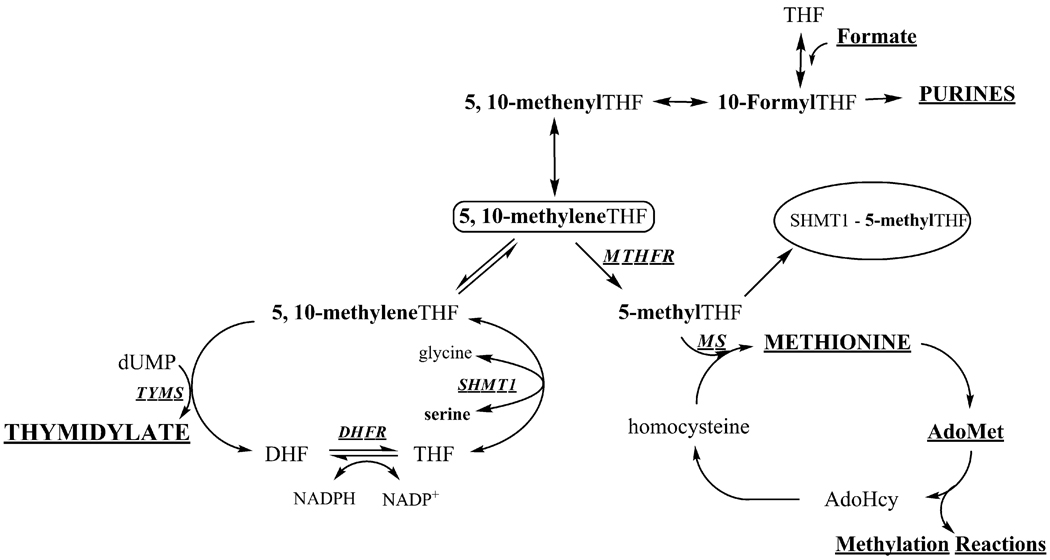
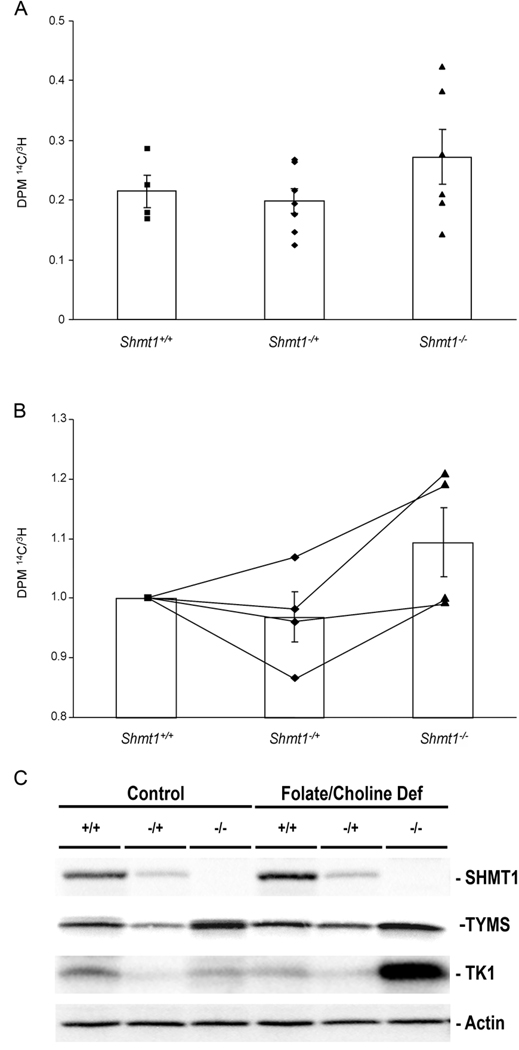
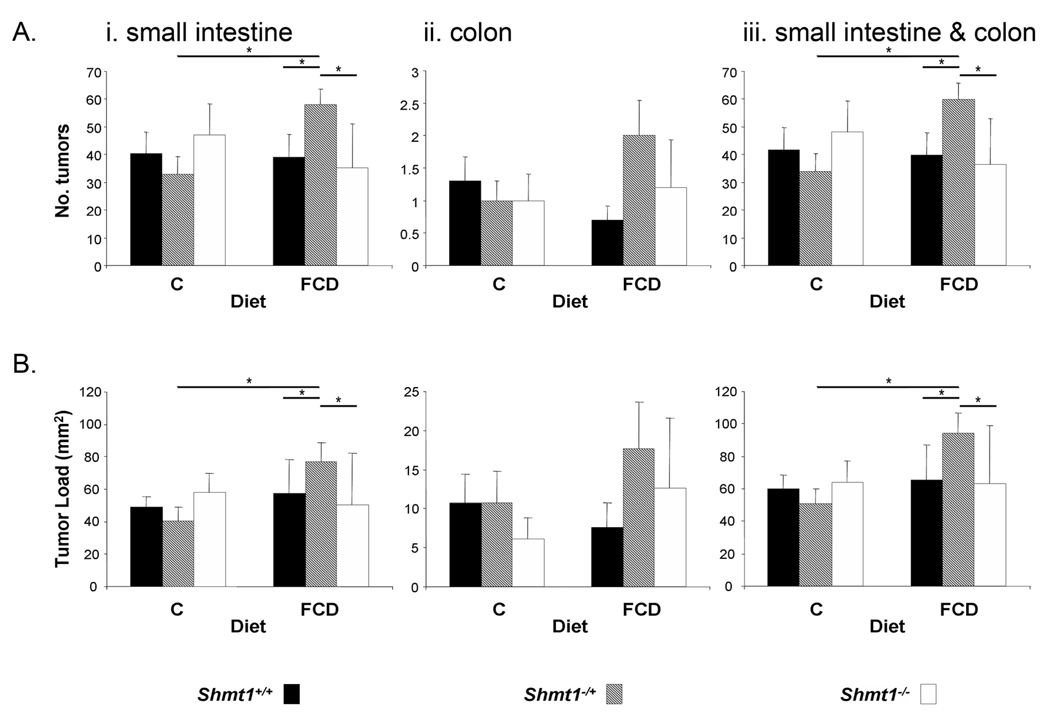
Folate-mediated one-carbon metabolism is required for the de novo synthesis of purines, thymidylate, and S-adenosylmethionine, the primary cellular methyl donor. Impairments in folate metabolism diminish cellular methylation potential and genome stability, which are risk factors for colorectal cancer (CRC). Cytoplasmic serine hydroxymethyltransferase (SHMT1) regulates the partitioning of folate-activated one-carbons between thymidylate and S-adenosylmethionine biosynthesis. Therefore, changes in SHMT1 expression enable the determination of the specific contributions made by thymidylate and S-adenosylmethionine biosynthesis to CRC risk. Shmt1 hemizygosity was associated with a decreased capacity for thymidylate synthesis due to downregulation of enzymes in its biosynthetic pathway, namely thymidylate synthase and cytoplasmic thymidine kinase. Significant Shmt1-dependent changes to methylation capacity, gene expression, and purine synthesis were not observed. Shmt1 hemizygosity was associated with increased risk for intestinal cancer in Apc(min)(/+) mice through a gene-by-diet interaction, indicating that the capacity for thymidylate synthesis modifies susceptibility to intestinal cancer in Apc(min)(/+) mice.
叶酸代谢途径为嘌呤、胸苷酸和 S-腺苷甲硫氨酸的从头合成提供一碳单位,是细胞内主要的甲基供体。叶酸代谢受损会降低细胞内的甲基化潜能和基因组稳定性,这是结直肠癌(CRC)的风险因素。细胞质丝氨酸羟甲基转移酶(SHMT1)调节叶酸激活的一碳单位在胸苷酸和 S-腺苷甲硫氨酸生物合成之间的分配。因此,SHMT1 表达的变化能够确定胸苷酸和 S-腺苷甲硫氨酸生物合成对 CRC 风险的具体贡献。由于其生物合成途径中的酶,即胸苷酸合成酶和细胞质胸苷激酶下调,Shmt1 杂合性与胸苷酸合成能力降低有关。未观察到 SHMT1 依赖性甲基化能力、基因表达和嘌呤合成的显著变化。通过基因-饮食相互作用,Shmt1 杂合性与 Apc(min)(/+)小鼠的肠道癌症风险增加相关,表明胸苷酸合成能力改变了 Apc(min)(/+)小鼠肠道癌症的易感性。