Kind Taco, Faes Theo J C, Vonk-Noordegraaf Anton, Westerhof Nico
Cardiovasc Eng Technol. 2011 Mar;2(1):15-23. doi: 10.1007/s13239-010-0027-1. Epub 2010 Nov 11.
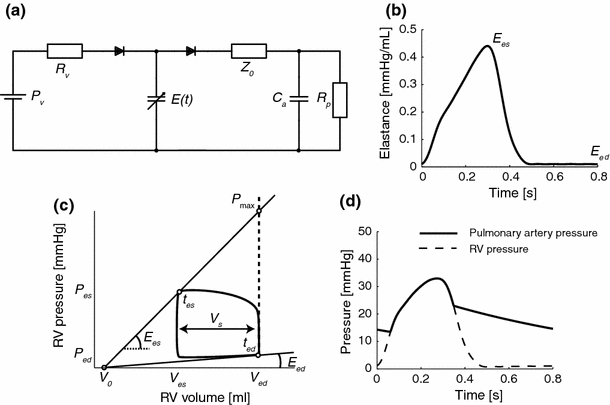
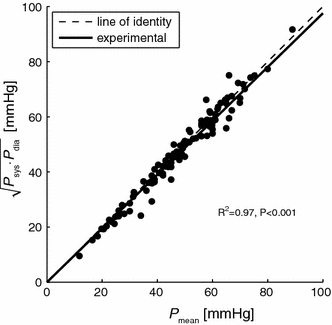
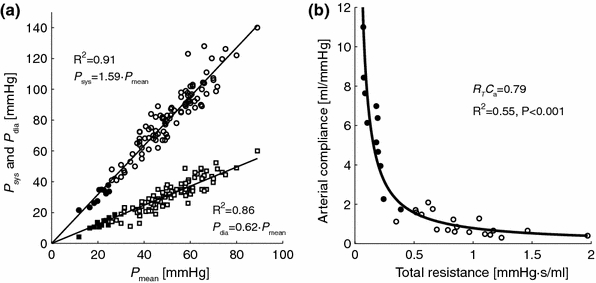
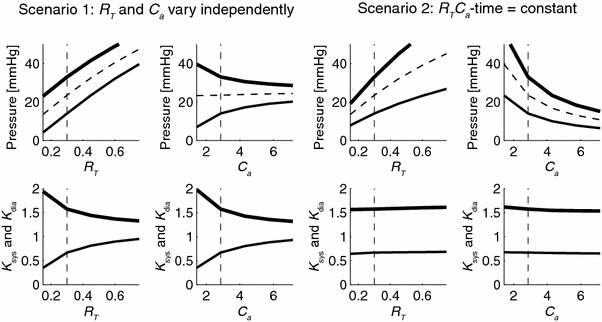
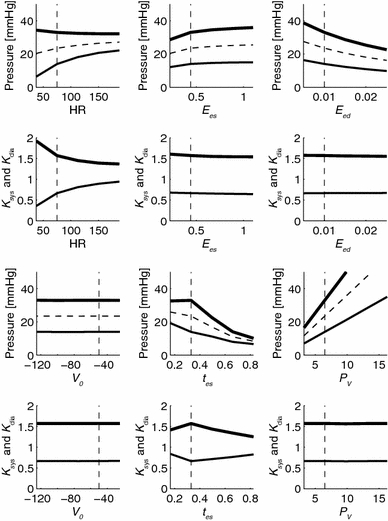
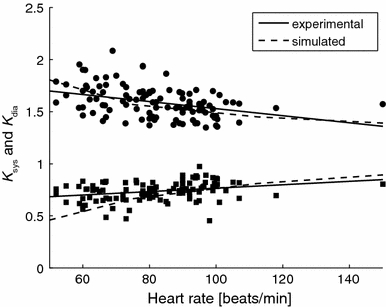
Recently, it was shown that proportional relationships exist between systolic, diastolic and mean pulmonary artery pressure (P(sys), P(dia) and P(mean)) and that they are maintained under various conditions in both health and disease. An arterial-ventricular interaction model was used to study the contribution of model parameters to the ratios P(sys)/P(mean), and P(dia)/P(mean). The heart was modeled by a time-varying elastance function, and the arterial system by a three-element windkessel model consisting of peripheral resistance, R(p), arterial compliance C(a), and pulmonary artery characteristic impedance Z(0). Baseline model parameters were estimated in control subjects and compared to values estimated in patients with pulmonary hypertension. Results indicate that experimentally derived ratios P(sys)/P(mean) and P(dia)/P(mean) could be accurately reproduced using our model (1.59 and 0.61 vs. 1.55 and 0.64, respectively). Sensitivity analysis showed that the (empirical) constancy of P(sys)/P(mean) and P(dia)/P(mean) was primarily based on the inverse hyperbolic relation between total vascular resistance (R(T); calculated as R(p) + Z(0)) and C(a), (i.e. constant R(T)C(a) product). Of the cardiac parameters, only heart rate affected the pressure ratios, but the contribution was small. Therefore, we conclude that proportional relations between systolic, diastolic and mean pulmonary artery pressure result from the constancy of R(T)C(a) thus from pulmonary arterial properties, with only little influence of heart rate.
最近的研究表明,收缩压、舒张压和平均肺动脉压(P(sys)、P(dia)和P(mean))之间存在比例关系,并且在健康和疾病的各种情况下都能保持这种关系。采用动脉-心室相互作用模型来研究模型参数对P(sys)/P(mean)和P(dia)/P(mean)比值的贡献。心脏由时变弹性函数建模,动脉系统由一个由外周阻力R(p)、动脉顺应性C(a)和肺动脉特征阻抗Z(0)组成的三元件风箱模型建模。在对照受试者中估计基线模型参数,并与肺动脉高压患者中估计的值进行比较。结果表明,使用我们的模型可以准确再现实验得出的P(sys)/P(mean)和P(dia)/P(mean)比值(分别为1.59和0.61,对比1.55和0.64)。敏感性分析表明,P(sys)/P(mean)和P(dia)/P(mean)的(经验性)恒定性主要基于总血管阻力(R(T);计算为R(p)+Z(0))和C(a)之间的反双曲关系(即R(T)C(a)乘积恒定)。在心脏参数中,只有心率影响压力比值,但影响较小。因此,我们得出结论,收缩压、舒张压和平均肺动脉压之间的比例关系源于R(T)C(a)的恒定性,从而源于肺动脉特性,心率的影响很小。