Vanden Eynden Frédéric, Bové Thierry, Chirade Marie-Luce, Van Nooten Guido, Segers Patrick
1 Cardiac Surgery, Université Libre de Bruxelles, Hôpital Académique Erasme, Brussels, Belgium.
2 Laboratory of Experimental Cardiac Surgery, Ghent University Hospital, Belgium.
Pulm Circ. 2018 Apr-Jun;8(2):2045894018776882. doi: 10.1177/2045894018776882. Epub 2018 Apr 30.
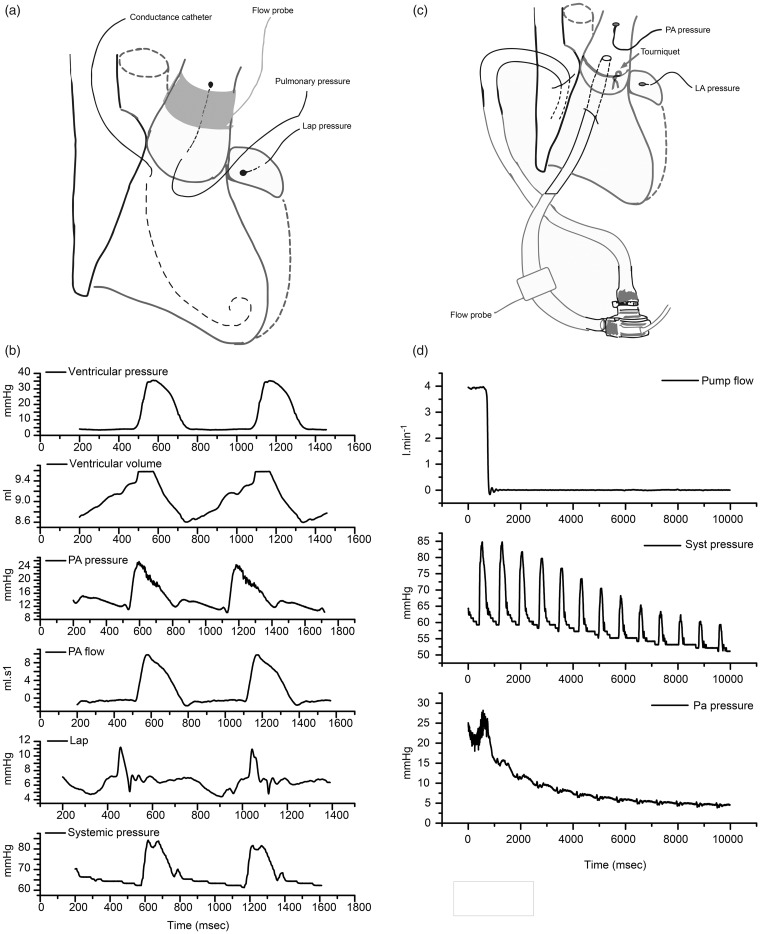
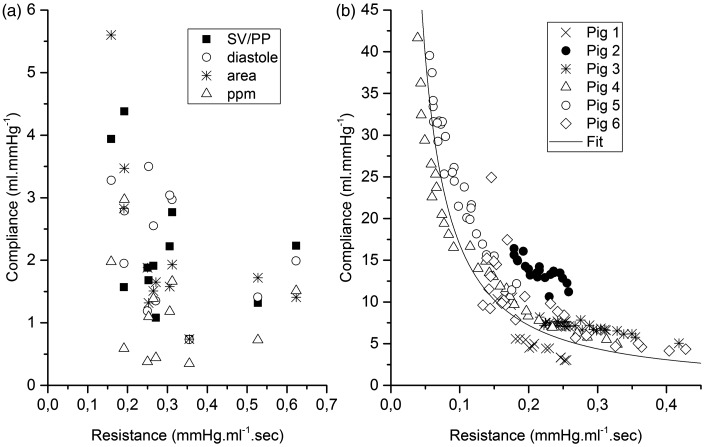
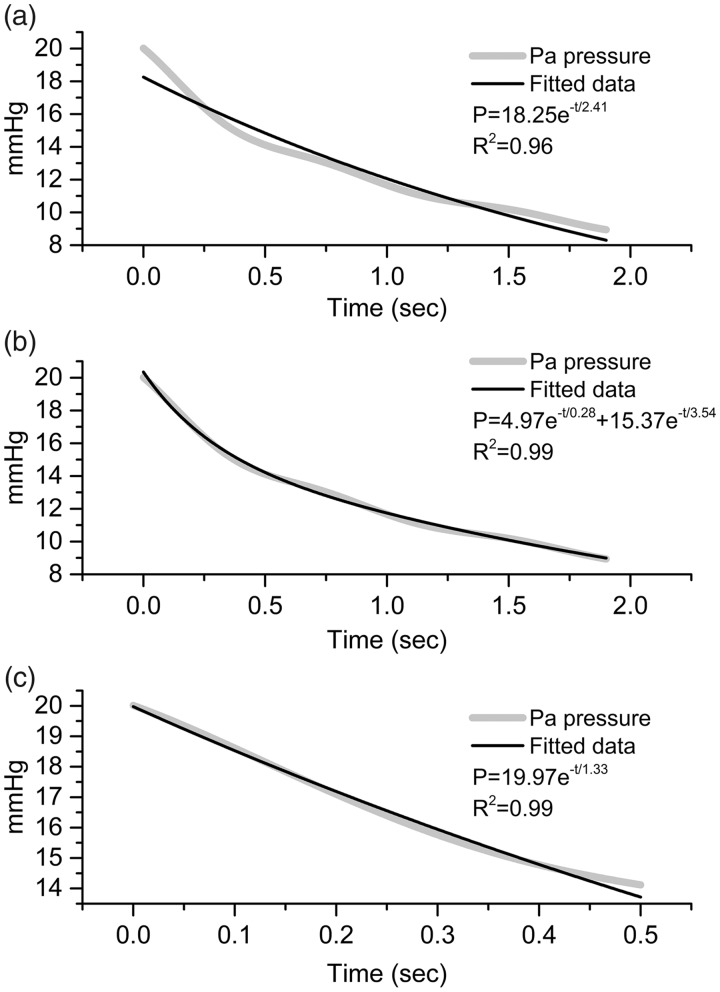
Arterial compliance (C) is related to the elasticity, size, and geometrical distribution of arteries. Compliance is a determinant of the load that impedes ventricular ejection. Measuring compliance is difficult, particularly in the pulmonary circulation in which resistive and compliant vessels overlap. Comparing different methods for quantification of compliance to a method that involves a continuous flow might help to identify the optimal method. Pulmonary arterial compliance was computed in six pigs based on the stroke volume to pulse pressure ratio, diastolic decay exponential fitting, area method, and the pulse pressure method (PPM). Compliance measurements were compared to those obtained under continuous flow conditions through a right ventricular bypass (Heartware Inc., Miami Lakes, FL, USA). Compliance was computed for various flows using diastolic decay exponential fitting after an abrupt interruption of the pump. Under the continuous flow conditions, resistance (R) was a decreasing function of the flow, and the fitting to P = e yielded a pulmonary time constant (RC) of 2.06 s ( ± 0.48). Compliance was an increasing function of flow. Steady flow inter-method comparisons of compliance under pulsatile flow conditions showed large discrepancies and values (7.23 ± 4.47 mL/mmHg) which were lower than those obtained under continuous flow conditions (10.19 ± 1 0.31 mL/mmHg). Best agreement with steady flow measurements is obtained with the diastolic decay method. Resistance and compliance are both flow-dependent and are inversely related in the pulmonary circulation. The dynamic nature of the pulsatile flow may induce a non-uniformly distributed compliance, with an influence on the methods of measurement.
动脉顺应性(C)与动脉的弹性、大小及几何分布有关。顺应性是阻碍心室射血负荷的一个决定因素。测量顺应性很困难,尤其是在肺循环中,阻力血管和顺应性血管相互重叠。将不同的顺应性量化方法与涉及连续血流的方法进行比较,可能有助于确定最佳方法。基于每搏量与脉压比值、舒张期衰减指数拟合、面积法和脉压法(PPM),计算了6头猪的肺动脉顺应性。将顺应性测量结果与通过右心室旁路(美国佛罗里达州迈阿密湖Heartware公司)在连续血流条件下获得的结果进行比较。在泵突然中断后,使用舒张期衰减指数拟合计算不同血流时的顺应性。在连续血流条件下,阻力(R)是血流的递减函数,拟合P = e得到的肺时间常数(RC)为2.06 s(±0.48)。顺应性是血流的递增函数。在脉动血流条件下进行的顺应性方法间稳态血流比较显示出很大差异,其值(7.23±4.47 mL/mmHg)低于在连续血流条件下获得的值(10.19±10.31 mL/mmHg)。舒张期衰减法与稳态血流测量结果的一致性最佳。在肺循环中,阻力和顺应性均与血流有关且呈负相关。脉动血流的动态特性可能导致顺应性分布不均匀,从而影响测量方法。