Medical Image Processing Group, Institute of Automation, Chinese Academy of Sciences, Beijing, 100190, China.
Mol Pain. 2011 Mar 23;7:19. doi: 10.1186/1744-8069-7-19.
Functional acupoint specificity is crucial to the clinical efficacy of acupuncture treatment, such as pain relief. Whether acupuncture needling at a peripheral acupoint produces distinct patterns of brain responses remains controversial.
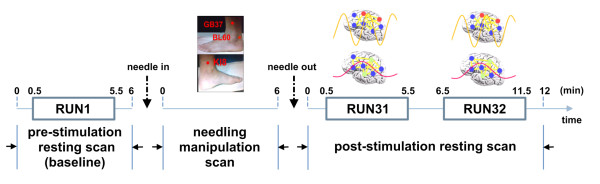
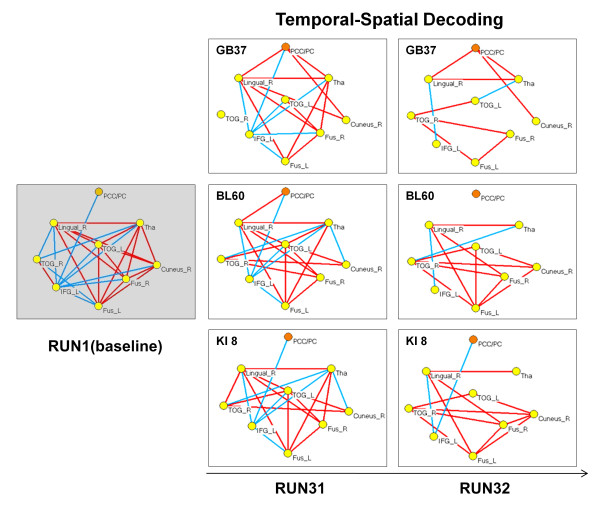
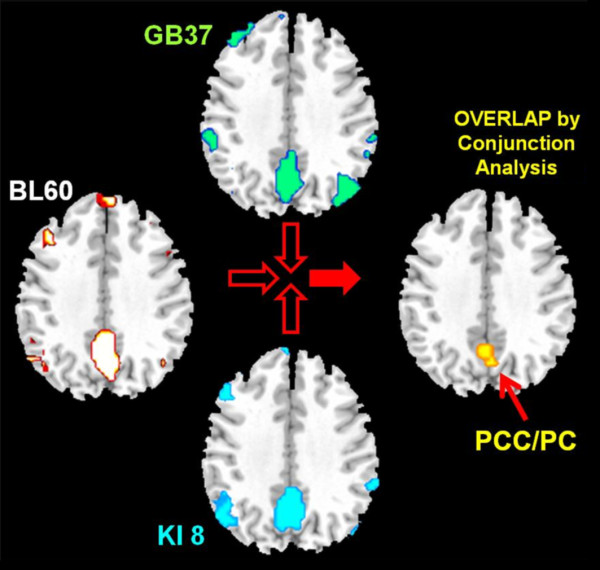
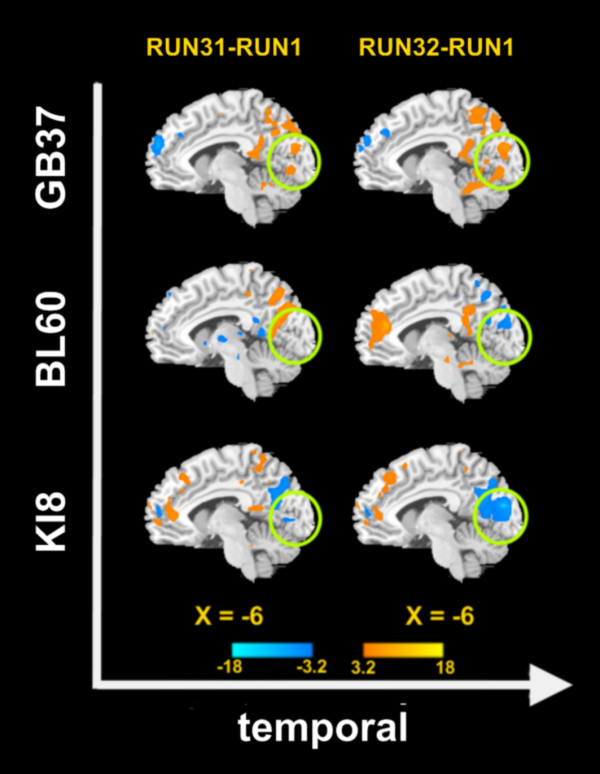
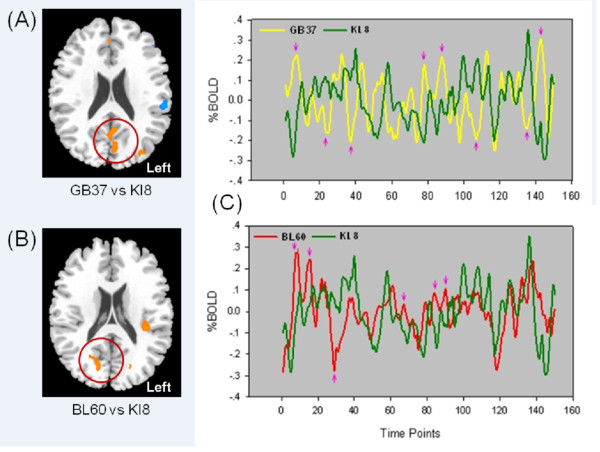
This fMRI study employed the complex network analysis (CNA) to test the hypothesis that acupuncture stimulation at an acupoint correspondingly induced activity changes in one or more intrinsic or resting-state brain networks. Built upon the sustained effect of acupuncture and its time-varying characteristics, we constructed a dynamic encoding system with the hub anchored at the posterior cingulate cortex and precuneus (PCC/pC). We found that needling at two visual acupoints (GB37 and BL60) and a non-visual acupoint (KI8) induced a spatially converging brain response, which overlapped at the PCC/pC. We also found distinct neural modulations during and after acupoint stimulation. During this period, the PCC/pC interacted with a visual resting-state network in different patterns. Furthermore, there was a delayed functional correspondence between the intrinsic visual network and manipulation over the visual acupoints (i.e., GB37 or BL60), but not the non-visual acupoint (KI8) via the PCC/pC, implicating a specific temporal-spatial encoding/decoding mechanism underlying the post-effect of acupuncture.
This study provided an integrated view exploring the functional specificity of acupuncture in which both the needling sensation and the following neural cascades may contribute to the overall effect of acupuncture through dynamic reconfiguration of complex neural networks.fMRI, acupoints, posterior cingulate cortex, precuneus, temporal-spatial encoding, resting-state networks.
功能穴位特异性对于针灸治疗的临床疗效至关重要,例如缓解疼痛。针刺外周穴位是否会产生不同的大脑反应模式仍存在争议。
这项 fMRI 研究采用复杂网络分析(CNA)来检验假设,即针刺穴位会相应地引起一个或多个内在或静息状态大脑网络的活动变化。基于针灸的持续效应及其时变特征,我们构建了一个动态编码系统,以后扣带回和楔前叶(PCC/pC)为枢纽。我们发现针刺两个视觉穴位(GB37 和 BL60)和一个非视觉穴位(KI8)会引起空间上汇聚的大脑反应,该反应在 PCC/pC 处重叠。我们还发现穴位刺激期间和之后存在不同的神经调节。在此期间,PCC/pC 以不同的模式与视觉静息态网络相互作用。此外,内在视觉网络与视觉穴位(即 GB37 或 BL60)之间存在延迟的功能对应关系,但与非视觉穴位(KI8)之间不存在对应关系,通过 PCC/pC 进行操作,暗示了针灸后效应背后存在特定的时空编码/解码机制。
这项研究提供了一个综合的视角,探索了针灸的功能特异性,其中针刺感觉和随后的神经级联可能通过复杂神经网络的动态重新配置对针灸的整体效果做出贡献。fMRI、穴位、后扣带回、楔前叶、时空编码、静息态网络。