Bordessoule D, Gaulard P, Mason D Y
Department of Haematology, University Hospital, Limoges, France.
J Clin Pathol. 1990 Jun;43(6):461-4. doi: 10.1136/jcp.43.6.461.
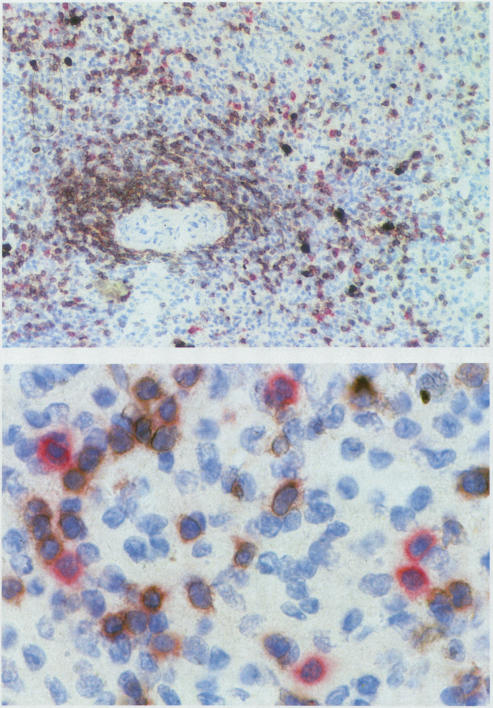
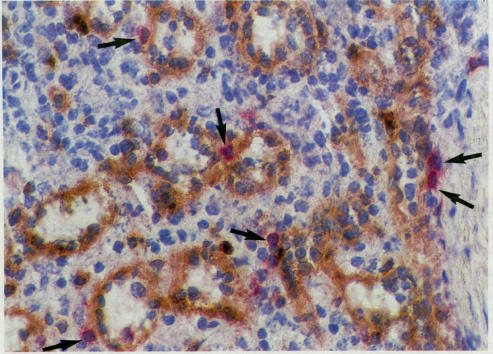
About 4% of human T cells carry antigen receptor composed of gamma and delta chains (rather than alpha and beta chains). Double immunoenzymatic staining of frozen sections of 14 samples of human spleen showed that gamma delta bearing T cells were preferentially localised in the red pulp of this organ where on average they accounted for 17% of all T cells. There was no correlation between the number of gamma delta T cells and the diagnosis, with the exception of a case of malaria in which an unusually high number (40%) of T cells were of this type. The gamma delta bearing T cells were scattered randomly through the red pulp, and double staining combined with a marker of splenic sinusoids (CD36) showed that almost all lie outside the sinusoids within the cords of the red pulp. It is suggested that the double immunoenzymatic technique could be used for further studies of the prevalence of gamma delta bearing T cells in lymphocytic infiltrates.
约4%的人类T细胞携带由γ链和δ链(而非α链和β链)组成的抗原受体。对14份人类脾脏样本的冰冻切片进行双免疫酶染色显示,携带γδ的T细胞优先定位于该器官的红髓,平均占所有T细胞的17%。除1例疟疾患者外,γδ T细胞数量与诊断之间无相关性,该疟疾患者中此类T细胞数量异常高(40%)。携带γδ的T细胞随机散布于红髓中,双染色结合脾血窦标记物(CD36)显示,几乎所有细胞都位于红髓索内的血窦之外。建议双免疫酶技术可用于进一步研究淋巴细胞浸润中携带γδ的T细胞的患病率。