Ray Debajyoti, Bossaerts Peter
Computation and Neural Systems, California Institute of Technology Pasadena, CA, USA.
Front Neurosci. 2011 Jan 28;5:2. doi: 10.3389/fnins.2011.00002. eCollection 2011.
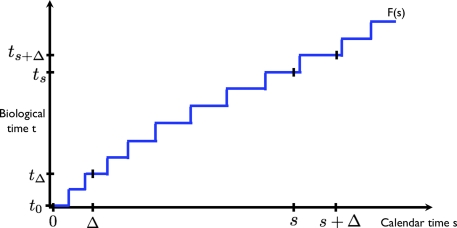
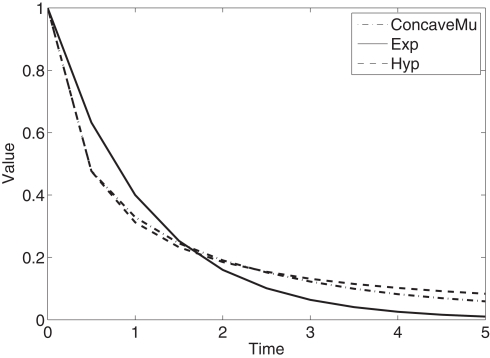
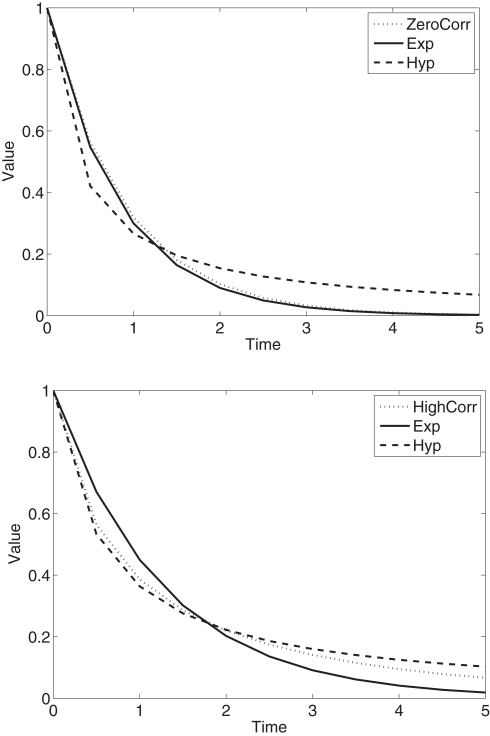
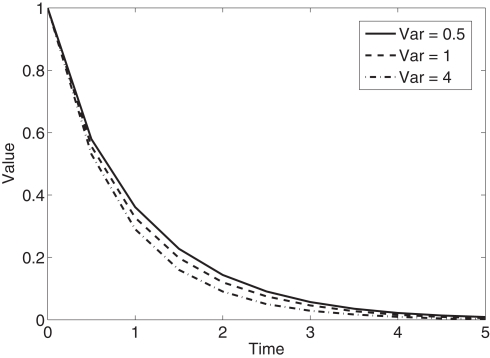
Temporal preferences of animals and humans often exhibit inconsistencies, whereby an earlier, smaller reward may be preferred when it occurs immediately but not when it is delayed. Such choices reflect hyperbolic discounting of future rewards, rather than the exponential discounting required for temporal consistency. Simultaneously, however, evidence has emerged that suggests that animals and humans have an internal representation of time that often differs from the calendar time used in detection of temporal inconsistencies. Here, we prove that temporal inconsistencies emerge if fixed durations in calendar time are experienced as positively related (positive quadrant dependent). Hence, what are time-consistent choices within the time framework of the decision maker appear as time-inconsistent to an outsider who analyzes choices in calendar time. As the biological clock becomes more variable, the fit of the hyperbolic discounting model improves. A recent alternative explanation for temporal choice inconsistencies builds on persistent under-estimation of the length of distant time intervals. By increasing the expected speed of our stochastic biological clock for time farther into the future, we can emulate this explanation. Ours is therefore an encompassing theoretical framework that predicts context-dependent degrees of intertemporal choice inconsistencies, to the extent that context can generate changes in autocorrelation, variability, and expected speed of the biological clock. Our finding should lead to novel experiments that will clarify the role of time perception in impulsivity, with critical implications for, among others, our understanding of aging, drug abuse, and pathological gambling.
动物和人类的时间偏好常常表现出不一致性,即当一个更早但更小的奖励立即出现时可能会被偏好,但延迟出现时则不然。这种选择反映了对未来奖励的双曲线贴现,而不是时间一致性所需的指数贴现。然而,与此同时,有证据表明动物和人类具有一种时间的内部表征,它往往与检测时间不一致性时所使用的日历时间不同。在这里,我们证明,如果日历时间中的固定持续时间被体验为正相关(依赖于正象限),那么时间不一致性就会出现。因此,在决策者的时间框架内属于时间一致的选择,对于在日历时间中分析选择的局外人来说却显得是时间不一致的。随着生物钟变得更具变异性,双曲线贴现模型的拟合度会提高。最近对时间选择不一致性的一种替代解释基于对遥远时间间隔长度的持续低估。通过提高我们随机生物钟对更遥远未来时间的预期速度,我们可以模拟这种解释。因此,我们的是一个全面的理论框架,它能够预测跨期选择不一致性的情境依赖程度,只要情境能够在生物钟的自相关性、变异性和预期速度方面产生变化。我们的发现应该会引发新的实验,这些实验将阐明时间感知在冲动性中的作用,对我们理解衰老、药物滥用和病态赌博等问题具有关键意义。