Vassiliadis Efstathios, Veidal Sanne Skovgård, Barascuk Natasha, Mullick Jhinuk Basu, Clausen Rikke Elgaard, Larsen Lise, Simonsen Henrik, Larsen Dorthe Vang, Bay-Jensen Anne-Christine, Segovia-Silvestre Toni, Leeming Diana Julie, Karsdal Morten A
Assay Development, Nordic Bioscience, Herlev Hovedgade 207, DK-2730, Copenhagen, Denmark.
BMC Dermatol. 2011 Mar 29;11:6. doi: 10.1186/1471-5945-11-6.
The current study utilized a Bleomycin-induced model of skin fibrosis to investigate the neo-epitope CO3-610 (KNGETGPQGP), a fragment of collagen III released during matrix metalloproteinase-9 (MMP9) degradation of the protein, we have previously described as a novel biomarker for liver fibrosis. The aim was to investigate CO3-610 levels in another well characterised model of fibrosis, to better describe the biomarker in relation to additional fibrotic pathologies.
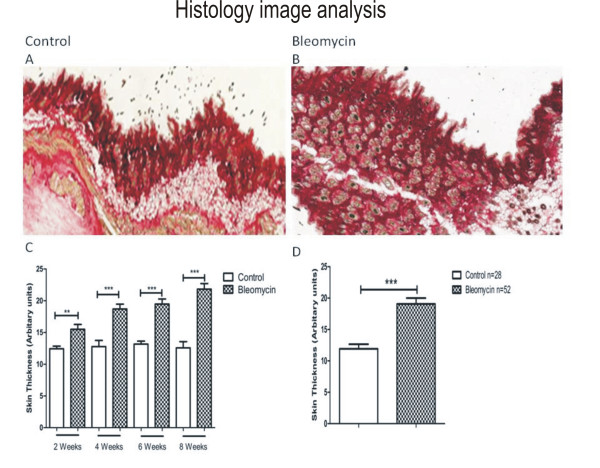
Skin fibrosis was induced by daily injections of Bleomycin to a total of 52 female C3 H mice, while control mice (n = 28) were treated with phosphate buffered saline (PBS), for 2, 4, 6 or 8 weeks. Skin fibrosis was evaluated using Visiopharm software on Sirius-red stained skin sections. Urine ELISA assays and creatinine corrections were performed to measure CO3-610 levels.
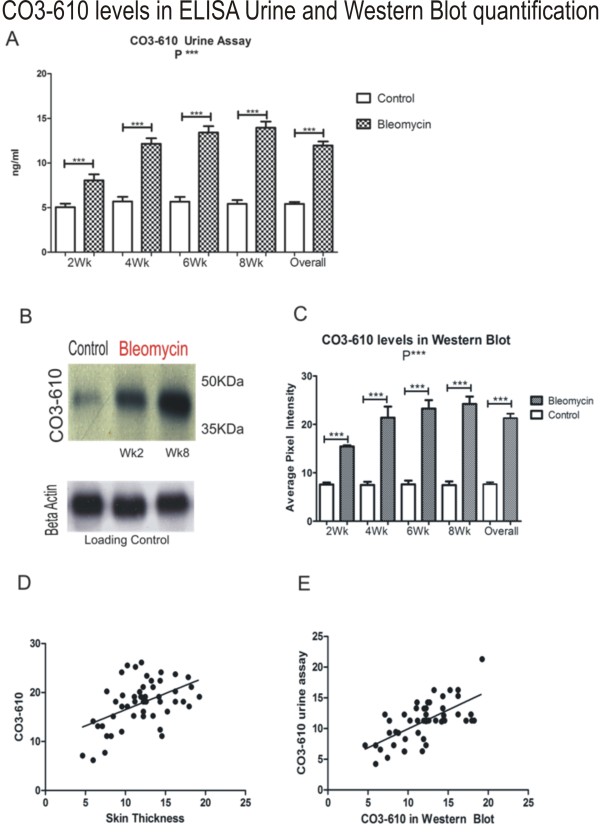
CO3-610 levels were significantly higher in Bleomycin-treated vs. PBS-treated mice at each time point of termination. The mean increases were: 59.2%, P < 0.0008, at 2 weeks; 113.5%, P < 0.001, at 4 weeks; 136.8%, P < 0.0001 at 6 weeks; 157.2%, P < 0.0001 at 8 weeks). PBS-treated mice showed a non-significant increase in CO3-610 levels (mean increase for weeks 2-8 = 1.7%, P = 0.789) CO3-610 levels assayed in urine were statistically significantly correlated with Western blot analysis showing increased skin fibrosis (P < 0.0001, r = 0.65).
Increased levels in mouse urine of the MMP-9 mediated collagen III degradation fragment CO3-610 were correlated with skin fibrosis progression, suggesting that CO3-610 may be a potential positive biomarker to study the pathogenesis of skin fibrosis in mice.
本研究利用博来霉素诱导的皮肤纤维化模型,研究新表位CO3 - 610(KNGETGPQGP),其为基质金属蛋白酶 - 9(MMP9)降解胶原蛋白III时释放的片段,我们之前已将其描述为肝纤维化的一种新型生物标志物。目的是在另一个特征明确的纤维化模型中研究CO3 - 610水平,以便更好地描述该生物标志物与其他纤维化病理的关系。
对总共52只雌性C3H小鼠每日注射博来霉素诱导皮肤纤维化,而对照小鼠(n = 28)用磷酸盐缓冲盐水(PBS)处理,持续2、4、6或8周。使用Visiopharm软件对天狼星红染色的皮肤切片评估皮肤纤维化情况。进行尿ELISA检测和肌酐校正以测量CO3 - 610水平。
在每个终止时间点,博来霉素处理的小鼠中CO3 - 610水平均显著高于PBS处理的小鼠。平均升高幅度分别为:2周时升高59.2%,P < 0.0008;4周时升高113.5%,P < 0.001;6周时升高136.8%,P < 0.0001;8周时升高157.2%,P < 0.0001)。PBS处理的小鼠中CO3 - 610水平有不显著的升高(第2 - 8周平均升高1.7%,P = 0.789)。尿中检测的CO3 - 610水平与显示皮肤纤维化增加的蛋白质印迹分析在统计学上显著相关(P < 0.0001,r = 0.65)。
小鼠尿液中MMP - 9介导的胶原蛋白III降解片段CO3 - 610水平升高与皮肤纤维化进展相关,表明CO3 - 610可能是研究小鼠皮肤纤维化发病机制的一种潜在阳性生物标志物。