Division of Epidemiology and Public Health, The University of Nottingham, Nottingham City Hospital, Nottingham, United Kingdom.
Gastroenterology. 2011 Jul;141(1):62-70. doi: 10.1053/j.gastro.2011.03.048. Epub 2011 Mar 27.
BACKGROUND & AIMS: It is unclear whether mortality from upper gastrointestinal hemorrhage is changing: any differences observed might result from changes in age or comorbidity of patient populations. We estimated trends in 28-day mortality in England following hospital admission for gastrointestinal hemorrhage.
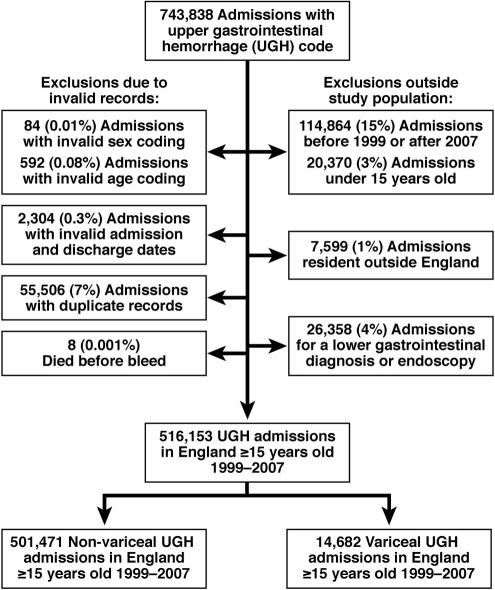
We used a case-control study design to analyze data from all adults administered to a National Health Service hospital, for upper gastrointestinal hemorrhage, from 1999 to 2007 (n=516,153). Cases were deaths within 28 days of admission (n=74,992), and controls were survivors to 28 days. The 28-day mortality was derived from the linked national death register. A logistic regression model was used to adjust trends in nonvariceal and variceal hemorrhage mortality for age, sex, and comorbidities and to investigate potential interactions.
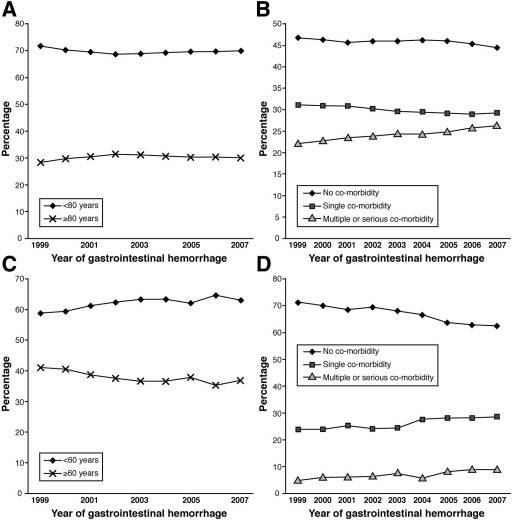
During the study period, the unadjusted, overall, 28-day mortality following nonvariceal hemorrhage was reduced from 14.7% to 13.1% (unadjusted odds ratio, 0.87; 95% confidence interval: 0.84-0.90). The mortality following variceal hemorrhage was reduced from 24.6% to 20.9% (unadjusted odds ratio, 0.8; 95% confidence interval: 0.69-0.95). Adjustments for age and comorbidity partly accounted for the observed trends in mortality. Different mortality trends were identified for different age groups following nonvariceal hemorrhage.
The 28-day mortality in England following both nonvariceal and variceal upper gastrointestinal hemorrhage decreased from 1999 to 2007, and the reduction had been partly obscured by changes in patient age and comorbidities. Our findings indicate that the overall management of bleeding has improved within the first 4 weeks of admission.
上消化道出血的死亡率是否在变化尚不清楚:观察到的任何差异可能是由于患者人群年龄或合并症的变化所致。我们评估了英格兰因上消化道出血住院后 28 天死亡率的趋势。
我们采用病例对照研究设计,分析了 1999 年至 2007 年期间所有在国民保健服务医院接受上消化道出血治疗的成年人的数据(n=516153)。病例为入院后 28 天内死亡(n=74992),对照为存活至 28 天。28 天死亡率来自国家死亡登记处的链接。使用逻辑回归模型调整非静脉曲张性和静脉曲张性出血死亡率的趋势,以调整年龄、性别和合并症,并调查潜在的相互作用。
在研究期间,未经调整的非静脉曲张性出血后 28 天总体死亡率从 14.7%降至 13.1%(未调整的优势比,0.87;95%置信区间:0.84-0.90)。静脉曲张性出血后的死亡率从 24.6%降至 20.9%(未调整的优势比,0.8;95%置信区间:0.69-0.95)。年龄和合并症的调整部分解释了观察到的死亡率趋势。非静脉曲张性出血后,不同年龄组的死亡率趋势不同。
1999 年至 2007 年期间,英格兰因非静脉曲张性和静脉曲张性上消化道出血后 28 天死亡率下降,患者年龄和合并症的变化部分掩盖了这种下降。我们的发现表明,在入院后 4 周内,出血的总体管理有所改善。