Robert Koch Institute, Wernigerode Branch, Wernigerode, Germany.
BMC Infect Dis. 2011 Mar 31;11:80. doi: 10.1186/1471-2334-11-80.
Hospital strains of Enterococcus faecium could be characterized and typed by various molecular methods (MLST, AFLP, MLVA) and allocated to a distinct clonal complex known as MLST CC17. However, these techniques are laborious, time-consuming and cost-intensive. Our aim was to identify hospital E. faecium strains and differentiate them from colonizing and animal variants by a simple, inexpensive and reliable PCR-based screening assay. We describe here performance and predictive value of a single PCR detecting the insertion element, IS16, to identify hospital E. faecium isolates within a collection of 260 strains of hospital, animal and human commensal origins.
Specific primers were selected amplifying a 547-bp fragment of IS16. Presence of IS16 was determined by PCR screenings among the 260 E. faecium isolates. Distribution of IS16 was compared with a prevalence of commonly used markers for hospital strains, esp and hylEfm. All isolates were typed by MLST and partly by PFGE. Location of IS16 was analysed by Southern hybridization of plasmid and chromosomal DNA.
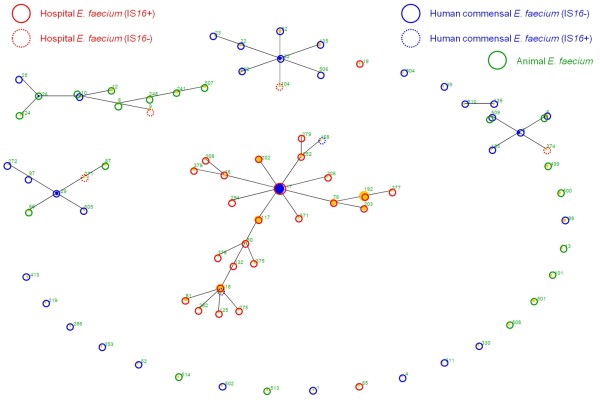
IS16 was exclusively distributed only among 155 invasive strains belonging to the clonal complex of hospital-associated strains ("CC17"; 28 MLST types) and various vancomycin resistance genotypes (vanA/B/negative). The five invasive IS16-negative strains did not belong to the clonal complex of hospital-associated strains (CC17). IS16 was absent in all but three isolates from 100 livestock, food-associated and human commensal strains ("non-CC17"; 64 MLST types). The three IS16-positive human commensal isolates revealed MLST types belonging to the clonal complex of hospital-associated strains (CC17). The values predicting a hospital-associated strain ("CC17") deduced from presence and absence of IS16 was 100% and thus superior to screening for the presence of esp (66%) and/or hylEfm (46%). Southern hybridizations revealed chromosomal as well as plasmid localization of IS16.
This simple screening assay for insertion element IS16 is capable of differentiating hospital-associated from human commensal, livestock- and food-associated E. faecium strains and thus allows predicting the epidemic strengths or supposed pathogenic potential of a given E. faecium isolate identified within the nosocomial setting.
肠球菌属粪肠球菌可通过各种分子方法(MLST、AFLP、MLVA)进行特征和分型,并归属于一个特定的克隆复合体,称为 MLST CC17。然而,这些技术既繁琐又耗时,成本也很高。我们的目的是通过一种简单、廉价和可靠的基于 PCR 的筛选试验来鉴定医院粪肠球菌菌株,并将其与定植和动物变异株区分开来。我们在此描述了一种检测插入元件 IS16 的单一 PCR 试验的性能和预测值,该试验用于鉴定 260 株来自医院、动物和人类共生来源的粪肠球菌菌株中的医院粪肠球菌分离株。
选择特异性引物扩增 IS16 的 547-bp 片段。通过 PCR 筛选试验确定 260 株粪肠球菌分离株中 IS16 的存在。比较 IS16 的分布与医院菌株常用标记物 esp 和 hylEfm 的流行情况。所有分离株均通过 MLST 分型,部分通过 PFGE 分型。通过质粒和染色体 DNA 的 Southern 杂交分析 IS16 的位置。
IS16 仅分布于 155 株侵袭性菌株中,这些菌株属于医院相关菌株的克隆复合体(“CC17”;28 种 MLST 型)和各种万古霉素耐药基因型(vanA/B/阴性)。5 株侵袭性 IS16 阴性菌株不属于医院相关菌株的克隆复合体(CC17)。除 100 株来自牲畜、食品和人类共生的分离株(“非 CC17”;64 种 MLST 型)外,其他分离株均未发现 IS16。3 株 IS16 阳性的人类共生分离株显示出属于医院相关菌株的克隆复合体(CC17)的 MLST 型。根据 IS16 的存在和缺失预测医院相关菌株(“CC17”)的概率为 100%,因此优于筛选 esp(66%)和/或 hylEfm(46%)的存在。Southern 杂交显示 IS16 位于染色体和质粒上。
这种简单的插入元件 IS16 筛选试验能够区分医院相关、人类共生、牲畜和食品相关的粪肠球菌菌株,从而能够预测在医院环境中鉴定出的特定粪肠球菌分离株的流行强度或假定的致病性潜力。