Lopes Jéssica, de Lencastre Hermínia, Conceição Teresa
Laboratory of Molecular Genetics, Instituto de Tecnologia Química e Biológica António Xavier, Universidade Nova de Lisboa (ITQB NOVA), Oeiras, Portugal.
Laboratory of Microbiology and Infectious Diseases, The Rockefeller University, New York, NY, United States.
Front Microbiol. 2024 Sep 11;15:1466990. doi: 10.3389/fmicb.2024.1466990. eCollection 2024.
Enterococci are commensals of the gastrointestinal tract of humans and animals that evolved into opportunistic pathogens with high antimicrobial resistance and virulence. Multidrug-resistant is a major cause of hospital-acquired infections worldwide. For this reason, the characterization of non-clinical reservoirs of Enterococci and their epidemiological link to resistant hospital isolates is crucial for controlling their spread.
A total of 295 samples collected from livestock (pigs and cows, = 135) and environment (public buses, passengers hands, and urban environments, = 160) were screened for spp. antimicrobial resistance profiles, virulence potential, and clonal population were further characterized.
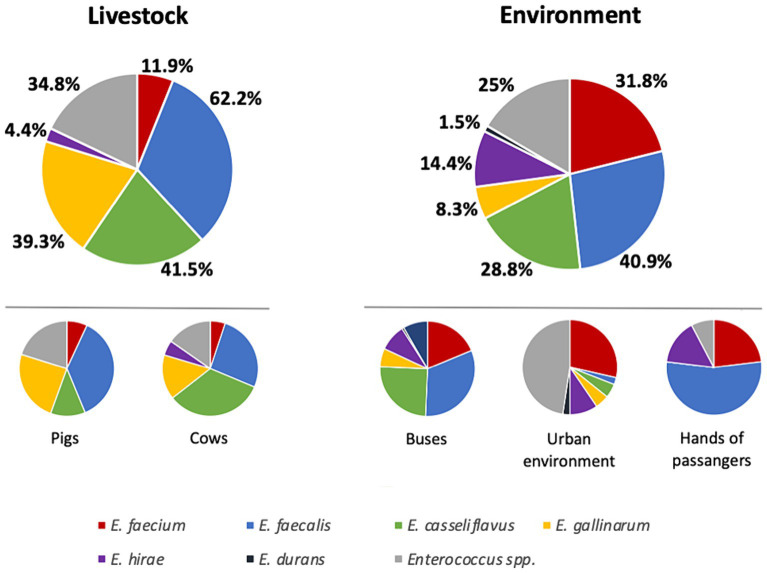
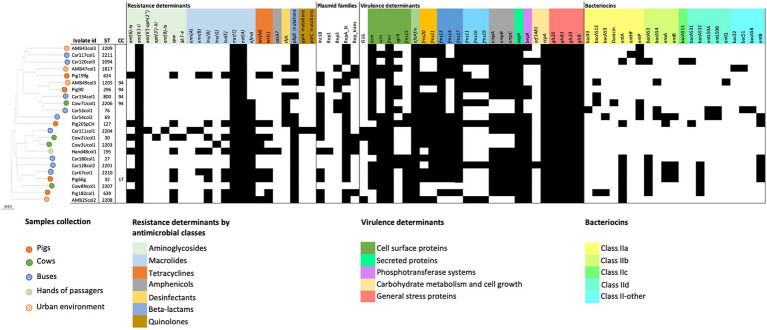
Enterococci were detected in 90.5% ( = 267) of the samples, with a higher prevalence in livestock (100%) than the environment (82.5%, < 0.0001), but none of the isolates exhibited vancomycin resistance. was the most prevalent species (51.7%), predominantly found in livestock (62.2%), while was more common in the environment. Of the 59 isolates, 78% showed resistance to ≥3 antibiotic classes and contained associated resistance genes, namely tetracyclines ( and ), beta-lactams (mutations in ), and high-level resistance to aminoglycosides ( and ). A wide array of virulence factors was detected among , associated with adherence, biofilm formation, and adaptation to host response, while hospital-associated virulence markers, such as IS16, were less frequent, probably due to the non-clinical nature of the isolates. Clonal population analysis revealed a diverse population. Although no direct epidemiological link could be traced between our isolates and specific clinical isolates, infection-associated genetic backgrounds were identified in non-clinical isolates: one isolate from pigs belonged to CC17 (ST32), while four isolates belonged to CC94, including one recovered from pigs (ST296), one from cows (ST2206), one from the urban environment (ST1205), and other from buses (ST800).
This study underscores a high prevalence of clinically relevant species among healthy livestock and the environment. Despite the absence of vancomycin resistance and limited hospital infection-associated clonal lineages, the presence of with significant virulence potential and resistance to critical antibiotics in human and veterinary medicine highlights the need for continuing surveillance of non-clinical reservoirs.
肠球菌是人和动物胃肠道的共生菌,已演变成具有高抗菌耐药性和毒力的机会致病菌。多重耐药是全球医院获得性感染的主要原因。因此,对肠球菌的非临床储存库进行特征分析及其与耐药医院分离株的流行病学联系对于控制其传播至关重要。
共收集了295份来自家畜(猪和牛,n = 135)和环境(公共汽车、乘客手部和城市环境,n = 160)的样本,筛选肠球菌属。进一步对其抗菌耐药谱、毒力潜力和克隆群体进行特征分析。
在90.5%(n = 267)的样本中检测到肠球菌,在家畜中的流行率(100%)高于环境(82.5%,P < 0.0001),但所有分离株均未表现出对万古霉素的耐药性。粪肠球菌是最常见的菌种(51.7%),主要在家畜中发现(62.2%),而屎肠球菌在环境中更为常见。在59株肠球菌分离株中,78%对≥3类抗生素耐药,并含有相关耐药基因,即四环素(tetM和tetL)、β-内酰胺类(PBP5突变)以及对氨基糖苷类的高水平耐药(aac(6')-aph(2'')和ant(6)-Ia)。在粪肠球菌中检测到多种毒力因子,与黏附、生物膜形成和对宿主反应的适应性有关,而医院相关毒力标志物,如IS16,出现频率较低,可能是由于分离株的非临床性质。克隆群体分析显示肠球菌群体具有多样性。虽然无法追踪到我们的分离株与特定临床分离株之间的直接流行病学联系,但在非临床分离株中鉴定出了与感染相关的遗传背景:一株来自猪的分离株属于CC17(ST32),而四株属于CC94,包括一株从猪身上分离的(ST296)、一株从牛身上分离的(ST2206)、一株从城市环境中分离的(ST1205)和一株从公共汽车上分离的(ST800)。
本研究强调了健康家畜和环境中临床相关肠球菌属菌种的高流行率。尽管缺乏万古霉素耐药性且与医院感染相关的克隆谱系有限,但具有显著毒力潜力且对人和兽医学中关键抗生素耐药的肠球菌的存在凸显了对非临床储存库持续监测的必要性。