Department of Microbiology, Faculty of Medicine, Mbarara University of Science and Technology, Mbarara, Uganda.
BMC Infect Dis. 2011 Mar 31;11:81. doi: 10.1186/1471-2334-11-81.
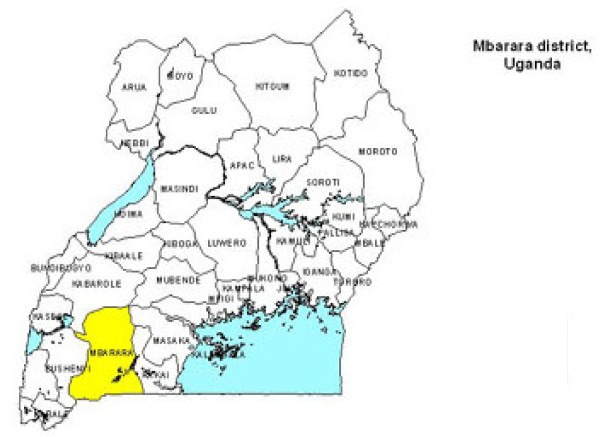
Determination of the prevalence and drug susceptibility of the M. tuberculosis strains is important in tuberculosis control. We determined the genetic diversity and susceptibility profiles of mycobacteria isolated from tuberculosis patients in Mbarara, South Western Uganda.
We enrolled, consecutively; all newly diagnosed and previously treated smear-positive TB patients aged≥18 years. The isolates were characterized using regions of difference (RD) analysis and spoligotyping. Drug resistance against rifampicin and isoniazid were tested using the Genotype® MDRTBplus assay and the indirect proportion method on Lowenstein-Jensen media. HIV-1 testing was performed using two rapid HIV tests.
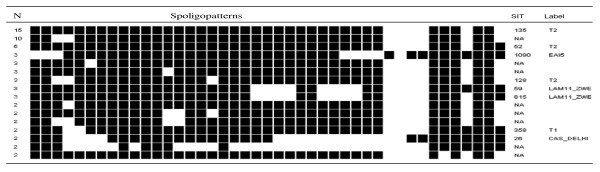
A total of 125 isolates from 167 TB suspects (60% males) with a mean age 33.7 years and HIV prevalence of 67.9% (55/81) were analyzed. Majority (92.8%) were new cases while only 7.2% were retreatment cases. All the 125 isolates were identified as M. tuberculosis strict sense with the majority (92.8%) of the isolates being modern strains while seven (7.2%) isolates were ancestral strains. Spoligotyping revealed 79 spoligotype patterns, with an overall diversity of 63.2%. Sixty two (49.6%) of the isolates formed 16 clusters consisting of 2-15 isolates each. A majority (59.2%) of the isolates belong to the Uganda genotype group of strains. The major shared spoligotypes in our sample were SIT 135 (T2-Uganda) with 15 isolates and SIT 128 (T2) with 3 isolates. Sixty nine (87%) of the 79 patterns had not yet been defined in the SpolDB4.0.database. Resistance mutations to either RIF or INH were detected in 6.4% of the isolates. Multidrug resistance, INH and RIF resistance was 1.6%, 3.2% and 4.8%, respectively. The rpoβ gene mutations seen in the sample were D516V, S531L, H526Y H526D and D516V, while one strain had a Δ1 mutation in the wild type probes. There were three strains with katG (codon 315) gene mutations only while one strain showed the inhA promoter gene mutation.
The present study shows that the TB epidemic in Mbarara is caused by modern M. tuberculosis strains mainly belonging to the Uganda genotype and anti-TB drug resistance rate in the region is low.
结核分枝杆菌菌株的流行率和药敏性的确定对结核病控制非常重要。我们确定了来自乌干达西南部姆巴拉拉的结核患者的分枝杆菌的遗传多样性和药敏谱。
我们连续纳入所有新诊断和既往治疗过的痰涂片阳性肺结核患者(年龄≥18 岁)。使用差异区(RD)分析和 spoligotyping 对分离株进行特征描述。使用 Genotype® MDRTBplus 检测和间接比例法在 Lowenstein-Jensen 培养基上检测利福平和顺铂的耐药性。使用两种快速 HIV 检测进行 HIV-1 检测。
共分析了来自 167 名可疑结核病患者(60%为男性)的 125 株分离株(平均年龄 33.7 岁,HIV 流行率为 67.9%(55/81))。大多数(92.8%)为新发病例,只有 7.2%为复治病例。所有 125 株分离株均被鉴定为结核分枝杆菌严格型,其中大多数(92.8%)为现代菌株,7 株(7.2%)为祖先菌株。 spoligotyping 显示了 79 种 spoligotype 模式,总体多样性为 63.2%。62 株(49.6%)分离株形成了 16 个包含 2-15 株分离株的簇。大多数(59.2%)分离株属于乌干达基因型菌株组。我们样本中的主要共享 spoligotypes 是 SIT 135(T2-Uganda),有 15 株,SIT 128(T2),有 3 株。79 个模式中的 69 个(87%)尚未在 SpolDB4.0.数据库中定义。在 6.4%的分离株中检测到利福平或异烟肼耐药性的突变。耐多药、异烟肼和利福平耐药率分别为 1.6%、3.2%和 4.8%。样本中观察到的 rpoβ基因突变是 D516V、S531L、H526Y H526D 和 D516V,而一株在野生型探针中具有 Δ1 突变。有三株仅具有 katG(密码子 315)基因突变,一株显示 inhA 启动子基因突变。
本研究表明,姆巴拉拉的结核病流行是由现代结核分枝杆菌菌株引起的,主要属于乌干达基因型,该地区的抗结核药物耐药率较低。