Department of Public Health and Infectious Diseases, Sapienza - University of Rome, Ple Aldo Moro 5, 00185 Rome, Italy.
BMC Infect Dis. 2011 Mar 31;11:82. doi: 10.1186/1471-2334-11-82.
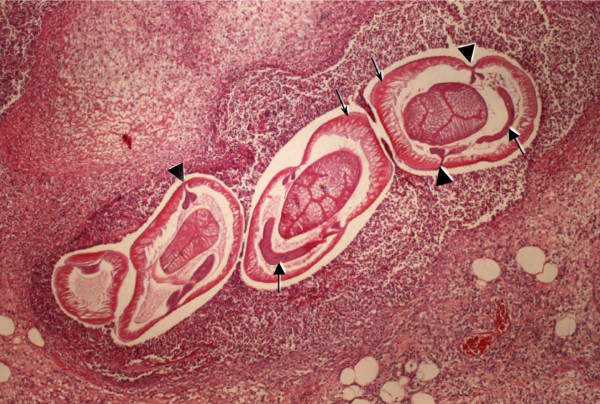
Anisakiasis is an important fish-borne zoonosis provoked by larval stages of nematodes belonging to the genus Anisakis. The detection and identification of human infections is difficult. This is due to: a) the low specificity of the clinical features and symptomatology related to human infections; b) the paucity of diagnostic features of larvae found in granulomatous lesions characteristic of "invasive anisakiasis"; and c) the lack morphological characters diagnostic at the specific level when larvae of Anisakis are detected. Thus, molecular-based diagnostic approaches are warranted.
We have developed a PCR method that amplifies the DNA of Anisakis spp. in fixed paraffin-embedded tissues. This method was applied to a granuloma removed from a human case of intestinal anisakiasis in Italy. Specific primers of the mtDNA cox2 gene were used and sequence analysis was performed according to the procedures already established for species of Anisakis.
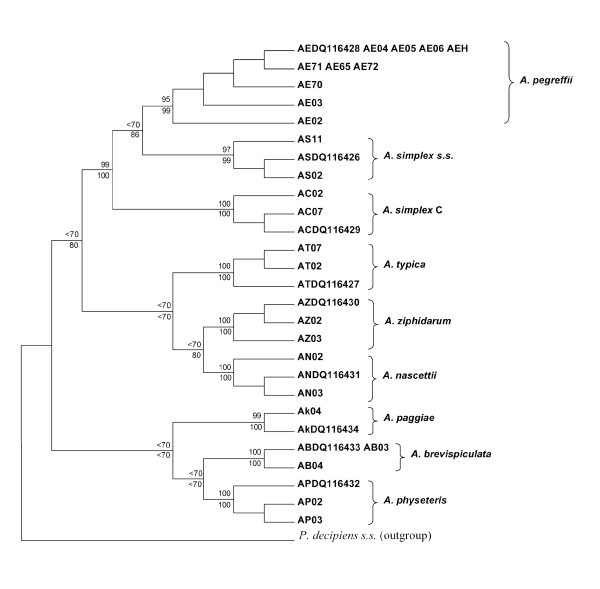
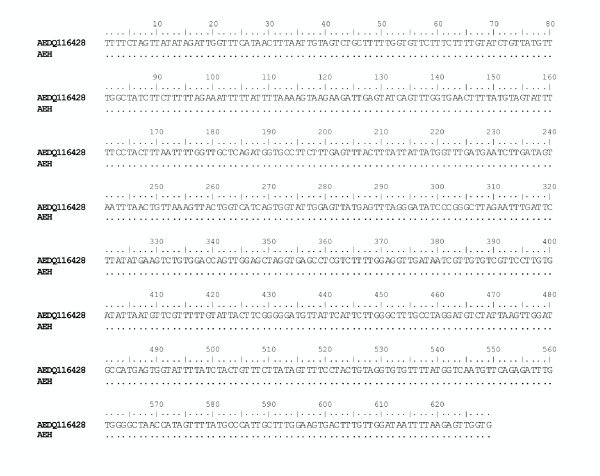
The sequence obtained (629 bp) was compared with those of the other species of Anisakis which have so far been genetically characterized and with sequences obtained from larval stages of Anisakis collected from the Mediterranean fish Engraulis encrasicolus. This enabled the genetic identification of the larva in the human tissue as A. pegreffii. This is the first instance of human intestinal anisakiasis diagnosed using PCR of DNA purified from a fixed eosinophilic granuloma embedded in paraffin.
The case of human anisakiasis presented reinforces the pathological significance of the species A. pegreffii to humans. The molecular/genetic methodological approach based on mtDNA cox2 sequence analysis, described here, can allow easy and rapid identification of Anisakis spp. in formalin-fixed and paraffin embedded tissues removed from cases of either gastric or intestinal human anisakiasis.
异尖线虫病是一种重要的鱼类源性人畜共患病,由属于异尖线虫属的幼虫引起。人类感染的检测和鉴定很困难。这是由于:a)与人类感染相关的临床特征和症状特异性低;b)在具有“侵袭性异尖线虫病”特征的肉芽肿性病变中发现幼虫的诊断特征很少;c)当检测到异尖线虫幼虫时,缺乏具有特定水平诊断特征的形态学特征。因此,有必要采用基于分子的诊断方法。
我们开发了一种可扩增固定石蜡包埋组织中异尖线虫属 DNA 的 PCR 方法。该方法应用于从意大利一例肠异尖线虫病患者的肉芽肿中切除的组织。使用 mtDNA cox2 基因的特异性引物,并根据已建立的用于鉴定异尖线虫属物种的程序进行序列分析。
获得的序列(629bp)与迄今为止已遗传鉴定的其他异尖线虫属物种的序列以及从地中海鱼类海鲷中收集的异尖线虫幼虫的序列进行了比较。这使得从石蜡包埋的嗜酸性粒细胞肉芽肿中提取的 DNA 纯化的 PCR 能够对人类组织中的幼虫进行基因鉴定,鉴定为 A. pegreffii。这是首例使用从固定嗜酸性粒细胞肉芽肿中提取的 DNA 进行 PCR 诊断的人类肠异尖线虫病。
本人类异尖线虫病病例增强了 A. pegreffii 对人类的病理学意义。本文所述基于 mtDNA cox2 序列分析的分子/遗传方法学方法可在从胃或肠人类异尖线虫病病例中切除的福尔马林固定和石蜡包埋组织中轻松快速地鉴定异尖线虫属。