Department of Infectious Disease, Tongji Hospital, Tongji Medical College, Huazhong University of Science and Technology, Wuhan 430030, China.
Virol J. 2011 Apr 1;8:152. doi: 10.1186/1743-422X-8-152.
Epidemiological investigations, detections and vaccines of hepatitis E (HE) have been paid a focus of attention in prior studies, while studies on clinical features and risk factors with a large number of sporadic HE patients are scarce.
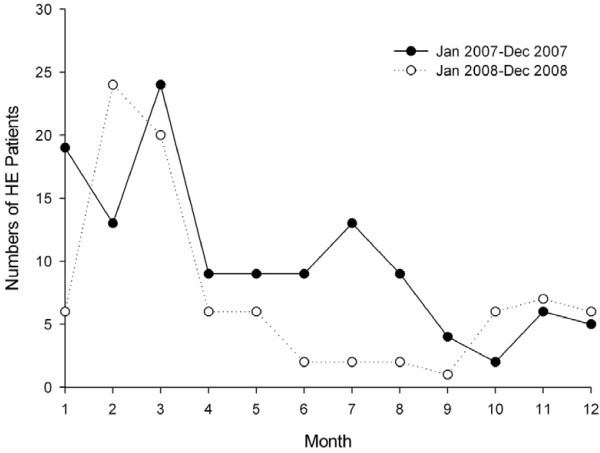
Sporadic HE can occur throughout the year, with the highest incidence rate in the first quarter of a year, in central of China. Of the 210 patients, 85.2% were male, and the most common clinical symptoms were jaundice (85.7%), fatigue (70.5%) and anorexia (64.8%). Total bilirubin (TBil), blood urea nitrogen (BUN), and international normalized ratio (INR) were found as major risk factors for death of HE patients. There was an overall mortality of 10%, and the mortality in the cirrhotic and non-cirrhotic group was 25% and 6.47%, respectively. Moreover, hepatitis E virus (HEV) infected patients with liver cirrhosis had a higher mortality and incidence of complications.
TBil, BUN, and INR are major risk factors of mortality for HE. Liver cirrhosis can aggravate HE, and lead to a higher mortality. HEV infection can cause decompensation in patients with cirrhosis, as evidenced by a worsening Child-Pugh score.
在以往的研究中,戊型肝炎(HE)的流行病学调查、检测和疫苗一直受到关注,而关于大量散发性 HE 患者的临床特征和危险因素的研究则很少。
散发性 HE 可全年发生,在中国中部地区,第一季度发病率最高。210 例患者中,85.2%为男性,最常见的临床症状是黄疸(85.7%)、疲劳(70.5%)和食欲不振(64.8%)。总胆红素(TBil)、血尿素氮(BUN)和国际标准化比值(INR)是 HE 患者死亡的主要危险因素。HE 患者的总死亡率为 10%,肝硬化组和非肝硬化组的死亡率分别为 25%和 6.47%。此外,HEV 感染的肝硬化患者死亡率和并发症发生率更高。
TBil、BUN 和 INR 是 HE 患者死亡的主要危险因素。肝硬化可加重 HE,并导致更高的死亡率。HEV 感染可导致肝硬化患者失代偿,表现为 Child-Pugh 评分恶化。