Department of Radiology and Research Institute of Radiology, Asan Medical Center, University of Ulsan College of Medicine, Seoul, Korea.
Allergy Asthma Immunol Res. 2011 Apr;3(2):111-7. doi: 10.4168/aair.2011.3.2.111. Epub 2010 Dec 1.
Airway remodeling may be responsible for irreversible airway obstruction in asthma, and a low post-bronchodilator FEV1/FVC ratio can be used as a noninvasive marker of airway remodeling. We investigated correlations between airway wall indices on computed tomography (CT) and various clinical indices, including post-bronchodilator FEV1/FVC ratio, in patients with asthma.
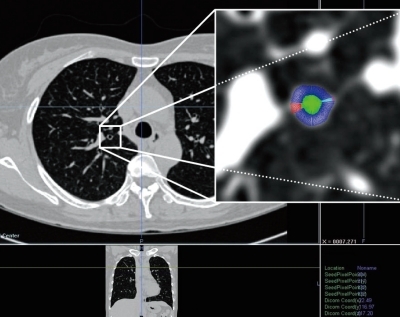
Volumetric CT was performed on 22 stable asthma patients who were taking inhaled corticosteroids. Airway dimensions were measured at four segmental bronchi using in-house software based on the full-width/half-maximum method. Parameters included luminal area, wall thickness (WT), wall thickness percentage (WT%), wall area percentage (WA%), bronchial-to-arterial diameter (BA) ratio on inspiration CT, airway collapsibility (AC), and air trapping index (ATI). Correlations were analyzed between CT parameters and clinical indices, including %FEV1, FEV1/FVC, FEF(25-75%), and post-bronchodilator FEV1/FVC ratio.
Post-bronchodilator FEV1/FVC showed significant correlations with WT%, WT, BA ratio, AC, and ATI (r=-0.503, -0.576, 0.454, 0.475, and -0.610, respectively). WT showed negative correlations with FEV1/FVC and FEF(25-75%) (r=-0.431 and -0.581), and WT% was negatively correlated with %FEV1, FEV1/FVC, and FEF(25-75%) (r=-0.434, -0.431, and -0.540, respectively). WA% showed correlations with FEF(25-75%) and body mass index (r=-0.459 and 0.453). The BA ratio was positively correlated with %FEV1 (r=0.459) and FEF(25-75%) (r=0.479). AC showed strong positive correlation with FEV1/FVC (r=0.592), and ATI showed negative correlations with FEV1/FVC (r=-0.534) and FEF(25-75%) (r=-0.591).
WT%, WT, BA ratio, and AC on inspiration and expiration CT are good indices for measuring airway remodeling defined by post-bronchodilator FEV1/FVC in stable asthma patients treated with inhaled corticosteroids.
气道重塑可能是哮喘不可逆气道阻塞的原因,而支气管扩张剂后 FEV1/FVC 比值降低可作为气道重塑的无创标志物。我们研究了哮喘患者 CT 气道壁指数与各种临床指标(包括支气管扩张剂后 FEV1/FVC 比值)之间的相关性。
对 22 例稳定期接受吸入性皮质激素治疗的哮喘患者进行容积 CT 检查。使用基于全宽/半最大值方法的内部软件在四个节段性支气管测量气道尺寸。参数包括管腔面积、壁厚度(WT)、壁厚度百分比(WT%)、壁面积百分比(WA%)、吸气 CT 时支气管-动脉直径(BA)比、气道 collapsibility(AC)和空气滞留指数(ATI)。分析 CT 参数与临床指标(包括 %FEV1、FEV1/FVC、FEF(25-75%)和支气管扩张剂后 FEV1/FVC 比值)之间的相关性。
支气管扩张剂后 FEV1/FVC 与 WT%、WT、BA 比、AC 和 ATI 呈显著负相关(r=-0.503、-0.576、0.454、0.475 和-0.610)。WT 与 FEV1/FVC 和 FEF(25-75%)呈负相关(r=-0.431 和-0.581),WT%与 %FEV1、FEV1/FVC 和 FEF(25-75%)呈负相关(r=-0.434、-0.431 和-0.540)。WA%与 FEF(25-75%)和体重指数(r=-0.459 和 0.453)呈负相关。BA 比与 %FEV1(r=0.459)和 FEF(25-75%)(r=0.479)呈正相关。AC 与 FEV1/FVC 呈强正相关(r=0.592),ATI 与 FEV1/FVC(r=-0.534)和 FEF(25-75%)(r=-0.591)呈负相关。
在接受吸入性皮质激素治疗的稳定期哮喘患者中,支气管扩张剂后 FEV1/FVC 定义的气道重塑与吸气和呼气 CT 上的 WT%、WT、BA 比和 AC 是良好的测量指标。