Department of Solid Mechanics, School of Engineering Sciences, The Royal Institute of Technology (KTH), Stockholm, Sweden.
J R Soc Interface. 2011 Oct 7;8(63):1449-61. doi: 10.1098/rsif.2011.0041. Epub 2011 Apr 6.
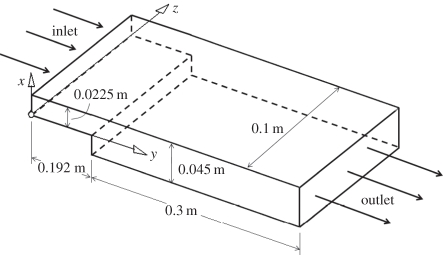
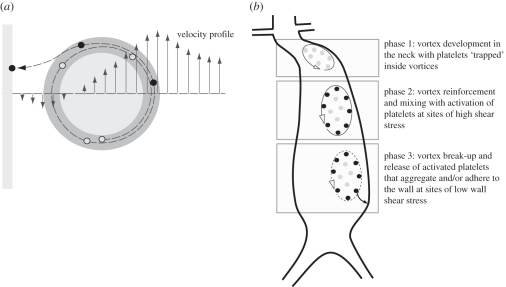
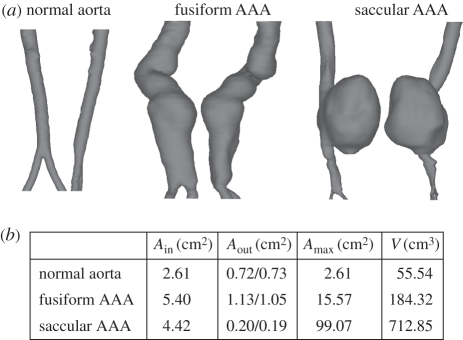
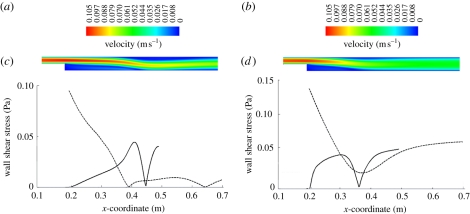
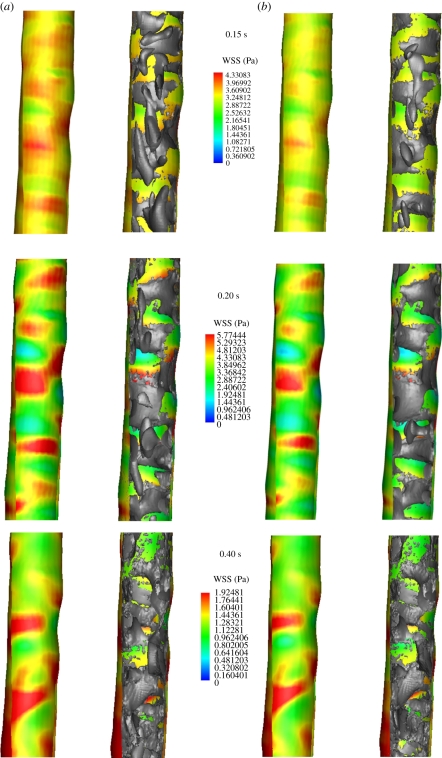
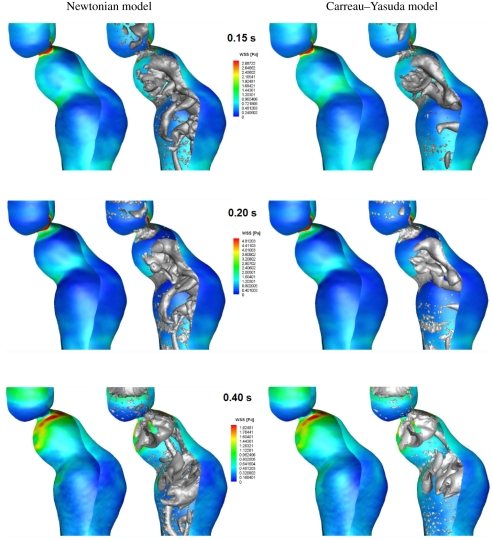
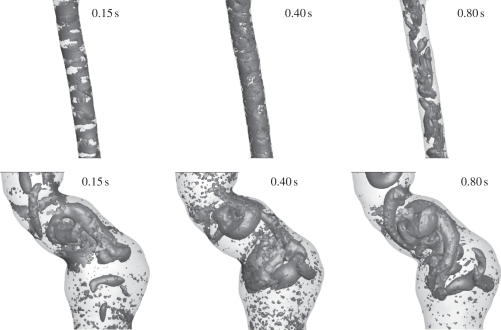
Abdominal aortic aneurysms (AAAs) are frequently characterized by the development of an intra-luminal thrombus (ILT), which is known to have multiple biochemical and biomechanical implications. Development of the ILT is not well understood, and shear-stress-triggered activation of platelets could be the first step in its evolution. Vortical structures (VSs) in the flow affect platelet dynamics, which motivated the present study of a possible correlation between VS and ILT formation in AAAs. VSs educed by the λ(2)-method using computational fluid dynamics simulations of the backward-facing step problem, normal aorta, fusiform AAA and saccular AAA were investigated. Patient-specific luminal geometries were reconstructed from computed tomography scans, and Newtonian and Carreau-Yasuda models were used to capture salient rheological features of blood flow. Particularly in complex flow domains, results depended on the constitutive model. VSs developed all along the normal aorta, showing that a clear correlation between VSs and high wall shear stress (WSS) existed, and that VSs started to break up during late systole. In contrast, in the fusiform AAA, large VSs developed at sites of tortuous geometry and high WSS, occupying the entire lumen, and lasting over the entire cardiac cycle. Downward motion of VSs in the AAA was in the range of a few centimetres per cardiac cycle, and with a VS burst at that location, the release (from VSs) of shear-stress-activated platelets and their deposition to the wall was within the lower part of the diseased artery, i.e. where the thickest ILT layer is typically observed. In the saccular AAA, only one VS was found near the healthy portion of the aorta, while in the aneurysmatic bulge, no VSs occurred. We present a fluid-dynamics-motivated mechanism for platelet activation, convection and deposition in AAAs that has the potential of improving our current understanding of the pathophysiology of fluid-driven ILT growth.
腹主动脉瘤(AAA)常表现为腔内血栓(ILT)的形成,已知其具有多种生化和生物力学意义。ILT 的形成机制尚不清楚,血小板剪切应力触发激活可能是其演变的第一步。流动中的旋涡结构(VS)会影响血小板动力学,这促使我们研究 AAA 中 VS 与 ILT 形成之间可能存在的相关性。使用计算流体动力学模拟后向台阶问题的 λ(2)方法,研究了反向阶跃问题、正常主动脉、梭形 AAA 和囊状 AAA 中的 VS。从计算机断层扫描重建了患者特定的管腔几何形状,并使用牛顿和 Carreau-Yasuda 模型来捕捉血流的显著流变特征。特别是在复杂的流动区域,结果取决于本构模型。在正常主动脉中,VS 沿着整个管腔发展,表明 VS 与高壁剪切应力(WSS)之间存在明确的相关性,并且 VS 在收缩晚期开始破裂。相比之下,在梭形 AAA 中,大的 VS 在弯曲几何形状和高 WSS 的部位发展,占据整个管腔,并持续整个心动周期。AAA 中 VS 的向下运动范围在每心动周期几厘米,在该位置的 VS 爆发时,剪切应力激活的血小板从 VS 释放并沉积到管壁,位于病变动脉的下部,即通常观察到最厚 ILT 层的位置。在囊状 AAA 中,仅在主动脉的健康部分附近发现一个 VS,而在动脉瘤膨出部位,则没有 VS。我们提出了一种基于流体动力学的血小板激活、对流和沉积机制,这有可能提高我们对流体驱动 ILT 生长的病理生理学的现有认识。