Chen Fabian, Lam Raymond, Shaywitz David, Hendrickson Ronald C, Opiteck Gregory J, Wishengrad Dana, Liaw Andy, Song Qinghua, Stewart Adrian J, Cummings Corinne E, Beals Chan, Yarasheski Kevin E, Reicin Alise, Ruddy Marcella, Hu Xuguang, Yates Nathan A, Menetski Joseph, Herman Gary A
J Cachexia Sarcopenia Muscle. 2011 Mar;2(1):45-56. doi: 10.1007/s13539-011-0021-y. Epub 2011 Feb 26.
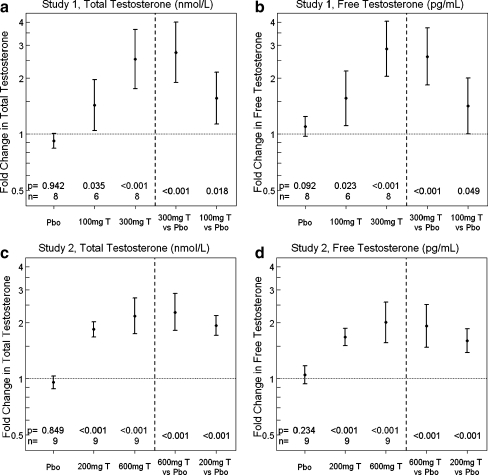
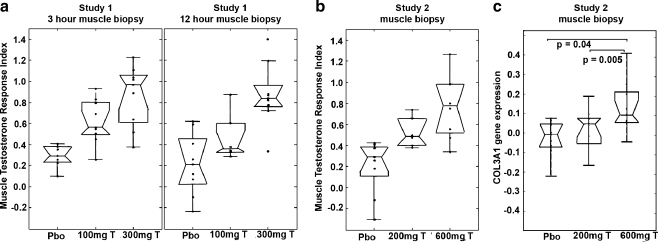
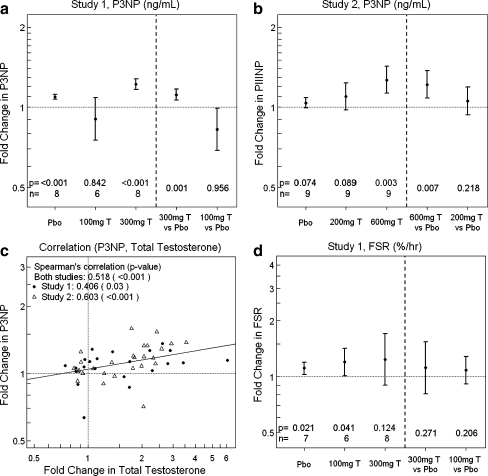
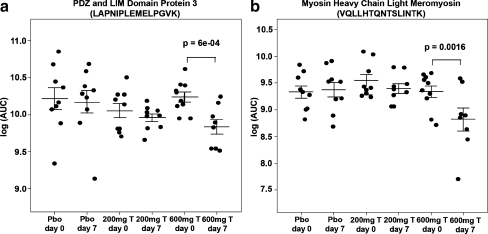
Early biomarkers of skeletal muscle anabolism will facilitate the development of therapies for sarcopenia and frailty. METHODS AND RESULTS: We examined plasma type III collagen N-terminal propeptide (P3NP), skeletal muscle protein fractional synthesis rate, and gene and protein expression profiles to identify testosterone-induced changes in muscle anabolism. Two placebo-controlled studies enrolled community-dwelling men (study 1, 60-75 years; study 2, 18-40 years) with low to normal testosterone levels. Men were randomized to lower dose (study 1, 100 mg; study 2, 200 mg) or higher dose (study 1, 300 mg; study 2, 600 mg) single intramuscular testosterone or saline injection. After 1 week, testosterone acutely increased plasma P3NP levels in a dose-dependent manner and altered the expression of several skeletal muscle transcripts and proteins. Though not statistically significant, mixed muscle protein fractional synthesis rate tended to increase (1.08-fold with 100 mg testosterone, 1.12-fold with 300 mg testosterone). Testosterone exposure also increased skeletal muscle expression of the collagen type III gene that encodes P3NP. CONCLUSION: P3NP is a potentially useful early biomarker for muscle anabolic therapy. Skeletal muscle protein and RNA profiling are useful tools for the discovery of novel muscle anabolic biomarkers.
骨骼肌合成代谢的早期生物标志物将有助于开发治疗肌肉减少症和虚弱症的疗法。
我们检测了血浆III型胶原N端前肽(P3NP)、骨骼肌蛋白分数合成率以及基因和蛋白质表达谱,以确定睾酮诱导的肌肉合成代谢变化。两项安慰剂对照研究纳入了睾酮水平低至正常的社区居住男性(研究1,60 - 75岁;研究2,18 - 40岁)。男性被随机分为低剂量(研究1,100 mg;研究2,200 mg)或高剂量(研究1,300 mg;研究2,600 mg)单次肌内注射睾酮或生理盐水。1周后,睾酮以剂量依赖的方式急性增加血浆P3NP水平,并改变了几种骨骼肌转录本和蛋白质的表达。尽管无统计学意义,但混合肌肉蛋白分数合成率有增加趋势(100 mg睾酮时为1.08倍,300 mg睾酮时为1.12倍)。睾酮暴露还增加了编码P3NP的III型胶原基因在骨骼肌中的表达。
P3NP是肌肉合成代谢治疗的一种潜在有用的早期生物标志物。骨骼肌蛋白质和RNA分析是发现新型肌肉合成代谢生物标志物的有用工具。