Souza Juli T, Minicucci Marcos F, Ferreira Natália C, Polegato Bertha F, Okoshi Marina P, Modolo Gabriel P, Leal-Pereira Filipe W, Phillips Bethan E, Atherton Philip J, Smith Kenneth, Wilkinson Daniel J, Gordon Adam L, Tanni Suzana E, Costa Vladimir E, Fernandes Maria F, Bazan Silméia G, Zornoff Leonardo M, Paiva Sérgio R, Bazan Rodrigo, Azevedo Paula S
Department of Internal Medicine, Medical School, São Paulo State University (UNESP), Botucatu 18618-970, SP, Brazil.
Department of Neuroscience and Mental Health, Medical School, São Paulo State University (UNESP), Botucatu 18618-970, SP, Brazil.
Nutrients. 2024 Nov 29;16(23):4148. doi: 10.3390/nu16234148.
BACKGROUND/OBJECTIVES: The acute phase of stroke is marked by inflammation and mobility changes that can compromise nutritional status. This study was a randomized, double-blind, placebo-controlled trial evaluating the effectiveness of creatine supplementation for older people during seven days of hospitalization for stroke compared to usual care.
The primary outcome measures were changes in functional capacity, strength, muscle mass, and muscle degradation. The secondary outcomes were changes in serum biomarkers related to inflammation, fibrosis, anabolism, and muscle synthesis. In addition, a follow-up 90 days after the stroke verified functional capacity, strength, quality of life, and mortality. Following admission for an acute stroke, participants received either creatine (10 g) or a visually identical placebo (10 g) orally twice daily. Both groups received supplementation with protein to achieve the goal of 1.5 g of protein/kg of body weight/day and underwent daily mobility training during seven days of hospitalization.
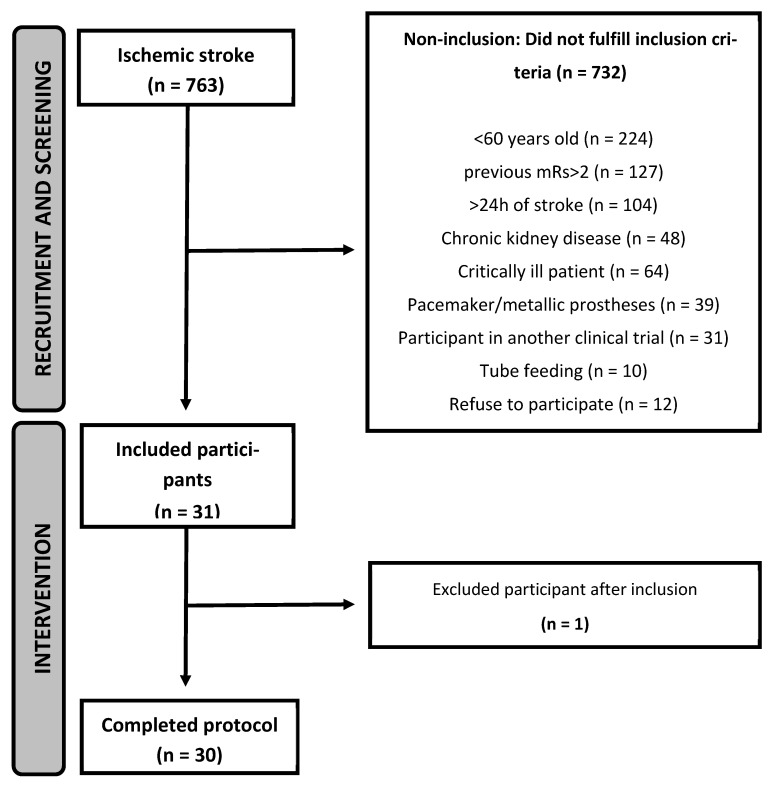
Thirty older people were included in two similar groups concerning baseline attributes (15-treatment/15-placebo).
Creatine supplementation did not influence functional capacity, strength, or muscle mass during the first 7 days or outcomes 90 days after stroke. There were no serious adverse events associated with creatine supplementation. However, it decreased progranulin levels, raising a new possibility of creatine action. This finding needs further exploration to understand the biological significance of creatine-progranulin interaction.
背景/目的:中风急性期的特点是炎症反应和活动能力改变,这可能会影响营养状况。本研究是一项随机、双盲、安慰剂对照试验,旨在评估与常规护理相比,中风住院7天期间补充肌酸对老年人的有效性。
主要结局指标为功能能力、力量、肌肉质量和肌肉降解的变化。次要结局为与炎症、纤维化、合成代谢和肌肉合成相关的血清生物标志物的变化。此外,中风后90天的随访核实了功能能力、力量、生活质量和死亡率。急性中风入院后,参与者每天口服两次肌酸(10克)或外观相同的安慰剂(10克)。两组均补充蛋白质,以达到每天每公斤体重1.5克蛋白质的目标,并在住院7天期间接受每日活动训练。
30名老年人被纳入两个基线特征相似的组(15例治疗组/15例安慰剂组)。
补充肌酸在中风后的前7天或90天结局中,对功能能力、力量或肌肉质量没有影响。补充肌酸没有严重不良事件。然而,它降低了颗粒前体蛋白水平,这为肌酸的作用带来了新的可能性。这一发现需要进一步探索,以了解肌酸-颗粒前体蛋白相互作用的生物学意义。