Division of Mental Health and Addiction, Institute of Clinical Medicine, University of Oslo, Oslo, Norway.
Soc Psychiatry Psychiatr Epidemiol. 2012 Apr;47(4):589-95. doi: 10.1007/s00127-011-0359-7. Epub 2011 Apr 8.
Most internally displaced persons (IDPs) live in low-income countries and have experienced war. Few studies have assessed their psychosocial needs and disability. We carried out a comprehensive assessment of perceived needs, self-reported health, and disability among IDPs in Nepal and examined factors associated with disability.
A cross-sectional survey among 290 IDPs in Nepal was conducted between June and July 2003. We used the World Health Organization's Disability Assessment Schedule-II (WHO-DAS II) with additional local items to assess disability symptoms and a separate checklist to identify their perceived needs. Depression and anxiety symptoms were measured using the Hopkins Symptom Check List (HSCL-25), while the Posttraumatic Stress Disorder Checklist Civilian Version (PCL-C) was used to assess Posttraumatic Stress Disorder (PTSD) symptoms.
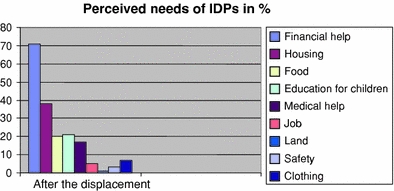
Different perceived needs such as financial help (70%), housing (40%), food and education for their children (20%) were expressed by the IDPs. Self-reported health status was strongly associated with distress and disability scores. Factors independently associated with disability were higher age, self-reported health, depression, anxiety but not PTSD. There was good correlation between WHO-DAS II and the locally identified items of disability measurement.
The reporting of findings only about psychiatric symptoms is insufficient in studying the mental health of displaced and potentially traumatized populations living in low-income countries. Assessments of perceived needs and factors associated with disability give a more comprehensive understanding of the underlying needs among crisis populations, and this can inform intervention programs. Depression and anxiety should be treated effectively to avoid disability.
大多数国内流离失所者(IDPs)生活在低收入国家,经历过战争。很少有研究评估他们的心理社会需求和残疾情况。我们对尼泊尔的 IDPs 进行了全面的需求评估、自我报告的健康状况和残疾评估,并研究了与残疾相关的因素。
2003 年 6 月至 7 月,在尼泊尔对 290 名 IDPs 进行了横断面调查。我们使用世界卫生组织残疾评估表-II(WHO-DAS II)和额外的本地项目来评估残疾症状,并使用单独的清单来识别他们的感知需求。使用 Hopkins 症状检查表(HSCL-25)评估抑郁和焦虑症状,使用平民版创伤后应激障碍检查表(PCL-C)评估创伤后应激障碍(PTSD)症状。
IDPs 表达了不同的需求,例如经济援助(70%)、住房(40%)、儿童的食物和教育(20%)。自我报告的健康状况与痛苦和残疾评分密切相关。与残疾相关的独立因素是年龄较大、自我报告的健康状况、抑郁、焦虑,但不是 PTSD。WHO-DAS II 与当地确定的残疾测量项目之间存在良好的相关性。
在研究生活在低收入国家的流离失所和潜在受创伤人群的心理健康时,仅报告精神症状的发现是不够的。评估感知需求和与残疾相关的因素可以更全面地了解危机人群的基本需求,并为干预计划提供信息。应有效治疗抑郁和焦虑,以避免残疾。