Kohrt Brandon A, Jordans Mark J D, Turner Elizabeth L, Sikkema Kathleen J, Luitel Nagendra P, Rai Sauharda, Singla Daisy R, Lamichhane Jagannath, Lund Crick, Patel Vikram
1Duke Global Health Institute, Duke University, Durham, USA.
Transcultural Psychosocial Organization Nepal, Baluwatar, Nepal.
Pilot Feasibility Stud. 2018 Jan 24;4:36. doi: 10.1186/s40814-018-0234-3. eCollection 2018.
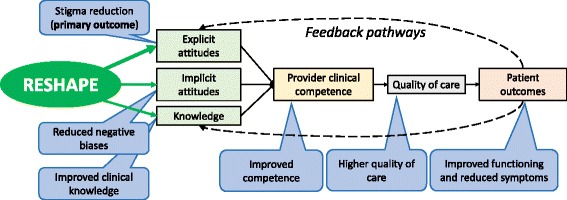
Non-specialist healthcare providers, including primary and community healthcare workers, in low- and middle-income countries can effectively treat mental illness. However, scaling-up mental health services within existing health systems has been limited by barriers such as stigma against people with mental illness. Therefore, interventions are needed to address attitudes and behaviors among non-specialists. Aimed at addressing this gap, ducing tigma among ealthcre roviders to Improv mental health services (RESHAPE) is an intervention in which social contact with mental health service users is added to training for non-specialist healthcare workers integrating mental health services into primary healthcare.
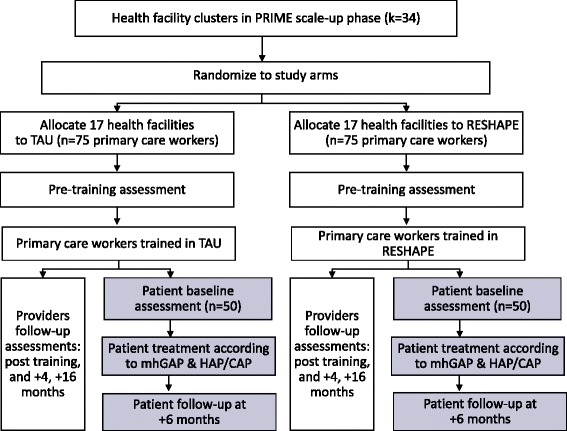
This protocol describes a mixed methods pilot and feasibility study in primary care centers in Chitwan, Nepal. The qualitative component will include key informant interviews and focus group discussions. The quantitative component consists of a pilot cluster randomized controlled trial (c-RCT), which will establish parameters for a future effectiveness study of RESHAPE compared to training as usual (TAU). Primary healthcare facilities (the cluster unit, = 34) will be randomized to TAU or RESHAPE. The direct beneficiaries of the intervention are the primary healthcare workers in the facilities ( = 150); indirect beneficiaries are their patients ( = 100). The TAU condition is existing mental health training and supervision for primary healthcare workers delivered through the Programme for Improving Mental healthcarE (PRIME) implementing the mental health Gap Action Programme (mhGAP). The primary objective is to evaluate acceptability and feasibility through qualitative interviews with primary healthcare workers, trainers, and mental health service users. The secondary objective is to collect quantitative information on health worker outcomes including mental health stigma (Social Distance Scale), clinical knowledge (mhGAP), clinical competency (ENhancing Assessment of Common Therapeutic factors, ENACT), and implicit attitudes (Implicit Association Test, IAT), and patient outcomes including stigma-related barriers to care, daily functioning, and symptoms.
The pilot and feasibility study will contribute to refining recommendations for implementation of mhGAP and other mental health services in primary healthcare settings in low-resource health systems. The pilot c-RCT findings will inform an effectiveness trial of RESHAPE to advance the evidence-base for optimal approaches to training and supervision for non-specialist providers.
ClinicalTrials.gov identifier, NCT02793271.
在低收入和中等收入国家,包括初级和社区医护人员在内的非专科医疗服务提供者能够有效治疗精神疾病。然而,在现有卫生系统内扩大精神卫生服务受到诸如对精神疾病患者的污名化等障碍的限制。因此,需要采取干预措施来解决非专科人员的态度和行为问题。为解决这一差距,减少卫生保健提供者的污名以改善精神卫生服务(RESHAPE)是一项干预措施,即在为将精神卫生服务纳入初级卫生保健的非专科医护人员提供的培训中增加与精神卫生服务使用者的社会接触。
本方案描述了在尼泊尔奇旺的初级保健中心进行的一项混合方法试点和可行性研究。定性部分将包括关键信息访谈和焦点小组讨论。定量部分包括一项试点整群随机对照试验(c-RCT),该试验将确定与常规培训(TAU)相比,RESHAPE未来有效性研究的参数。初级卫生保健设施(整群单位,n = 34)将被随机分配到TAU或RESHAPE组。干预措施的直接受益对象是这些设施中的初级卫生保健工作者(n = 150);间接受益对象是他们的患者(n = 100)。TAU组是通过实施精神卫生差距行动计划(mhGAP)的改善精神卫生保健计划(PRIME)为初级卫生保健工作者提供的现有精神卫生培训和监督。主要目标是通过对初级卫生保健工作者、培训人员和精神卫生服务使用者进行定性访谈来评估可接受性和可行性。次要目标是收集关于卫生工作者结果的定量信息,包括精神卫生污名(社会距离量表)、临床知识(mhGAP)、临床能力(增强常见治疗因素评估,ENACT)和内隐态度(内隐联想测验,IAT),以及患者结果,包括与污名相关的护理障碍、日常功能和症状。
该试点和可行性研究将有助于完善在资源匮乏的卫生系统中初级卫生保健环境中实施mhGAP和其他精神卫生服务的建议。试点c-RCT的结果将为RESHAPE的有效性试验提供信息,以推进非专科提供者培训和监督最佳方法的证据基础。
ClinicalTrials.gov标识符,NCT02793271。