Department of Bioengineering, Stanford University, California 94305, USA.
Nat Nanotechnol. 2011 May;6(5):314-20. doi: 10.1038/nnano.2011.45. Epub 2011 Apr 10.
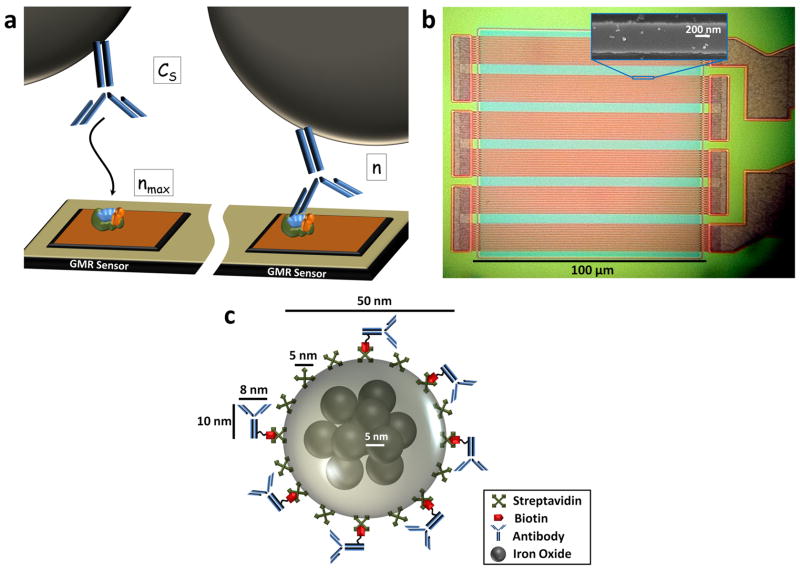
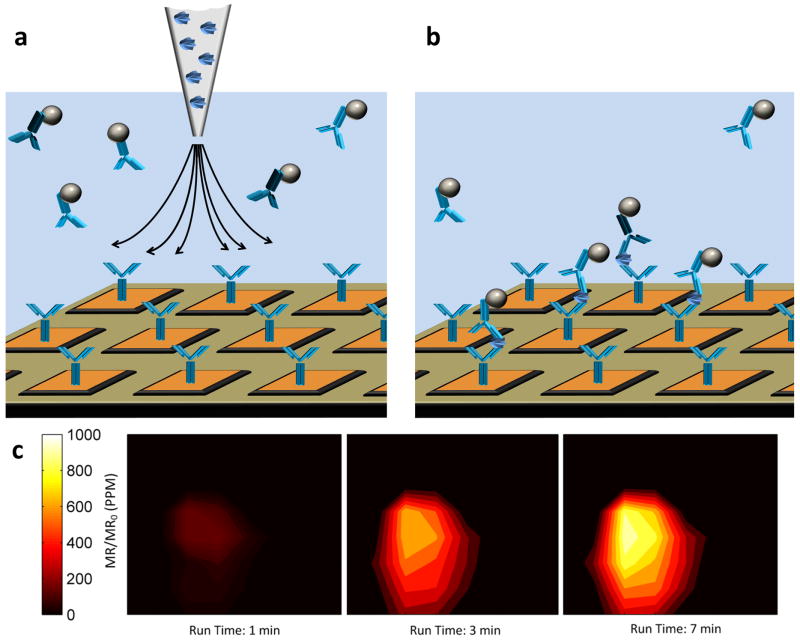
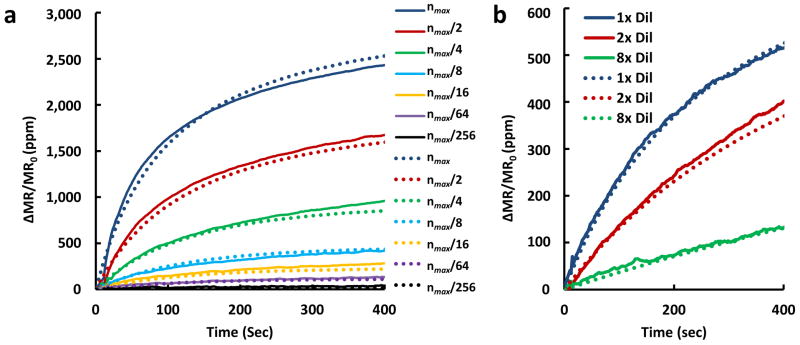
Monitoring the kinetics of protein interactions on a high-density sensor array is vital to drug development and proteomic analysis. Label-free kinetic assays based on surface plasmon resonance are the current gold standard, but they have poor detection limits, suffer from non-specific binding, and are not amenable to high-throughput analyses. Here, we show that magnetically responsive nanosensors that have been scaled to over 100,000 sensors per cm² can be used to measure the binding kinetics of various proteins with high spatial and temporal resolution. We present an analytical model that describes the binding of magnetically labelled antibodies to proteins that are immobilized on the sensor surface. This model is able to quantify the kinetics of antibody-antigen binding at sensitivities as low as 20 zeptomoles of solute.
监测高密度传感器阵列上蛋白质相互作用的动力学对于药物开发和蛋白质组学分析至关重要。基于表面等离子体共振的无标记动力学分析是目前的金标准,但它们的检测限较差,容易受到非特异性结合的影响,并且不适合高通量分析。在这里,我们展示了可以使用经过扩展的超过 100,000 个传感器/平方厘米的磁性响应纳米传感器来测量各种蛋白质的结合动力学,具有高空间和时间分辨率。我们提出了一个分析模型,描述了固定在传感器表面的磁性标记抗体与蛋白质的结合。该模型能够以低至 20 飞摩尔的溶质的灵敏度定量抗体-抗原结合的动力学。