Bruker Daltonik GmbH, Fahrenheitstr. 4, 28359, Bremen, Germany.
Anal Bioanal Chem. 2011 Jul;401(1):167-81. doi: 10.1007/s00216-011-4929-z. Epub 2011 Apr 12.
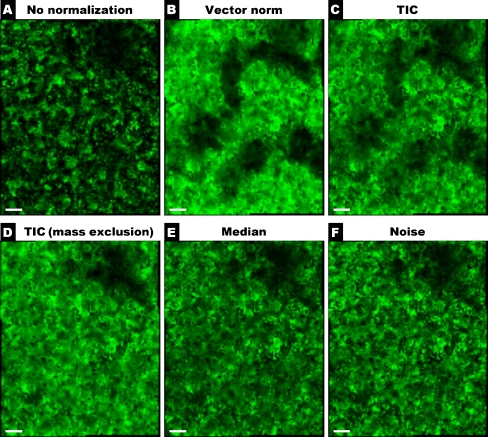
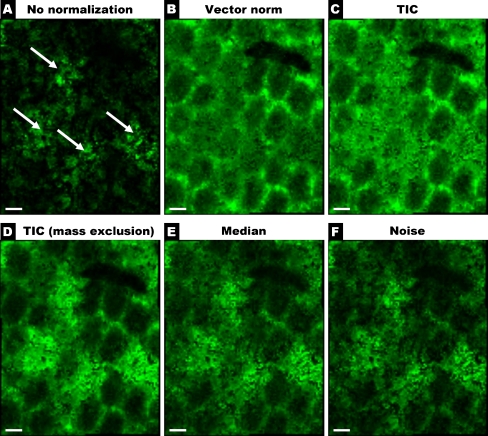
Normalization is critically important for the proper interpretation of matrix-assisted laser desorption/ionization (MALDI) imaging datasets. The effects of the commonly used normalization techniques based on total ion count (TIC) or vector norm normalization are significant, and they are frequently beneficial. In certain cases, however, these normalization algorithms may produce misleading results and possibly lead to wrong conclusions, e.g. regarding to potential biomarker distributions. This is typical for tissues in which signals of prominent abundance are present in confined areas, such as insulin in the pancreas or β-amyloid peptides in the brain. In this work, we investigated whether normalization can be improved if dominant signals are excluded from the calculation. Because manual interaction with the data (e.g., defining the abundant signals) is not desired for routine analysis, we investigated two alternatives: normalization on the spectra noise level or on the median of signal intensities in the spectrum. Normalization on the median and the noise level was found to be significantly more robust against artifact generation compared to normalization on the TIC. Therefore, we propose to include these normalization methods in the standard "toolbox" of MALDI imaging for reliable results under conditions of automation.
归一化对于正确解释基质辅助激光解吸/电离(MALDI)成像数据集至关重要。基于总离子计数(TIC)或向量范数归一化的常用归一化技术的影响是显著的,而且通常是有益的。然而,在某些情况下,这些归一化算法可能会产生误导性的结果,并可能导致错误的结论,例如关于潜在生物标志物分布的结论。这种情况在信号丰度高的信号局限于特定区域的组织中很常见,例如胰腺中的胰岛素或大脑中的β-淀粉样肽。在这项工作中,我们研究了如果从计算中排除主要信号,归一化是否可以得到改善。由于不希望对常规分析进行手动与数据交互(例如,定义丰富的信号),我们研究了两种替代方法:在谱噪声水平上或在谱中信号强度的中位数上进行归一化。与基于 TIC 的归一化相比,基于中位数和噪声水平的归一化在生成伪影方面表现出显著的稳健性。因此,我们建议将这些归一化方法纳入 MALDI 成像的标准“工具箱”中,以便在自动化条件下获得可靠的结果。