Center for Qualitative Research, New England Research Institutes, Watertown, Massachusetts 02472, USA.
Qual Health Res. 2011 Sep;21(9):1229-38. doi: 10.1177/1049732311405682. Epub 2011 Apr 11.
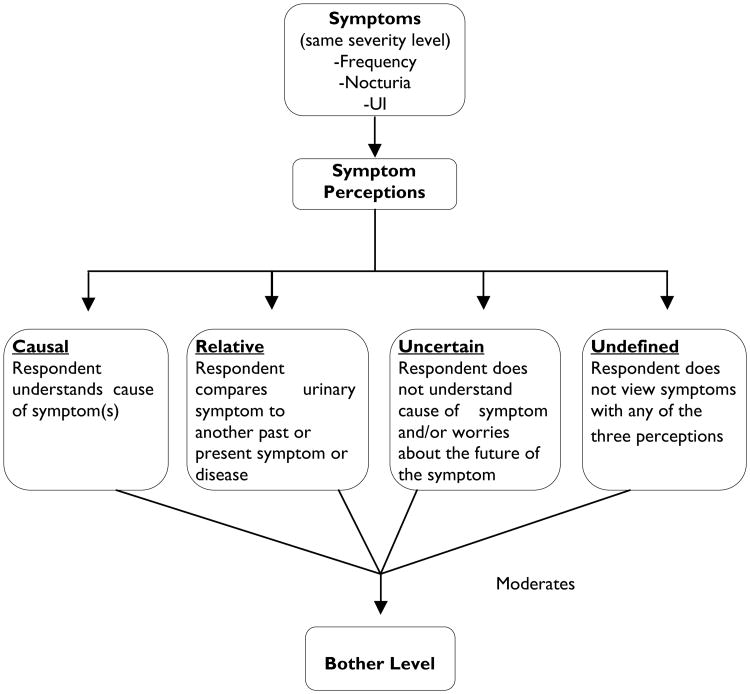
We compared reports of symptom bother for the same urinary symptoms to understand why symptom severity and bother do not correspond in a straightforward manner. We used a grounded theory approach to analyze qualitative data from 123 individual interviews and developed a conceptual framework, identifying three symptom perceptions that might moderate symptom bother: causal, relative, and uncertainty. Symptom bother was lower for respondents who viewed symptoms causally (symptoms seemed explainable or "normal") or relatively (urinary symptoms were compared to other symptoms or conditions). Bother tended to be higher for respondents who viewed symptoms with uncertainty (when symptom etiology and course were unknown). A greater portion of respondents in the causal perception group had not sought health care for their symptoms. This conceptual framework is useful for understanding the relationship between reactions to and health care seeking for other symptoms.
我们比较了相同的尿路症状的报告,以了解为什么症状的严重程度和困扰没有直接对应。我们使用扎根理论方法分析了 123 次个人访谈的定性数据,并制定了一个概念框架,确定了可能调节症状困扰的三个症状感知:因果关系、相对关系和不确定性。那些认为症状具有因果关系(症状似乎可以解释或“正常”)或相对关系(与其他症状或状况相比)的受访者,其症状困扰程度较低。对于那些认为症状不确定的受访者(当症状的病因和病程未知时),困扰程度往往较高。在因果感知组中,有更大比例的受访者没有因症状寻求医疗护理。这个概念框架有助于理解对其他症状的反应和寻求医疗护理之间的关系。