Agarwal Arnav, Eryuzlu Leyla N, Cartwright Rufus, Thorlund Kristian, Tammela Teuvo L J, Guyatt Gordon H, Auvinen Anssi, Tikkinen Kari A O
Department of Clinical Epidemiology and Biostatistics, McMaster University, Hamilton, ON, Canada; Faculty of Health Sciences, McMaster University, Hamilton, Ontario, Canada.
Department of Epidemiology and Biostatistics, Imperial College London, London, UK; Department of Urogynaecology, St. Mary's Hospital, London, UK.
Eur Urol. 2014 Jun;65(6):1211-7. doi: 10.1016/j.eururo.2014.01.019. Epub 2014 Jan 24.
No study has compared the bothersomeness of all lower urinary tract symptoms (LUTS) using a population-based sample of adults. Despite this lack of evidence, investigators have often cited their LUTS of interest as the "most bothersome" or "one of the most bothersome."
To compare the population- and individual-level burden of LUTS in men and women.
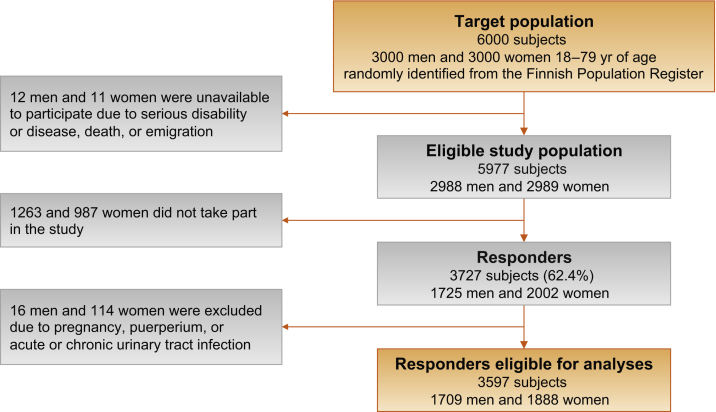
DESIGN, SETTING, AND PARTICIPANTS: In this population-based cross-sectional study, questionnaires were mailed to 6000 individuals (18-79 yr of age) randomly identified from the Finnish Population Register.
The validated Danish Prostatic Symptom Score questionnaire was used for assessment of bother of 12 different LUTS. The age-standardized prevalence of at least moderate bother was calculated for each symptom (population-level burden). Among symptomatic individuals, the proportion of affected individuals with at least moderate bother was calculated for each symptom (individual-level bother).
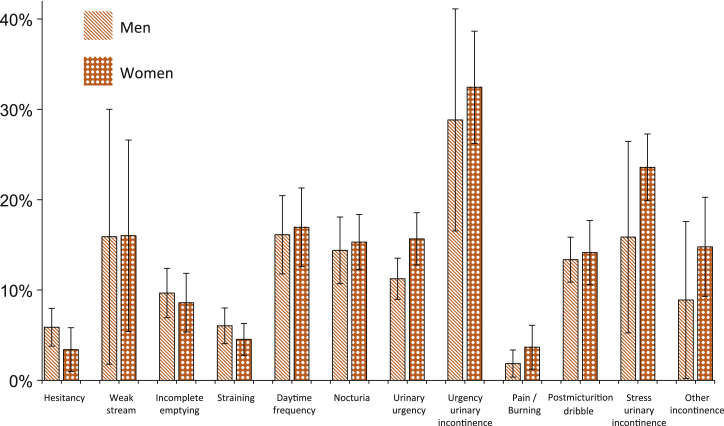
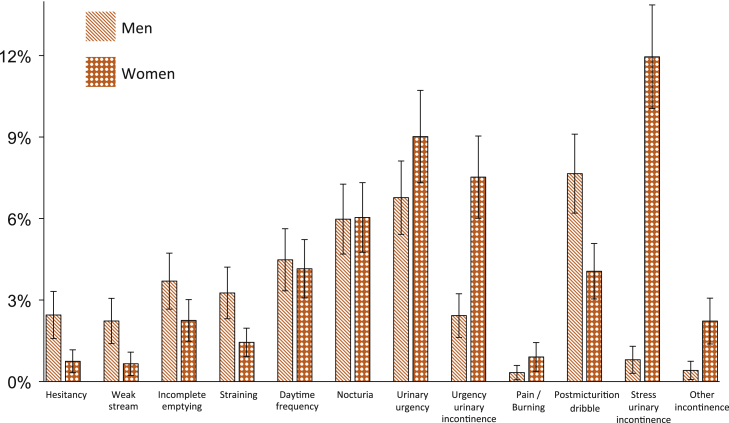
A total of 3727 individuals (62.4%) participated (53.7% female). The LUTS with the greatest population-level burden were urgency (7.9% with at least moderate bother), stress urinary incontinence (SUI) (6.5%), nocturia (6.0%), postmicturition dribble (5.8%), and urgency urinary incontinence (UUI) (5.0%). Burden from incontinence symptoms was higher in women than men, and the opposite was true for voiding and postmicturition symptoms. At the individual level, UUI was the most bothersome for both genders. Although the response proportion was high, approximately a third did not participate.
Both men and women with UUI report moderate or major bother more frequently than individuals with other LUTS. At the population level, the most prevalent bothersome symptoms are urgency, SUI, and nocturia.
Urinary urgency was the most common troubling symptom in a large population-based study; however, for individuals, urgency incontinence was the most likely to be rated as bothersome.
尚无研究使用基于人群的成年样本比较所有下尿路症状(LUTS)的困扰程度。尽管缺乏这方面的证据,但研究人员经常将他们感兴趣的LUTS称为“最困扰的”或“最困扰的之一”。
比较男性和女性LUTS在人群和个体层面的负担。
设计、地点和参与者:在这项基于人群的横断面研究中,问卷被邮寄给从芬兰人口登记册中随机抽取的6000名个体(18 - 79岁)。
使用经过验证的丹麦前列腺症状评分问卷来评估12种不同LUTS的困扰程度。计算每种症状至少中度困扰的年龄标准化患病率(人群层面负担)。在有症状的个体中,计算每种症状至少中度困扰的受影响个体比例(个体层面困扰)。
共有3727名个体(62.4%)参与(53.7%为女性)。人群层面负担最大的LUTS是尿急(7.9%至少中度困扰)、压力性尿失禁(SUI)(6.5%)、夜尿症(6.0%)、排尿后滴沥(5.8%)和急迫性尿失禁(UUI)(5.0%)。失禁症状的负担女性高于男性,而排尿和排尿后症状则相反。在个体层面,UUI对两性来说都是最困扰的。尽管回复比例较高,但仍有大约三分之一的人未参与。
与其他LUTS患者相比,患有UUI的男性和女性报告中度或重度困扰的频率更高。在人群层面,最普遍的困扰症状是尿急、SUI和夜尿症。
在一项大型基于人群的研究中,尿急是最常见的困扰症状;然而,对于个体而言,急迫性尿失禁最有可能被评为困扰。