Departament de Bioquimica i Biologia Molecular, Facultat de Biologia, Universitat de Barcelona, and IBUB, Barcelona, Spain.
PLoS Comput Biol. 2011 Mar;7(3):e1001115. doi: 10.1371/journal.pcbi.1001115. Epub 2011 Mar 31.
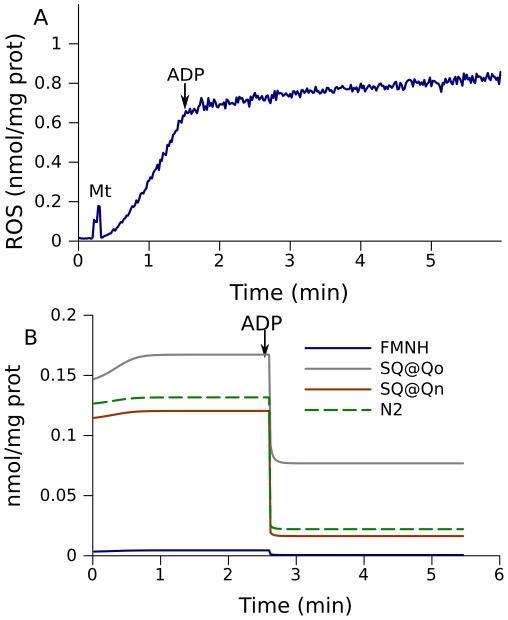
Reactive oxygen species (ROS) produced in the mitochondrial respiratory chain (RC) are primary signals that modulate cellular adaptation to environment, and are also destructive factors that damage cells under the conditions of hypoxia/reoxygenation relevant for various systemic diseases or transplantation. The important role of ROS in cell survival requires detailed investigation of mechanism and determinants of ROS production. To perform such an investigation we extended our rule-based model of complex III in order to account for electron transport in the whole RC coupled to proton translocation, transmembrane electrochemical potential generation, TCA cycle reactions, and substrate transport to mitochondria. It fits respiratory electron fluxes measured in rat brain mitochondria fueled by succinate or pyruvate and malate, and the dynamics of NAD(+) reduction by reverse electron transport from succinate through complex I. The fitting of measured characteristics gave an insight into the mechanism of underlying processes governing the formation of free radicals that can transfer an unpaired electron to oxygen-producing superoxide and thus can initiate the generation of ROS. Our analysis revealed an association of ROS production with levels of specific radicals of individual electron transporters and their combinations in species of complexes I and III. It was found that the phenomenon of bistability, revealed previously as a property of complex III, remains valid for the whole RC. The conditions for switching to a state with a high content of free radicals in complex III were predicted based on theoretical analysis and were confirmed experimentally. These findings provide a new insight into the mechanisms of ROS production in RC.
活性氧 (ROS) 是在线粒体呼吸链 (RC) 中产生的主要信号,可调节细胞对环境的适应,也是在与各种系统性疾病或移植相关的缺氧/再氧合条件下破坏细胞的有害因素。ROS 在细胞存活中的重要作用需要详细研究 ROS 产生的机制和决定因素。为了进行这样的调查,我们扩展了我们的基于规则的复合物 III 模型,以考虑与质子转运、跨膜电化学势生成、TCA 循环反应以及底物向线粒体转运相耦合的整个 RC 中的电子传递。它拟合了由琥珀酸或丙酮酸和苹果酸供能的大鼠脑线粒体的呼吸电子通量,以及通过复合物 I 从琥珀酸进行反向电子传递还原 NAD(+) 的动力学。拟合测量特性使我们深入了解了控制自由基形成的潜在过程的机制,自由基可以将不成对的电子转移到产生超氧化物的氧气中,从而可以引发 ROS 的产生。我们的分析揭示了 ROS 产生与个体电子转运体及其在复合物 I 和 III 物种中的组合的特定自由基水平之间的关联。发现先前被揭示为复合物 III 特性的双稳定性现象仍然适用于整个 RC。基于理论分析预测了复合物 III 中自由基含量高的状态切换条件,并通过实验得到了证实。这些发现为 RC 中 ROS 产生的机制提供了新的见解。