Poison Control and Drug Information Center (PCDIC). An-Najah National University, Nablus, Palestine.
Libyan J Med. 2009 Mar 1;4(1):37-40. doi: 10.4176/080920.
Stroke is a major health problem, yet no studies on stroke have been reported from Palestine. This one-year, hospital-based study was conducted to determine the prevalence of risk factors and the in-hospital mortality rate in patients with ischemic stroke.
All patients admitted to Al-Watani government hospital and diagnosed with ischemic stroke between September 2006 and August 2007 were included in the study. Data were obtained by retrospective review of medical charts. Pearson Chi-square and independent t test were used in the univariate analysis. Multiple logistic regression analysis was used to determine the independent predictors of in-hospital mortality rates among the patients. Statistical testing and graphics were carried out using SPSS 15.
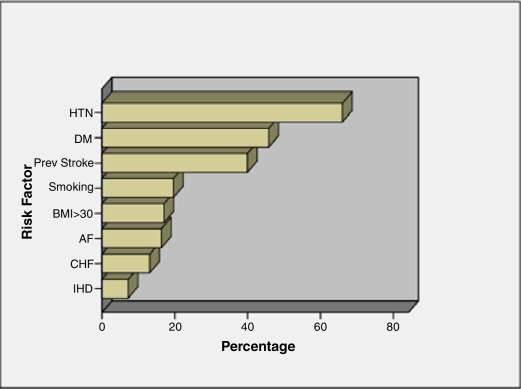
We identified 153 ischemic stroke patients (83 females and 70 males) of whom 92 were having a first-ever stroke (FES). Patients had several prevalent modifiable risk factors such as hypertension (HTN) (66%), diabetes mellitus (DM) (45.8%), and renal reduced renal function (crcl < 60 ml/ min) (33.9%). Twenty-six (17%) of the patients died during hospitalization. Four variables were significantly associated with in-hospital mortality: history of previous stroke (P= 0.004), crcl at admission (P = 0.004), number of post-stroke complications (P = 0.001), and age (P = 0.043). Multiple logistic regression analysis indicated that the number of post-stroke complications (P= 0.001) and previous stroke (P = 0.03) were significant independent predictors of in-hospital mortality.
Screening and better control of risk factors, especially HTN, DM and renal dysfunction, are required to decrease the incidence and in-hospital mortality among patients with ischemic stroke.
卒中是一个主要的健康问题,但目前尚无来自巴勒斯坦的卒中研究报告。本为期一年的以医院为基础的研究旨在确定缺血性卒中患者的危险因素流行率和院内死亡率。
所有于 2006 年 9 月至 2007 年 8 月期间因缺血性卒中入住 Al-Watani 政府医院的患者均被纳入本研究。通过回顾病历获取数据。单变量分析采用 Pearson Chi-square 和独立 t 检验。多变量逻辑回归分析用于确定患者院内死亡率的独立预测因素。统计测试和图形使用 SPSS 15 进行。
我们共识别出 153 例缺血性卒中患者(83 名女性和 70 名男性),其中 92 例为首次卒中(FES)。患者存在多种常见的可改变的危险因素,如高血压(HTN)(66%)、糖尿病(DM)(45.8%)和肾功能减退(crcl < 60 ml/min)(33.9%)。26(17%)例患者在住院期间死亡。4 个变量与院内死亡率显著相关:既往卒中史(P=0.004)、入院时 crcl(P=0.004)、卒中后并发症数(P=0.001)和年龄(P=0.043)。多变量逻辑回归分析表明,卒中后并发症数(P=0.001)和既往卒中史(P=0.03)是院内死亡率的显著独立预测因素。
需要筛查和更好地控制危险因素,尤其是 HTN、DM 和肾功能不全,以降低缺血性卒中患者的发病率和院内死亡率。