Department of Microbiology, Immunology, and Molecular Genetics, University of California Los Angeles, Los Angeles, California, United States of America.
PLoS One. 2011 Apr 5;6(4):e18270. doi: 10.1371/journal.pone.0018270.
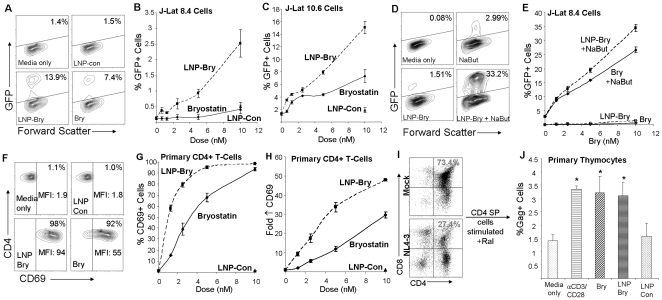
Antiretroviral therapy is currently only capable of controlling HIV replication rather than completely eradicating virus from patients. This is due in part to the establishment of a latent virus reservoir in resting CD4+ T cells, which persists even in the presence of HAART. It is thought that forced activation of latently infected cells could induce virus production, allowing targeting of the cell by the immune response. A variety of molecules are able to stimulate HIV from latency. However no tested purging strategy has proven capable of eliminating the infection completely or preventing viral rebound if therapy is stopped. Hence novel latency activation approaches are required. Nanoparticles can offer several advantages over more traditional drug delivery methods, including improved drug solubility, stability, and the ability to simultaneously target multiple different molecules to particular cell or tissue types. Here we describe the development of a novel lipid nanoparticle with the protein kinase C activator bryostatin-2 incorporated (LNP-Bry). These particles can target and activate primary human CD4+ T-cells and stimulate latent virus production from human T-cell lines in vitro and from latently infected cells in a humanized mouse model ex vivo. This activation was synergistically enhanced by the HDAC inhibitor sodium butyrate. Furthermore, LNP-Bry can also be loaded with the protease inhibitor nelfinavir (LNP-Bry-Nel), producing a particle capable of both activating latent virus and inhibiting viral spread. Taken together these data demonstrate the ability of nanotechnological approaches to provide improved methods for activating latent HIV and provide key proof-of-principle experiments showing how novel delivery systems may enhance future HIV therapy.
抗逆转录病毒疗法目前只能控制 HIV 的复制,而不能将病毒从患者体内完全清除。这部分是由于潜伏病毒储库在静止 CD4+T 细胞中的建立,即使在 HAART 存在的情况下,这种储库也会持续存在。人们认为,潜伏感染细胞的强制激活可能会诱导病毒产生,从而使免疫反应能够靶向细胞。有多种分子能够刺激潜伏的 HIV 病毒。然而,没有经过测试的清除策略被证明能够完全消除感染或防止病毒反弹,如果治疗停止的话。因此,需要新的潜伏激活方法。与更传统的药物输送方法相比,纳米颗粒具有几个优势,包括提高药物溶解度、稳定性以及同时靶向多种不同分子到特定细胞或组织类型的能力。在这里,我们描述了一种新型脂质纳米颗粒的开发,该颗粒包含蛋白激酶 C 激活剂 bryostatin-2(LNP-Bry)。这些颗粒可以靶向并激活原代人 CD4+T 细胞,并在体外刺激人 T 细胞系和人源化小鼠模型中的潜伏感染细胞产生潜伏病毒。这种激活作用通过组蛋白去乙酰化酶抑制剂丁酸钠协同增强。此外,LNP-Bry 还可以装载蛋白酶抑制剂奈非那韦(LNP-Bry-Nel),产生一种既能激活潜伏病毒又能抑制病毒扩散的颗粒。总之,这些数据表明,纳米技术方法能够提供改进的激活潜伏 HIV 的方法,并提供关键的原理验证实验,展示新型递送系统如何增强未来的 HIV 治疗。