The George Washington Cancer Center, The George Washington University, Washington, DC, United States.
Department of Medicine, The George Washington University, Washington, DC, United States.
Front Immunol. 2020 Apr 28;11:789. doi: 10.3389/fimmu.2020.00789. eCollection 2020.
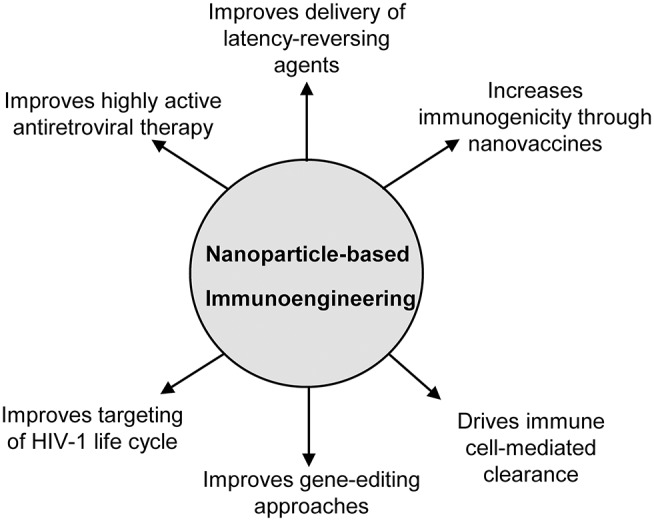
Highly active antiretroviral therapy (HAART) serves as an effective strategy to combat HIV infections by suppressing viral replication in patients with HIV/AIDS. However, HAART does not provide HIV/AIDS patients with a sterilizing or functional cure, and introduces several deleterious comorbidities. Moreover, the virus is able to persist within latent reservoirs, both undetected by the immune system and unaffected by HAART, increasing the risk of a viral rebound. The field of immunoengineering, which utilizes varied bioengineering approaches to interact with the immune system and potentiate its therapeutic effects against HIV, is being increasingly investigated in HIV cure research. In particular, nanoparticle-based immunoengineered approaches are especially attractive because they offer advantages including the improved delivery and functionality of classical HIV drugs such as antiretrovirals and experimental drugs such as latency-reversing agents (LRAs), among others. Here, we present and discuss the current state of the field in nanoparticle-based immunoengineering approaches for an HIV cure. Specifically, we discuss nanoparticle-based methods for improving HAART as well as latency reversal, developing vaccines, targeting viral fusion, enhancing gene editing approaches, improving adoptively transferred immune-cell mediated reservoir clearance, and other therapeutic and prevention approaches. Although nanoparticle-based immunoengineered approaches are currently at the stage of preclinical testing, the promising findings obtained in these studies demonstrate the potential of this emerging field for developing an HIV cure.
高效抗逆转录病毒疗法(HAART)通过抑制 HIV/AIDS 患者体内的病毒复制,是一种对抗 HIV 感染的有效策略。然而,HAART 并不能为 HIV/AIDS 患者提供根治或功能性治愈,反而会引发多种有害的合并症。此外,病毒能够潜伏在隐匿储库中,既不受免疫系统检测,也不受 HAART 影响,从而增加病毒反弹的风险。免疫工程学领域利用各种生物工程方法与免疫系统相互作用,并增强其对 HIV 的治疗效果,目前正在 HIV 治愈研究中得到越来越多的关注。特别是,基于纳米颗粒的免疫工程方法特别有吸引力,因为它们具有诸多优势,例如提高了经典 HIV 药物(如抗逆转录病毒药物)和实验药物(如潜伏期逆转剂(LRAs))的递送和功能。在这里,我们介绍并讨论了目前基于纳米颗粒的免疫工程方法在 HIV 治愈方面的研究现状。具体而言,我们讨论了基于纳米颗粒的方法,包括改善 HAART 和潜伏期逆转、开发疫苗、靶向病毒融合、增强基因编辑方法、改善过继转移免疫细胞介导的储库清除,以及其他治疗和预防方法。尽管基于纳米颗粒的免疫工程方法目前处于临床前测试阶段,但这些研究中获得的有前景的发现表明,该新兴领域有潜力开发出 HIV 治愈方法。