Department of Microbiology and Cell Biology, Indian Institute of Science, Bangalore, Karnataka, India.
PLoS One. 2011 Mar 31;6(3):e17438. doi: 10.1371/journal.pone.0017438.
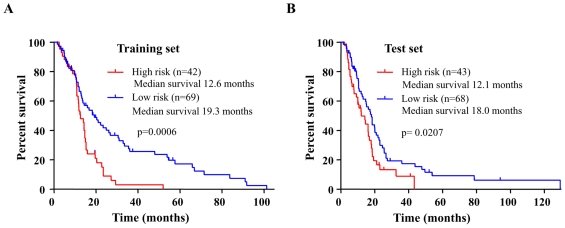
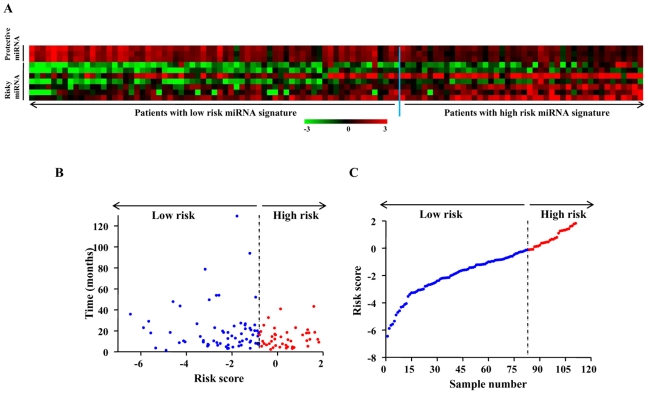
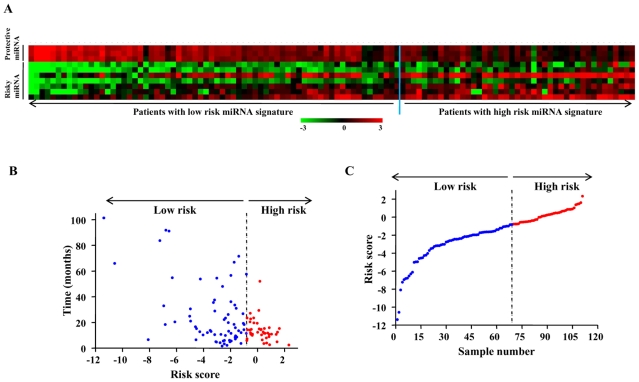
Glioblastoma (GBM) is the most common and aggressive primary brain tumor with very poor patient median survival. To identify a microRNA (miRNA) expression signature that can predict GBM patient survival, we analyzed the miRNA expression data of GBM patients (n=222) derived from The Cancer Genome Atlas (TCGA) dataset. We divided the patients randomly into training and testing sets with equal number in each group. We identified 10 significant miRNAs using Cox regression analysis on the training set and formulated a risk score based on the expression signature of these miRNAs that segregated the patients into high and low risk groups with significantly different survival times (hazard ratio [HR]=2.4; 95% CI=1.4-3.8; p<0.0001). Of these 10 miRNAs, 7 were found to be risky miRNAs and 3 were found to be protective. This signature was independently validated in the testing set (HR=1.7; 95% CI=1.1-2.8; p=0.002). GBM patients with high risk scores had overall poor survival compared to the patients with low risk scores. Overall survival among the entire patient set was 35.0% at 2 years, 21.5% at 3 years, 18.5% at 4 years and 11.8% at 5 years in the low risk group, versus 11.0%, 5.5%, 0.0 and 0.0% respectively in the high risk group (HR=2.0; 95% CI=1.4-2.8; p<0.0001). Cox multivariate analysis with patient age as a covariate on the entire patient set identified risk score based on the 10 miRNA expression signature to be an independent predictor of patient survival (HR=1.120; 95% CI=1.04-1.20; p=0.003). Thus we have identified a miRNA expression signature that can predict GBM patient survival. These findings may have implications in the understanding of gliomagenesis, development of targeted therapy and selection of high risk cancer patients for adjuvant therapy.
胶质母细胞瘤(GBM)是最常见和侵袭性最强的原发性脑肿瘤,患者的中位生存期非常差。为了确定能够预测 GBM 患者生存的微小 RNA(miRNA)表达特征,我们分析了来自癌症基因组图谱(TCGA)数据集的 GBM 患者(n=222)的 miRNA 表达数据。我们将患者随机分为训练集和测试集,每组的数量相等。我们使用 Cox 回归分析在训练集上识别了 10 个显著的 miRNA,并基于这些 miRNA 的表达特征制定了一个风险评分,该评分将患者分为高风险和低风险组,两组的生存时间有显著差异(风险比[HR]=2.4;95%置信区间[CI]=1.4-3.8;p<0.0001)。这 10 个 miRNA 中,有 7 个被认为是风险 miRNA,有 3 个被认为是保护性 miRNA。该特征在测试集中得到了独立验证(HR=1.7;95%CI=1.1-2.8;p=0.002)。与低风险组相比,高风险组的 GBM 患者总体预后较差。在整个患者组中,低风险组的 2 年总生存率为 35.0%,3 年生存率为 21.5%,4 年生存率为 18.5%,5 年生存率为 11.8%,而高风险组的 2 年生存率为 11.0%,3 年生存率为 5.5%,4 年生存率为 0.0%,5 年生存率为 0.0%(HR=2.0;95%CI=1.4-2.8;p<0.0001)。在整个患者组中,使用患者年龄作为协变量的 Cox 多变量分析确定基于 10 个 miRNA 表达特征的风险评分是患者生存的独立预测因子(HR=1.120;95%CI=1.04-1.20;p=0.003)。因此,我们已经确定了一种能够预测 GBM 患者生存的 miRNA 表达特征。这些发现可能对理解神经胶质瘤的发生、靶向治疗的发展以及选择高危癌症患者进行辅助治疗具有重要意义。