Department of Respiratory Diseases, Union Hospital, Tongji Medical College, Huazhong University of Science and Technology, 1277 Jiefang Avenue, 430022 Wuhan, People's Republic of China.
Qual Life Res. 2011 Dec;20(10):1721-6. doi: 10.1007/s11136-011-9898-3. Epub 2011 Apr 12.
The well-known excessive daytime sleepiness (EDS) assessment, Epworth Sleepiness Scale (ESS), is not consistently qualified for patients with diverse living habits. This study is aimed to build a modified ESS (mESS) and then to verify its feasibility in the assessment of EDS for patients with suspected sleep-disordered breathing (SDB) in central China.
A Ten-item Sleepiness Questionnaire (10-ISQ) was built by adding two backup items to the original ESS. Then the 10-ISQ was administered to 122 patients in central China with suspected SDB [among them, 119 cases met the minimal diagnostic criteria for obstructive sleep apnea by sleep study, e.g., apnea and hypopnea index (AHI) ≥ 5 h(-1)] and 117 healthy central Chinese volunteers without SDB. Multivariate exploratory techniques were used for item validation. The unreliable item in the original ESS was replaced by the eligible backup item, thus a modified ESS (mESS) was built, and then verified.
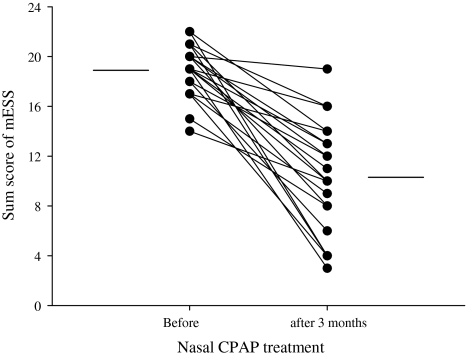
Item 8 proved to be the only unreliable item in central Chinese patients, with the least factor loading on the main factor and the lowest item-total correlation both in the 10-ISQ and in the original ESS, deletion of it would increase the Cronbach's alpha (from 0.86 to 0.87 in the 10-ISQ; from 0.83 to 0.85 in the original ESS). The mESS was subsequently built by replacing item 8 in the original ESS with item 10 in the 10-ISQ. Verification with patients' responses revealed that the mESS was a single-factor questionnaire with good internal consistency (Cronbach's alpha = 0.86). The sum score of the mESS not only correlated with AHI (P < 0.01) but was also able to discriminate the severity of obstructive apnea (P < 0.01). Nasal CPAP treatment for severe OSA reduced the score significantly (P < 0.001). The performance of the mESS was poor in evaluating normal subjects.
The mESS improves the validity of ESS for our patients. Therefore, it is justified to use it instead of the original one in assessment of EDS for patients with SDB in central China.
众所周知的日间过度嗜睡(EDS)评估量表,即 Epworth 嗜睡量表(ESS),对于生活习惯不同的患者并不总是适用。本研究旨在建立改良 ESS(mESS),然后验证其在中国中部地区疑似睡眠呼吸障碍(SDB)患者中评估 EDS 的可行性。
通过在原始 ESS 中添加两个备用项目,构建了一个十项睡眠问卷(10-ISQ)。然后,对 122 名中国中部地区疑似 SDB 的患者[其中 119 例通过睡眠研究符合阻塞性睡眠呼吸暂停的最低诊断标准,例如呼吸暂停低通气指数(AHI)≥5 小时(-1)]和 117 名无 SDB 的健康中国中部地区志愿者进行了 10-ISQ 测试。使用多元探索技术对项目进行验证。删除原始 ESS 中不可靠的项目,用合格的备用项目替换,从而建立改良 ESS(mESS),然后进行验证。
第 8 项在中国人中被证明是唯一不可靠的项目,在 10-ISQ 和原始 ESS 中,主因子上的因子负荷最小,项目总分相关性最低,删除该项目会增加克朗巴赫的 alpha 值(从 10-ISQ 的 0.86 增加到 0.87;从原始 ESS 的 0.83 增加到 0.85)。随后,用 10-ISQ 中的项目 10 替换原始 ESS 中的项目 8,建立 mESS。用患者的反应进行验证发现,mESS 是一个具有良好内部一致性的单因素问卷(克朗巴赫的 alpha = 0.86)。mESS 的总分不仅与 AHI 相关(P < 0.01),而且能够区分阻塞性呼吸暂停的严重程度(P < 0.01)。中重度 OSA 的经鼻持续气道正压通气(CPAP)治疗显著降低了评分(P < 0.001)。mESS 在评估正常受试者时表现不佳。
mESS 提高了 ESS 对我们患者的有效性。因此,在中国中部地区疑似 SDB 患者的 EDS 评估中,mESS 可替代原始 ESS。