Department of Life Science & Center for Tropical Ecology and Biodiversity, Tunghai University, Taichung, Taiwan.
BMC Evol Biol. 2011 Apr 12;11:94. doi: 10.1186/1471-2148-11-94.
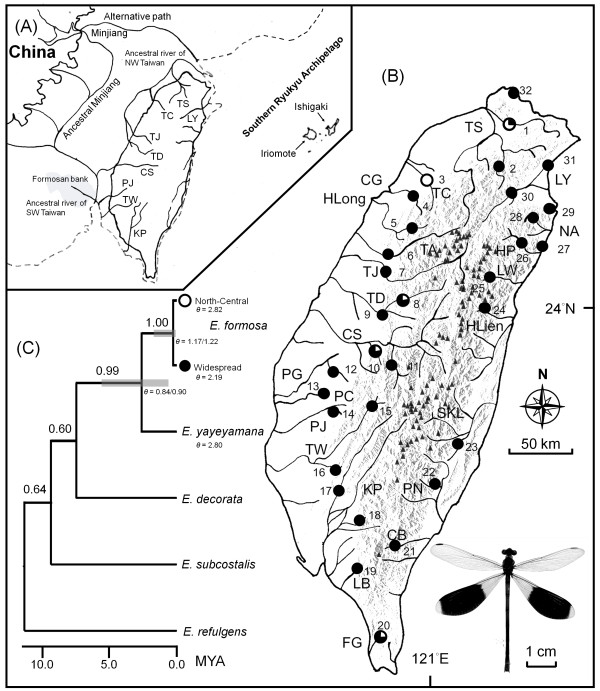
Pleistocene glacial oscillations have significantly affected the historical population dynamics of temperate taxa. However, the general effects of recent climatic changes on the evolutionary history and genetic structure of extant subtropical species remain poorly understood. In the present study, phylogeographic and historical demographic analyses based on mitochondrial and nuclear DNA sequences were used. The aim was to investigate whether Pleistocene climatic cycles, paleo-drainages or mountain vicariance of Taiwan shaped the evolutionary diversification of a subtropical gossamer-wing damselfly, Euphaea formosa.
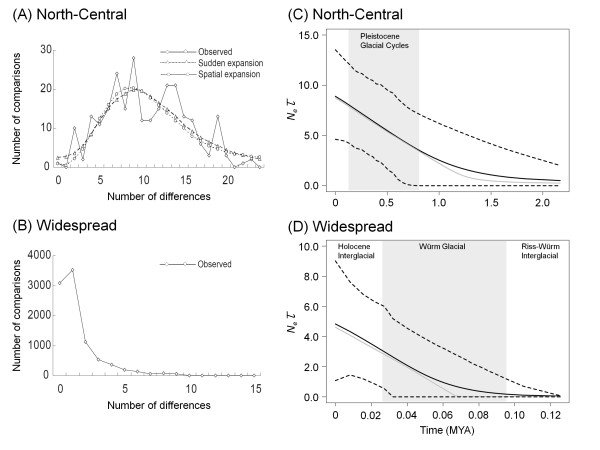
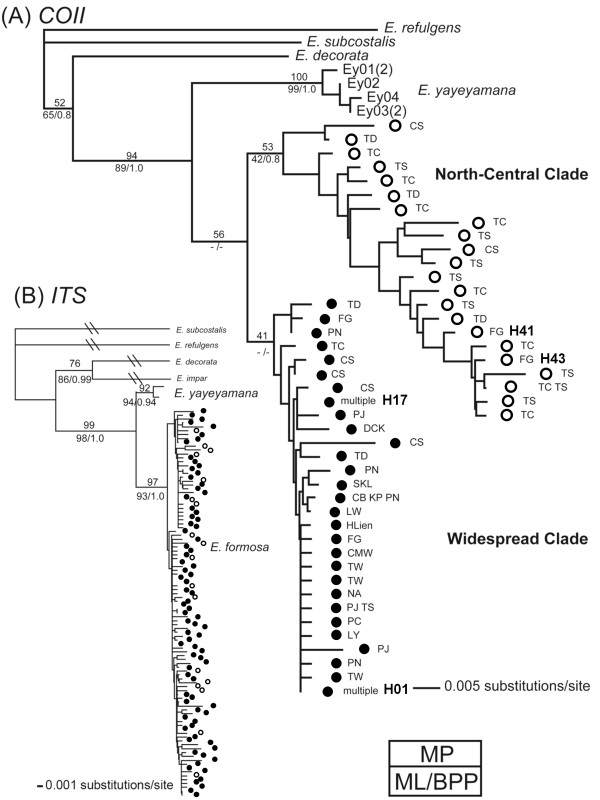
E. formosa populations originated in the middle Pleistocene period (0.3 Mya) and consisted of two evolutionarily independent lineages. It is likely that they derived from the Pleistocene paleo-drainages of northern and southern Minjiang, or alternatively by divergence within Taiwan. The ancestral North-central lineage colonized northwestern Taiwan first and maintained a slowly growing population throughout much of the early to middle Pleistocene period. The ancestral widespread lineage reached central-southern Taiwan and experienced a spatial and demographic expansion into eastern Taiwan. This expansion began approximately 30,000 years ago in the Holocene interglacial period. The ancestral southern expansion into eastern Taiwan indicates that the central mountain range (CMR) formed a barrier to east-west expansion. However, E. formosa populations in the three major biogeographic regions (East, South, and North-Central) exhibit no significant genetic partitions, suggesting that river drainages and mountains did not form strong geographical barriers against gene flow among extant populations.
The present study implies that the antiquity of E. formosa's colonization is associated with its high dispersal ability and larval tolerance to the late Pleistocene dry grasslands. The effect of late Pleistocene climatic changes on the subtropical damselfly's historical demography is lineage-specific, depending predominantly on its colonization history and geography. It is proposed that the Riss and Würm glaciations in the late Pleistocene period had a greater impact on the evolutionary diversification of subtropical insular species than the last glacial maximum (LGM).
更新世冰川震荡极大地影响了温带分类单元的历史种群动态。然而,近期气候变化对现存亚热带物种的进化历史和遗传结构的普遍影响仍知之甚少。本研究基于线粒体和核 DNA 序列进行了系统地理和历史种群动态分析,旨在探讨更新世气候循环、古水系或台湾山脉的地理隔离是否影响了亚热带丝尾𫚥虎鱼的进化多样化。
E. formosa 种群起源于中更新世(0.3 Mya),由两个进化上独立的谱系组成。它们可能起源于北部和南部闽江的更新世古水系,或者是在台湾内部分化而来。祖先的中北部谱系首先殖民于台湾西北部,并在中更新世早期至中期保持缓慢增长的种群。祖先的广泛谱系到达中南部台湾,并经历了向台湾东部的空间和种群扩张。这种扩张大约在 3 万年前的全新世间冰期开始。祖先向台湾东部的南部扩张表明中央山脉(CMR)形成了东西向扩张的障碍。然而,三大生物地理区(东部、南部和中北部)的 E. formosa 种群没有明显的遗传分区,这表明水系和山脉并没有形成阻止现存种群基因流的强烈地理障碍。
本研究表明,E. formosa 殖民的古老性与其高扩散能力和幼虫对晚更新世干旱草原的耐受性有关。晚更新世气候变化对亚热带蜻蜓历史种群动态的影响是谱系特异性的,主要取决于其殖民历史和地理。本研究提出,晚更新世的里斯和武木冰期对亚热带岛屿物种的进化多样化的影响大于末次冰盛期。