Harvard Skin Disease Research Center, Department of Dermatology, Brigham and Women's Hospital, Harvard Medical School, Boston, Massachusetts 02115, USA.
J Biol Chem. 2011 Jun 17;286(24):21717-31. doi: 10.1074/jbc.M110.194597. Epub 2011 Apr 14.
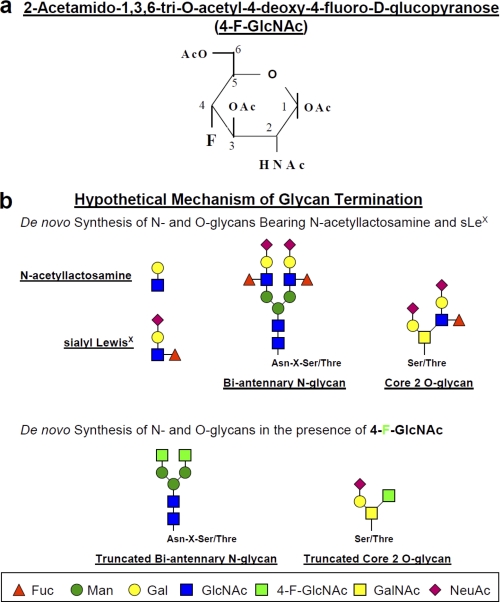
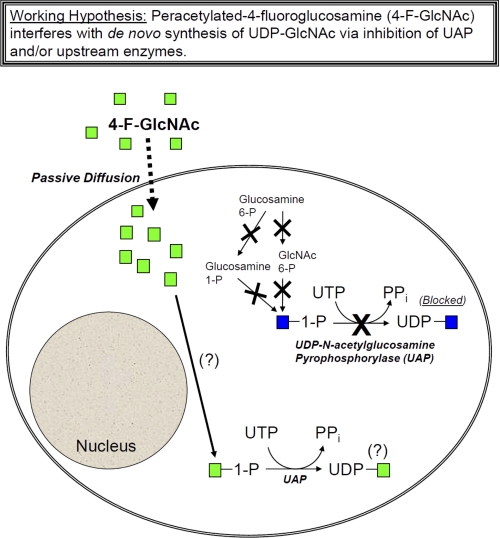
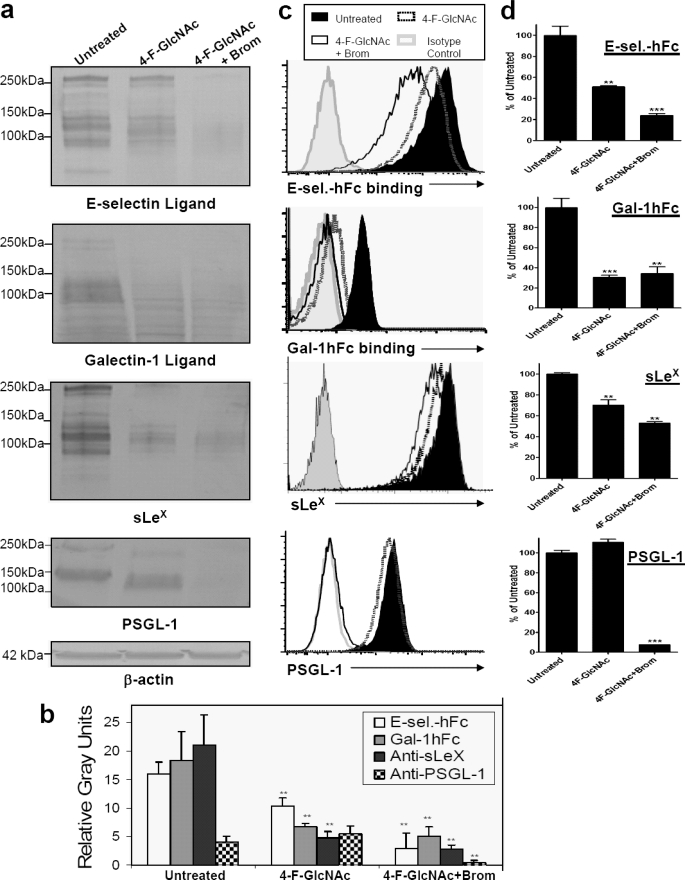
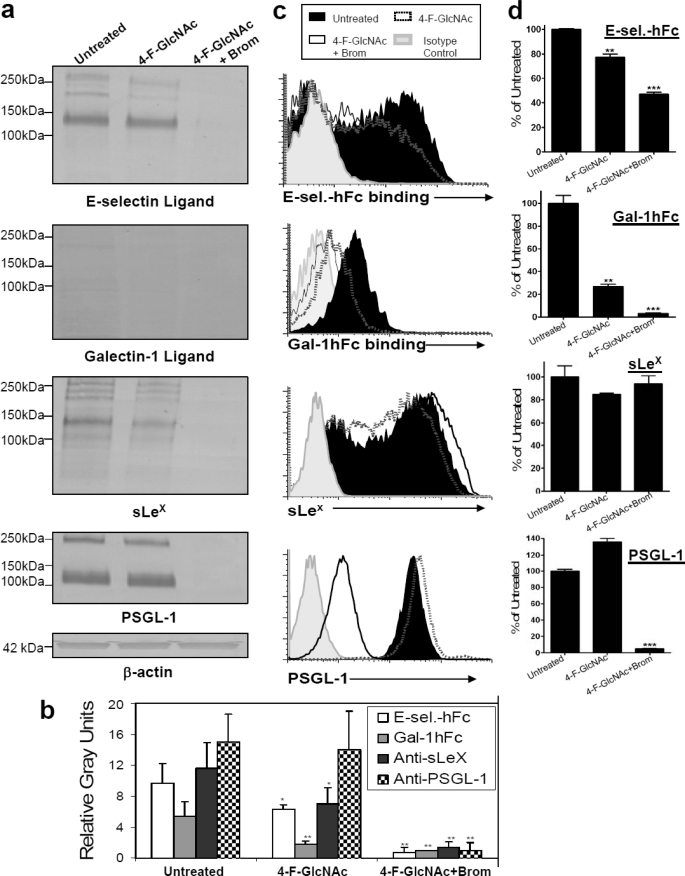
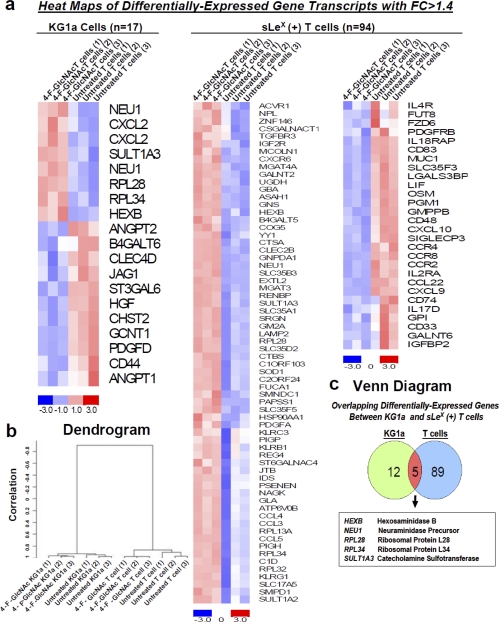
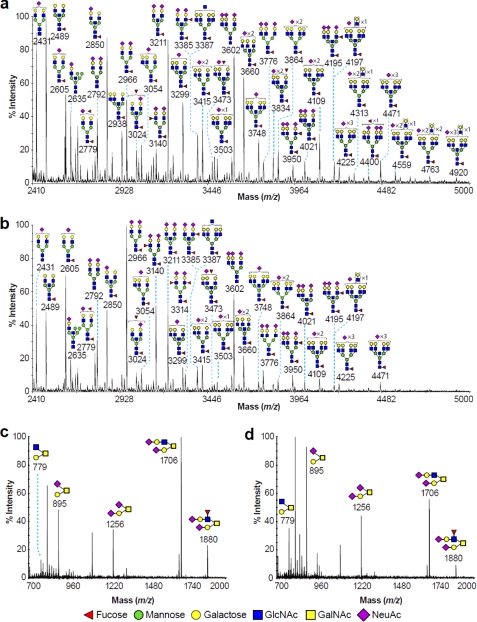
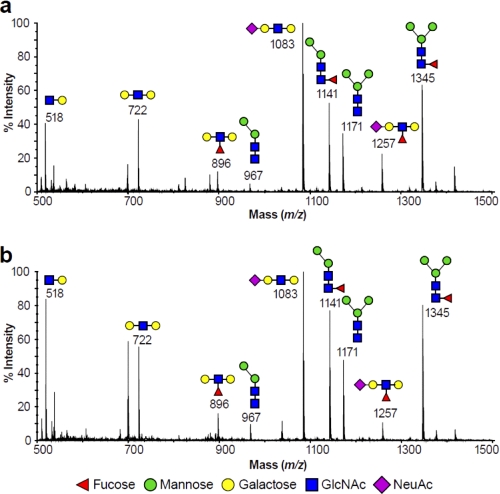
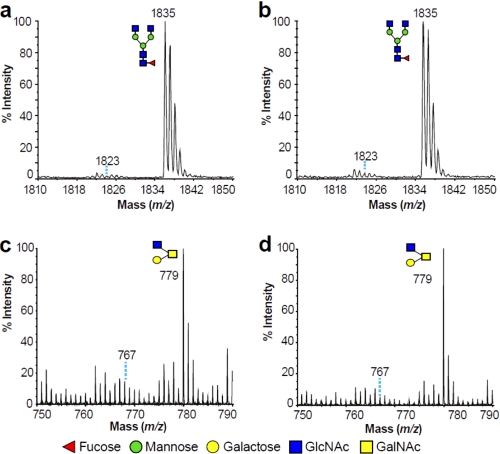
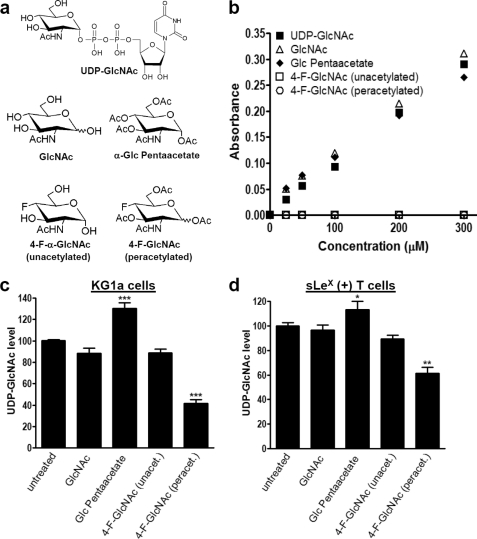
Prior studies have shown that treatment with the peracetylated 4-fluorinated analog of glucosamine (4-F-GlcNAc) elicits anti-skin inflammatory activity by ablating N-acetyllactosamine (LacNAc), sialyl Lewis X (sLe(X)), and related lectin ligands on effector leukocytes. Based on anti-sLe(X) antibody and lectin probing experiments on 4-F-GlcNAc-treated leukocytes, it was hypothesized that 4-F-GlcNAc inhibited sLe(X) formation by incorporating into LacNAc and blocking the addition of galactose or fucose at the carbon 4-position of 4-F-GlcNAc. To test this hypothesis, we determined whether 4-F-GlcNAc is directly incorporated into N- and O-glycans released from 4-F-GlcNAc-treated human sLe(X) (+) T cells and leukemic KG1a cells. At concentrations that abrogated galectin-1 (Gal-1) ligand and E-selectin ligand expression and related LacNAc and sLe(X) structures, MALDI-TOF and MALDI-TOF/TOF mass spectrometry analyses showed that 4-F-GlcNAc 1) reduced content and structural diversity of tri- and tetra-antennary N-glycans and of O-glycans, 2) increased biantennary N-glycans, and 3) reduced LacNAc and sLe(X) on N-glycans and on core 2 O-glycans. Moreover, MALDI-TOF MS did not reveal any m/z ratios relating to the presence of fluorine atoms, indicating that 4-F-GlcNAc did not incorporate into glycans. Further analysis showed that 4-F-GlcNAc treatment had minimal effect on expression of 1200 glycome-related genes and did not alter the activity of LacNAc-synthesizing enzymes. However, 4-F-GlcNAc dramatically reduced intracellular levels of uridine diphosphate-N-acetylglucosamine (UDP-GlcNAc), a key precursor of LacNAc synthesis. These data show that Gal-1 and E-selectin ligand reduction by 4-F-GlcNAc is not caused by direct 4-F-GlcNAc glycan incorporation and consequent chain termination but rather by interference with UDP-GlcNAc synthesis.
先前的研究表明,通过去除效应白细胞上的 N-乙酰乳糖胺(LacNAc)、唾液酸化路易斯 X(sLe(X))和相关的凝集素配体,对氨基葡萄糖的过乙酰化 4-氟类似物(4-F-GlcNAc)的治疗可发挥抗皮肤炎症活性。基于对 4-F-GlcNAc 处理的白细胞的抗 sLe(X)抗体和凝集素探测实验,假设 4-F-GlcNAc 通过掺入 LacNAc 并阻止在 4-F-GlcNAc 的碳 4 位添加半乳糖或岩藻糖来抑制 sLe(X)的形成。为了验证这一假设,我们确定 4-F-GlcNAc 是否直接掺入 4-F-GlcNAc 处理的人 sLe(X)(+)T 细胞和白血病 KG1a 细胞释放的 N-和 O-聚糖中。在浓度足以消除半乳糖凝集素-1(Gal-1)配体和 E-选择素配体表达以及相关的 LacNAc 和 sLe(X)结构的情况下,MALDI-TOF 和 MALDI-TOF/TOF 质谱分析表明,4-F-GlcNAc 1)降低了三触角和四触角 N-聚糖以及 O-聚糖的含量和结构多样性,2)增加了双触角 N-聚糖,3)降低了 N-聚糖和核心 2 O-聚糖上的 LacNAc 和 sLe(X)。此外,MALDI-TOF MS 未显示出与氟原子存在有关的任何 m/z 比值,表明 4-F-GlcNAc 未掺入聚糖。进一步的分析表明,4-F-GlcNAc 处理对 1200 个与聚糖相关的基因的表达几乎没有影响,也没有改变 LacNAc 合成酶的活性。然而,4-F-GlcNAc 显著降低了尿苷二磷酸-N-乙酰葡萄糖胺(UDP-GlcNAc)的细胞内水平,UDP-GlcNAc 是 LacNAc 合成的关键前体。这些数据表明,4-F-GlcNAc 降低 Gal-1 和 E-选择素配体不是由于直接掺入 4-F-GlcNAc 聚糖和随后的链终止引起的,而是由于干扰了 UDP-GlcNAc 的合成。