Department of Medical Biophysics, The University of Western Ontario, London, Ontario, Canada.
PLoS One. 2011 Apr 8;6(4):e18361. doi: 10.1371/journal.pone.0018361.
MRI can be used to non-invasively monitor tumour growth and response to treatment in mouse models of prostate cancer, particularly for longitudinal studies of orthotopically-implanted models. We have optimized the balanced steady-state free precession (bSSFP) pulse sequence for mouse prostate imaging.
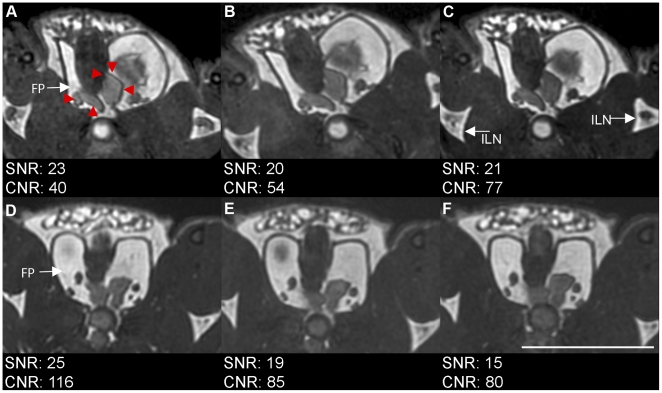
Phase cycling, excitations, flip angle and receiver bandwidth parameters were optimized for signal to noise ratio and contrast to noise ratio of the prostate. The optimized bSSFP sequence was compared to T1- and T2-weighted spin echo sequences.
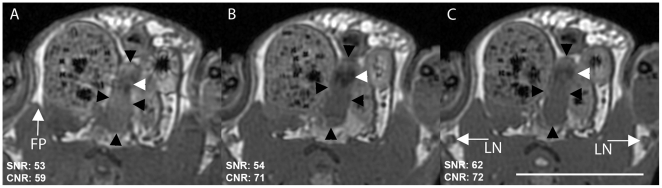
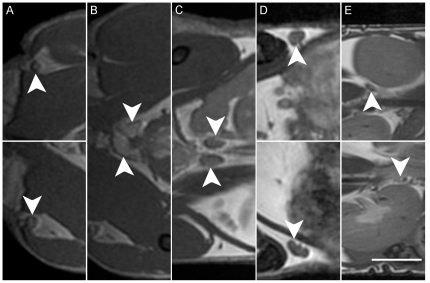
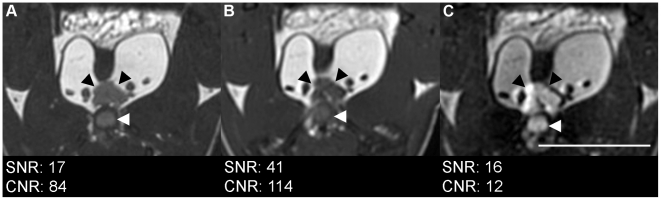
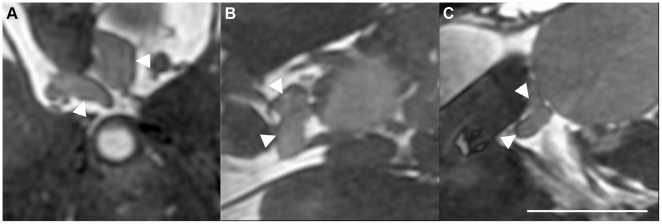
SNR and CNR increased with flip angle. As bandwidth increased, SNR, CNR and artifacts such as chemical shift decreased. The final optimized sequence was 4 PC, 2 NEX, FA 50°, BW ±62.5 kHz and took 14-26 minutes with 200 µm isotropic resolution. The SNR efficiency of the bSSFP images was higher than for T1WSE and T2WSE. CNR was highest for T1WSE, followed closely by bSSFP, with the T2WSE having the lowest CNR. With the bSSFP images the whole body and organs of interest including renal, iliac, inguinal and popliteal lymph nodes were visible.
We were able to obtain fast, high-resolution, high CNR images of the healthy mouse prostate with an optimized bSSFP sequence.
磁共振成像(MRI)可用于非侵入性地监测前列腺癌小鼠模型中的肿瘤生长和对治疗的反应,特别是对于原位植入模型的纵向研究。我们已经针对小鼠前列腺成像优化了平衡稳态自由进动(bSSFP)脉冲序列。
对相位循环、激发、翻转角和接收器带宽参数进行了优化,以实现前列腺的信噪比(SNR)和对比噪声比(CNR)。将优化后的 bSSFP 序列与 T1 和 T2 加权自旋回波序列进行了比较。
SNR 和 CNR 随翻转角的增加而增加。随着带宽的增加,SNR、CNR 和化学位移等伪影减少。最终优化的序列为 4 PC、2 NEX、FA 50°、BW ±62.5 kHz,分辨率为 200 µm 时,扫描时间为 14-26 分钟。bSSFP 图像的 SNR 效率高于 T1WSE 和 T2WSE。T1WSE 的 CNR 最高,其次是 bSSFP,而 T2WSE 的 CNR 最低。使用 bSSFP 图像,可以看到整个身体和感兴趣的器官,包括肾脏、髂骨、腹股沟和腘窝淋巴结。
我们能够使用优化的 bSSFP 序列获得快速、高分辨率、高 CNR 的健康小鼠前列腺图像。