Department of Experimental Psychology, University of Oxford, Oxford, England.
J Exp Psychol Learn Mem Cogn. 2011 Sep;37(5):1243-9. doi: 10.1037/a0023550.
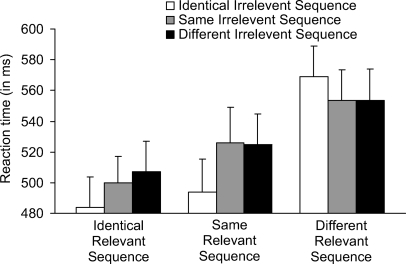
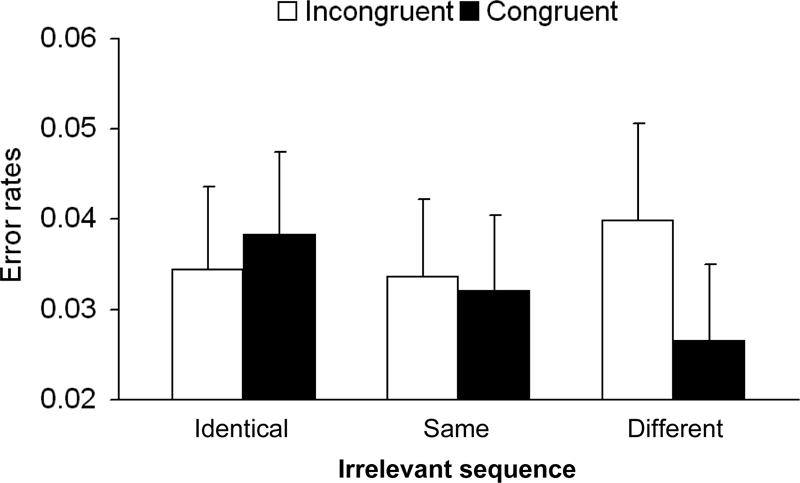
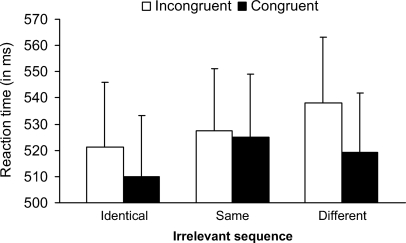
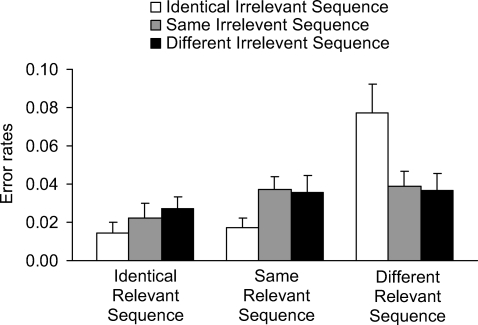
Automatic processing of irrelevant stimulus dimensions has been demonstrated in a variety of tasks. Previous studies have shown that conflict between relevant and irrelevant dimensions can be reduced when a feature of the irrelevant dimension is repeated. The specific level at which the automatic process is suppressed (e.g., perceptual repetition, response repetition), however, is less understood. In the current experiment we used the numerical Stroop paradigm, in which the processing of irrelevant numerical values of 2 digits interferes with the processing of their physical size, to pinpoint the precise level of the suppression. Using a sequential analysis, we dissociated perceptual repetition from response repetition of the relevant and irrelevant dimension. Our analyses of reaction times, error rates, and diffusion modeling revealed that the congruity effect is significantly reduced or even absent when the response sequence of the irrelevant dimension, rather than the numerical value or the physical size, is repeated. These results suggest that automatic activation of the irrelevant dimension is suppressed at the response level. The current results shed light on the level of interaction between numerical magnitude and physical size as well as the effect of variability of responses and stimuli on automatic processing.
自动处理无关刺激维度已在各种任务中得到证明。先前的研究表明,当无关维度的特征重复时,相关和无关维度之间的冲突可以减少。然而,自动处理被抑制的确切水平(例如,知觉重复、反应重复)不太清楚。在当前的实验中,我们使用了数字 Stroop 范式,其中 2 位数字的无关数值的处理会干扰其物理大小的处理,以确定抑制的精确水平。我们使用顺序分析,将相关和无关维度的知觉重复与反应重复分开。我们对反应时间、错误率和扩散建模的分析表明,当无关维度的反应序列而不是数字值或物理大小重复时,一致性效应显著降低甚至不存在。这些结果表明,无关维度的自动激活在反应水平上受到抑制。当前的结果揭示了数字大小和物理大小之间的相互作用水平,以及反应和刺激的可变性对自动处理的影响。