Center for Retrovirus Research, Department of Veterinary Biosciences, The Ohio State University, Columbus, OH 43210, USA.
Retrovirology. 2011 Apr 19;8:26. doi: 10.1186/1742-4690-8-26.
Dendritic cells (DCs) are among the first cells to encounter HIV-1 and play important roles in viral transmission and pathogenesis. Immature DCs allow productive HIV-1 replication and long-term viral dissemination. The pro-inflammatory factor lipopolysaccharide (LPS) induces DC maturation and enhances the efficiency of DC-mediated HIV-1 transmission. Type I interferon (IFN) partially inhibits HIV-1 replication and cell-cell transmission in CD4+ T cells and macrophages. Tetherin is a type I IFN-inducible restriction factor that blocks HIV-1 release and modulates CD4+ T cell-mediated cell-to-cell transmission of HIV-1. However, the role of type I IFN and tetherin in HIV-1 infection of DCs and DC-mediated viral transmission remains unknown.
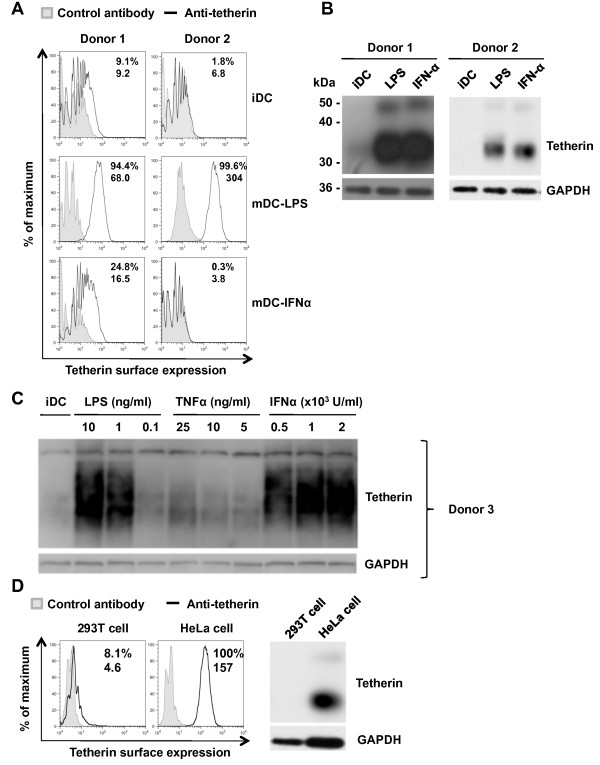
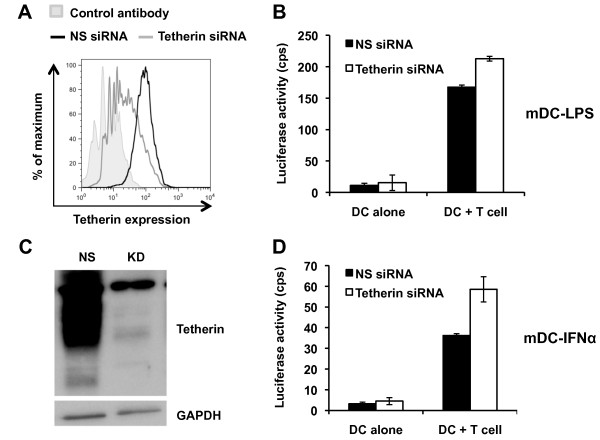
We demonstrated that IFN-alpha (IFNα)-induced mature DCs restricted HIV-1 replication and trans-infection of CD4+ T cells. Tetherin expression in monocyte-derived immature DCs was undetectable or very low. High levels of tetherin were transiently expressed in LPS- and IFNα-induced mature DCs, while HIV-1 localized into distinct patches in these DCs. Knockdown of induced tetherin in LPS- or IFNα-matured DCs modestly enhanced HIV-1 transmission to CD4+ T cells, but had no significant effect on wild-type HIV-1 replication in mature DCs. Intriguingly, we found that HIV-1 replication in immature DCs induced significant tetherin expression in a Nef-dependent manner.
The restriction of HIV-1 replication and transmission in IFNα-induced mature DCs indicates a potent anti-HIV-1 response; however, high levels of tetherin induced in mature DCs cannot significantly restrict wild-type HIV-1 release and DC-mediated HIV-1 transmission. Nef-dependent tetherin induction in HIV-1-infected immature DCs suggests an innate immune response of DCs to HIV-1 infection.
树突状细胞 (DCs) 是最早接触 HIV-1 的细胞之一,在病毒传播和发病机制中发挥重要作用。未成熟的 DCs 允许 HIV-1 进行复制并长期进行病毒传播。促炎因子脂多糖 (LPS) 诱导 DC 成熟并增强 DC 介导的 HIV-1 传播效率。I 型干扰素 (IFN) 可部分抑制 CD4+ T 细胞和巨噬细胞中的 HIV-1 复制和细胞间传播。 tetherin 是一种 I 型 IFN 诱导的限制因子,可阻断 HIV-1 的释放并调节 CD4+ T 细胞介导的 HIV-1 细胞间传播。然而,I 型 IFN 和 tetherin 在 HIV-1 感染 DC 和 DC 介导的病毒传播中的作用仍不清楚。
我们证明 IFN-α (IFNα) 诱导的成熟 DC 可限制 HIV-1 复制和对 CD4+ T 细胞的转感染。单核细胞来源的未成熟 DC 中的 tetherin 表达检测不到或非常低。LPS 和 IFNα 诱导的成熟 DC 中可短暂表达高水平的 tetherin,而 HIV-1 则定位于这些 DC 中的不同斑块中。在 LPS 或 IFNα 成熟的 DC 中敲低诱导的 tetherin 可适度增强 HIV-1 向 CD4+ T 细胞的传播,但对成熟 DC 中的野生型 HIV-1 复制没有显著影响。有趣的是,我们发现 HIV-1 在未成熟 DC 中的复制以 Nef 依赖的方式诱导 significant tetherin 表达。
IFNα 诱导的成熟 DC 中 HIV-1 复制和传播的限制表明存在有效的抗 HIV-1 反应;然而,成熟 DC 中诱导的高 tetherin 水平不能显著限制野生型 HIV-1 的释放和 DC 介导的 HIV-1 传播。HIV-1 感染的未成熟 DC 中 Nef 依赖性 tetherin 诱导提示 DC 对 HIV-1 感染的固有免疫反应。