Médecins Sans Frontières (Operational Centre Geneva), 78 rue de Lausanne, CH-1211 Genève 21, Switzerland.
BMC Int Health Hum Rights. 2011 Apr 19;11:5. doi: 10.1186/1472-698X-11-5.
The war in eastern Democratic Republic of Congo has been the subject of numerous studies related to the problem of sexual violence. Historically, such violence is known to be part of strategic war plans to conquer and destroy communities, but it is now unfortunately prevalent in times of relative calm.
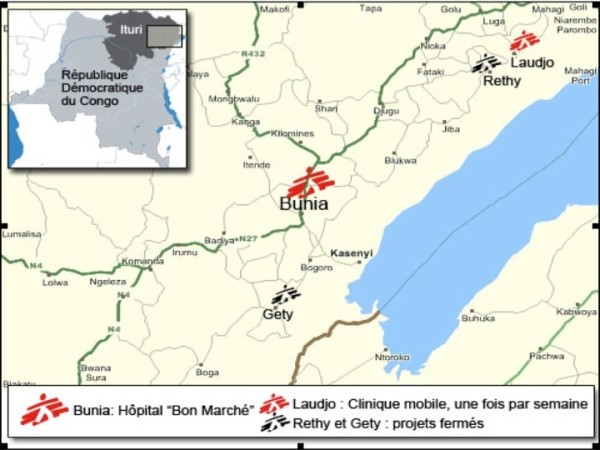
We describe the characteristics and consequences of sexual violence in Ituri province of Democratic Republic of Congo through the retrospective analysis of 2,565 patients who received medical care in the Médecins Sans Frontières sexual violence clinic in the capital of Ituri province, Bunia, between September 2005 and December 2006. Using a standardised questionnaire, we report patients' demographics, number and status of aggressor(s), forced detention and violent threats among other variables for all patients presenting for medical consultation after a sexually violent event during this period.
Ninety-six percent of our cohort were female and 29.3% minors, 18-29 years was the most represented age group. Acts of sexual violence (n = 2,565) were reported to be mainly perpetrated by men with military affiliations (73%), although civilians were implicated in 21% of crimes. The attack was perpetrated by two or more persons in over 74% of cases and most commonly perpetrators were unknown armed males, (87.2%). Male victims accounted for 4% (n = 103) of our cohort. Forty-eight percent of our patients reported being attacked whilst performing daily domestic duties outside the home and 18% of victims being detained by their perpetrators, the majority of whom were held for less than 2 weeks (61.6%).
The characteristics of sexually violent acts in Ituri province during this period cannot be simply explained as a 'weapon of war' as described in the literature, meaning the use of sexual violence within a military strategy where it is employed under the orders of a commander to harm a particular community. Whilst the majority of aggressions were by armed men there was an important proportion in which civilian perpetrators were implicated. This type of violence has become part of the general characteristics of violence in this war-torn population. Sometimes, as a means for some military factions to acquire remuneration with impunity and for some civilians, a means to counteract confronting, changing social norms occurring during chronic conflict.
在刚果民主共和国东部的战争一直是与性暴力问题有关的众多研究的主题。从历史上看,这种暴力被认为是征服和摧毁社区的战略战争计划的一部分,但不幸的是,在相对平静的时期,这种暴力现在很普遍。
我们通过回顾性分析 2005 年 9 月至 2006 年 12 月期间在刚果民主共和国伊图里省省会布尼亚的无国界医生组织性暴力诊所接受医疗护理的 2565 名患者,描述了伊图里省性暴力的特征和后果。使用标准化问卷,我们报告了所有在这段时间内发生性暴力事件后就诊的患者的人口统计学特征、袭击者的人数和身份、强制拘留和暴力威胁等变量。
我们的队列中 96%是女性,29.3%是未成年人,18-29 岁是最具代表性的年龄组。报告的性暴力行为(n=2565)主要由具有军事背景的男性(73%)实施,尽管平民在 21%的犯罪中也有牵连。在 74%以上的案件中,袭击是由两人或更多人实施的,大多数犯罪者是身份不明的武装男性(87.2%)。男性受害者占我们队列的 4%(n=103)。我们的患者中有 48%在离家外出从事日常家务时受到袭击,18%的受害者被犯罪者拘留,其中大多数人被拘留不到 2 周(61.6%)。
在这一时期,伊图里省性暴力行为的特征不能简单地解释为文献中描述的“战争武器”,这意味着在军事战略中使用性暴力,根据指挥官的命令对特定社区造成伤害。虽然大多数袭击者是武装人员,但也有相当一部分平民参与其中。这种类型的暴力已经成为这个饱受战争蹂躏的人群普遍暴力特征的一部分。有时,这是一些军事派别获得不受惩罚的报酬的一种手段,对一些平民来说,也是对抗在长期冲突中发生的变化的社会规范的一种手段。