Department of Microbiology and Immunology, University of North Carolina at Chapel Hill, Chapel Hill, North Carolina, USA.
Diabetes. 2011 Jun;60(6):1726-33. doi: 10.2337/db10-1287. Epub 2011 Apr 26.
Type 1 diabetes is an autoimmune disease characterized by the destruction of insulin-producing β-cells. NOD mice provide a useful tool for understanding disease pathogenesis and progression. Although much has been learned from studies with NOD mice, increased understanding of human type 1 diabetes can be gained by evaluating the pathogenic potential of human diabetogenic effector cells in vivo. Therefore, our objective in this study was to develop a small-animal model using human effector cells to study type 1 diabetes.
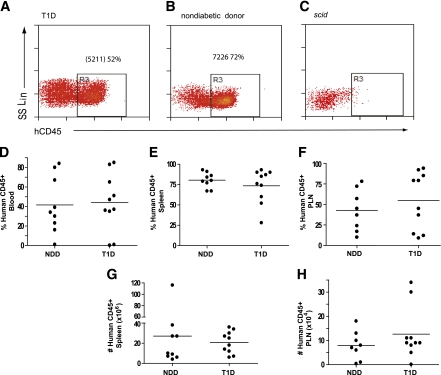
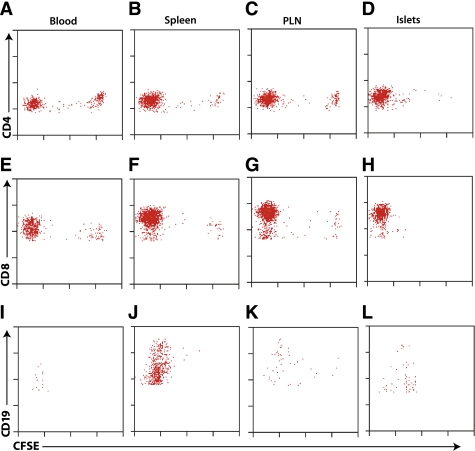
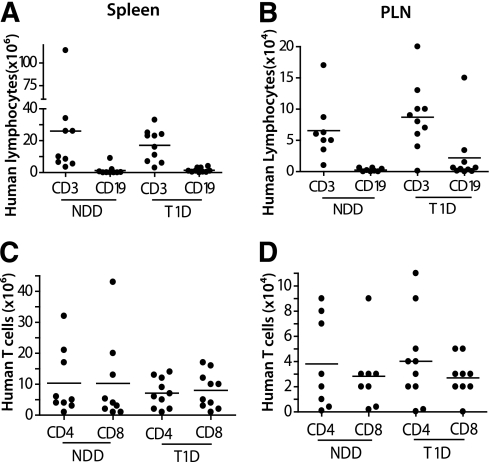
We adoptively transferred HLA-A2-matched peripheral blood mononuclear cells (PBMCs) from type 1 diabetic patients and nondiabetic control subjects into transgenic NOD-scid/γc(null)/HLA-A*0201 (NOD-scid/γc(null)/A2) mice. At various times after adoptive transfer, we determined the ability of these mice to support the survival and proliferation of the human lymphoid cells. Human lymphocytes were isolated and assessed from the blood, spleen, pancreatic lymph node and islets of NOD-scid/γc(null)/A2 mice after transfer.
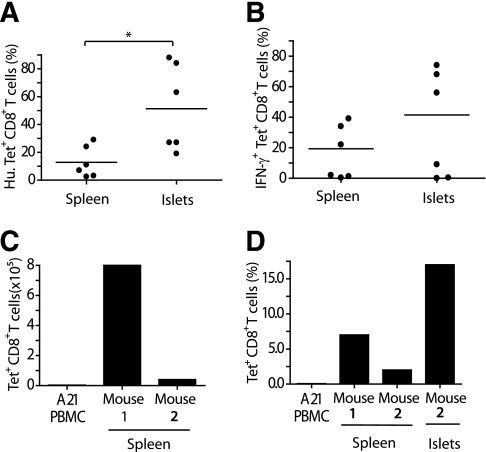
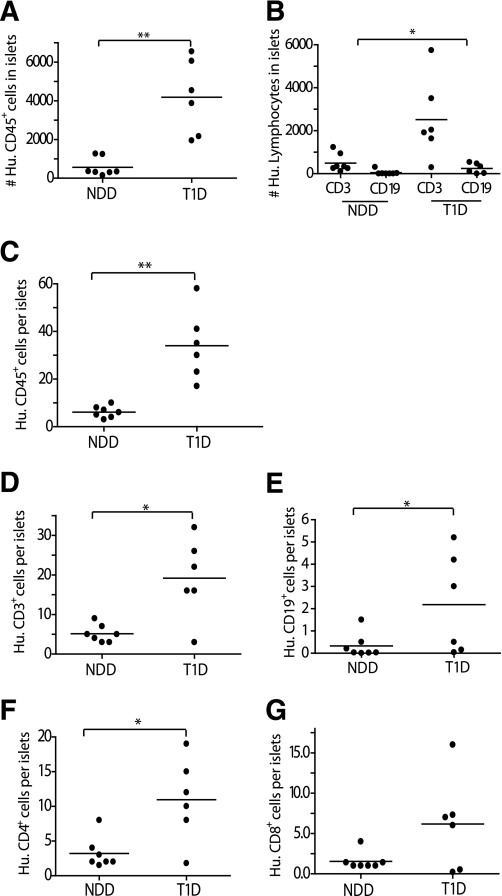
Human T and B cells proliferate and survive for at least 6 weeks and were recovered from the blood, spleen, draining pancreatic lymph node, and most importantly, islets of NOD-scid/γc(null)/A2 mice. Lymphocytes from type 1 diabetic patients preferentially infiltrate the islets of NOD-scid/γc(null)/A2 mice. In contrast, PBMCs from nondiabetic HLA-A2-matched donors showed significantly less islet infiltration. Moreover, in mice that received PBMCs from type 1 diabetic patients, we identified epitope-specific CD8(+) T cells among the islet infiltrates.
We show that insulitis is transferred to NOD-scid/γc(null)/A2 mice that received HLA-A2-matched PBMCs from type 1 diabetic patients. In addition, many of the infiltrating CD8(+) T cells are epitope-specific and produce interferon-γ after in vitro peptide stimulation. This indicates that NOD-scid/γc(null)/A2 mice transferred with HLA-A2-matched PBMCs from type 1 diabetic patients may serve as a useful tool for studying epitope-specific T-cell-mediated responses in patients with type 1 diabetes.
1 型糖尿病是一种自身免疫性疾病,其特征是胰岛素产生β细胞的破坏。NOD 小鼠为了解疾病的发病机制和进展提供了有用的工具。尽管从 NOD 小鼠的研究中已经了解了很多,但是通过评估人类致糖尿病效应细胞在体内的致病潜力,可以更好地了解人类 1 型糖尿病。因此,我们的目标是开发一种使用人类效应细胞的小动物模型来研究 1 型糖尿病。
我们将 1 型糖尿病患者和非糖尿病对照者的 HLA-A2 匹配的外周血单核细胞(PBMC)过继转移到转基因 NOD-scid/γc(null)/HLA-A*0201(NOD-scid/γc(null)/A2)小鼠中。在过继转移后的不同时间,我们确定这些小鼠支持人类淋巴样细胞存活和增殖的能力。转移后,从 NOD-scid/γc(null)/A2 小鼠的血液、脾脏、胰腺淋巴结和胰岛中分离和评估人类淋巴细胞。
人类 T 和 B 细胞至少增殖和存活 6 周,并从血液、脾脏、引流胰腺淋巴结中回收,最重要的是从 NOD-scid/γc(null)/A2 小鼠的胰岛中回收。1 型糖尿病患者的淋巴细胞优先浸润 NOD-scid/γc(null)/A2 小鼠的胰岛。相比之下,来自非糖尿病 HLA-A2 匹配供体的 PBMC 显示出明显较少的胰岛浸润。此外,在接受来自 1 型糖尿病患者的 PBMC 的小鼠中,我们在胰岛浸润物中鉴定出了表位特异性 CD8(+)T 细胞。
我们表明,胰岛炎被转移到接受来自 1 型糖尿病患者的 HLA-A2 匹配 PBMC 的 NOD-scid/γc(null)/A2 小鼠中。此外,许多浸润的 CD8(+)T 细胞是表位特异性的,在体外肽刺激后产生干扰素-γ。这表明,接受来自 1 型糖尿病患者的 HLA-A2 匹配 PBMC 的 NOD-scid/γc(null)/A2 小鼠可能成为研究 1 型糖尿病患者中表位特异性 T 细胞介导反应的有用工具。