Division of Hematology, Mayo Clinic College of Medicine, 200 First Street SW, Rochester, MN 55905, USA.
Nat Rev Clin Oncol. 2011 Apr 26;8(8):479-91. doi: 10.1038/nrclinonc.2011.63.
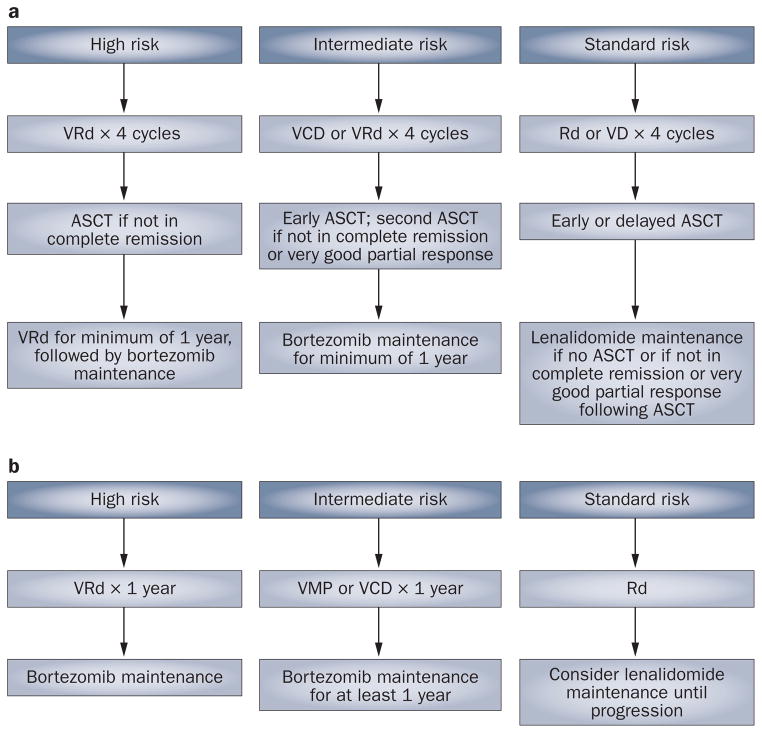
The treatment of multiple myeloma has changed dramatically in the past decade. The increase in the number of active agents has generated numerous possible drug combinations that can be used in the first-line and relapsed settings. As a result, there is considerable confusion about the choice of regimens for initial therapy, role of transplantation in the era of new drugs, end points for therapy, and the role of maintenance therapy. A hotly debated area is whether treatment approaches should achieve cure or disease control, which impacts greatly on the treatment strategy employed. This article provides an update on the treatment of multiple myeloma, with a focus on recent advances, newly diagnosed disease, role of transplantation and maintenance therapy. A synthesized approach to the treatment of myeloma is presented, along with a discussion of key paradigms that need to be challenged.
在过去的十年中,多发性骨髓瘤的治疗发生了巨大变化。活性药物数量的增加产生了许多可能的药物组合,可用于一线和复发环境。因此,对于初始治疗方案的选择、新药时代移植的作用、治疗终点以及维持治疗的作用存在相当大的困惑。一个激烈争论的领域是治疗方法是否应该达到治愈或疾病控制,这对所采用的治疗策略有重大影响。本文提供了多发性骨髓瘤治疗的最新信息,重点介绍了最近的进展、新诊断的疾病、移植和维持治疗的作用。提出了一种多发性骨髓瘤治疗的综合方法,并讨论了需要挑战的关键范例。