Interdisciplinary Program in Neuroscience, Seoul National University, Seoul, Korea.
J Korean Med Sci. 2011 May;26(5):665-74. doi: 10.3346/jkms.2011.26.5.665. Epub 2011 Apr 21.
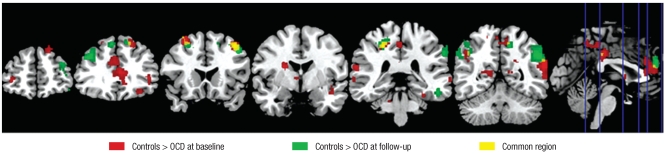
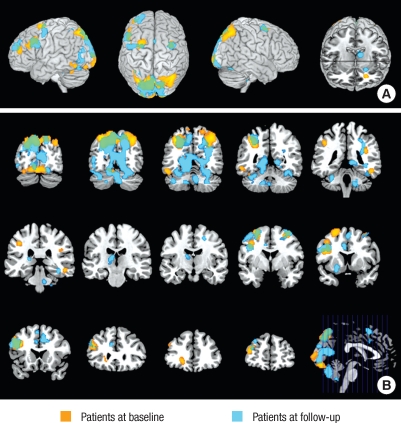
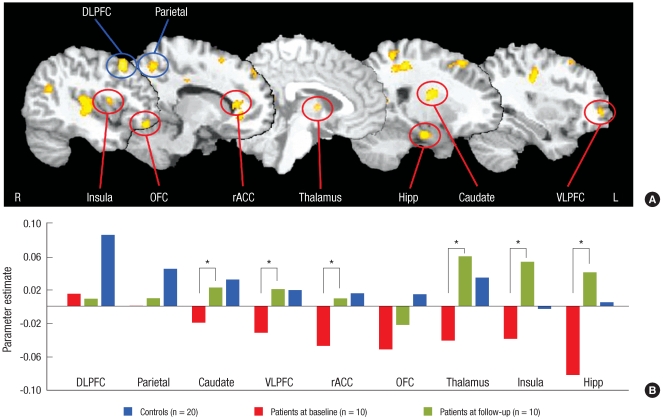
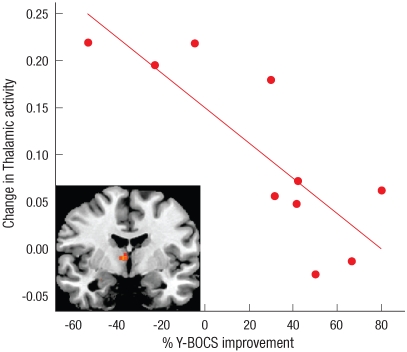
Recent studies have reported that cognitive inflexibility associated with impairments in a frontal-striatal circuit and parietal region is a core cognitive deficit of obsessive-compulsive disorder (OCD). However, few studies have examined progressive changes in these regions following clinical improvement in obsessive-compulsive symptoms. To determine if treatment changes the aberrant activation pattern associated with task switching in OCD, we examined the activation patterns in brain areas after treatment. The study was conducted on 10 unmedicated OCD patients and 20 matched controls using event-related functional magnetic resonance imaging. Treatment improved the clinical symptoms measured by the Yale-Brown Obsessive Compulsive Scale and behavioral flexibility indicated by the switching cost. At baseline, OCD showed significantly less activation in the dorsal and ventral frontal-striatal circuit and parietal regions under the task-switch minus task-repeat condition compared with controls. After treatment, the neural responses in the ventral frontal-striatal circuit in OCD were partially normalized, whereas the activation deficit in dorsal frontoparietal regions that mediate shifting attention or behavioral flexibility persisted. It is suggested that altered brain activation in ventral frontal-striatal regions in OCD patients is associated with their cognitive flexibility and changes in these regions may underlie the pathophysiology of OCD.
最近的研究报告称,与额-纹状体回路和顶叶区域损伤相关的认知灵活性障碍是强迫症(OCD)的核心认知缺陷。然而,很少有研究检查强迫症症状临床改善后这些区域的渐进性变化。为了确定治疗是否改变强迫症任务转换相关的异常激活模式,我们检查了治疗后的大脑区域的激活模式。这项研究使用事件相关功能磁共振成像,对 10 名未用药的强迫症患者和 20 名匹配的对照进行了研究。治疗改善了耶鲁-布朗强迫症量表测量的临床症状和转换成本表示的行为灵活性。在基线时,与对照组相比,OCD 在任务转换减去任务重复条件下,背侧和腹侧额纹状体回路以及顶叶区域的激活明显减少。治疗后,OCD 腹侧额纹状体回路的神经反应部分恢复正常,而介导注意力转移或行为灵活性的背侧额顶叶区域的激活缺陷仍然存在。这表明 OCD 患者腹侧额纹状体区域的大脑激活改变与其认知灵活性有关,这些区域的变化可能是 OCD 的病理生理学基础。